Tuesday, December 09, 2008

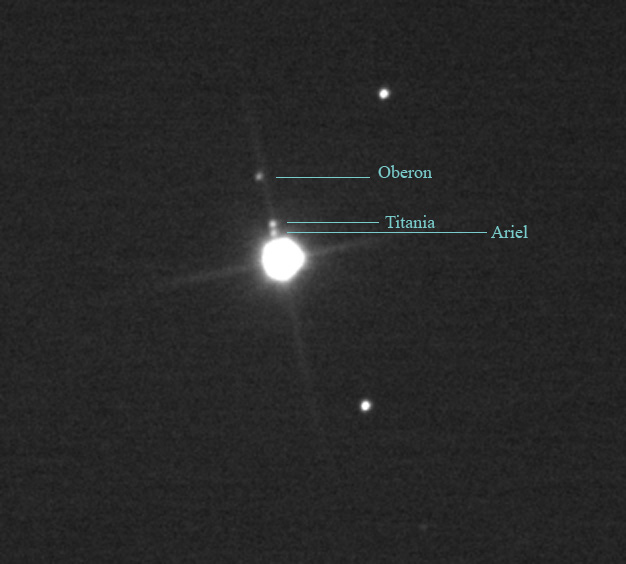
Uranus and three of its satellites: Ariel, Titania, and Oberon

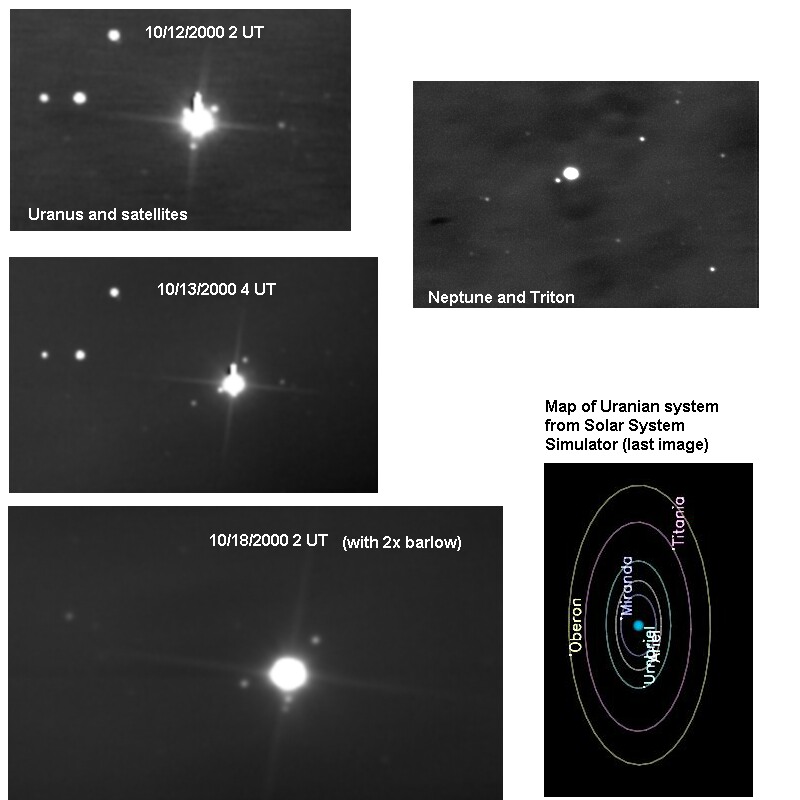
As part of that Black Friday imaging blitz, I took a look at Uranus. In contrast to a set of images I took some eight years ago (see below), Uranus is now experiencing an equinox--its equator is now pointing towards the inner Solar System. You might remember that in contrast to the rest of the planets, Uranus and its satellites are tilted nearly ninety degrees off of the ecliptic, leaving each hemisphere to experience 21 year long summer and winters. The long slumber of cold is over for one pole and the light is fading for the other. And, since the moons' orbit in the plane of the Uranian equator, they mutually transit and occult each other for a time period during the equinox. As we orbit quickly in the warm inner solar system the plane of the satellites appears to wobble back and forth from Earth's motion. The period of mutual events is coming to a close, with only three left, and the seasons will become definitive on Uranus.


Uranus and three of its satellites: Ariel, Titania, and Oberon. 88x5second exposures. Click to enlarge.


Satellites identified via the Solar System Simulator.


A series of images taken long ago on a 382x240 pixel CCD!. Click to enlarge.

Thursday, December 04, 2008

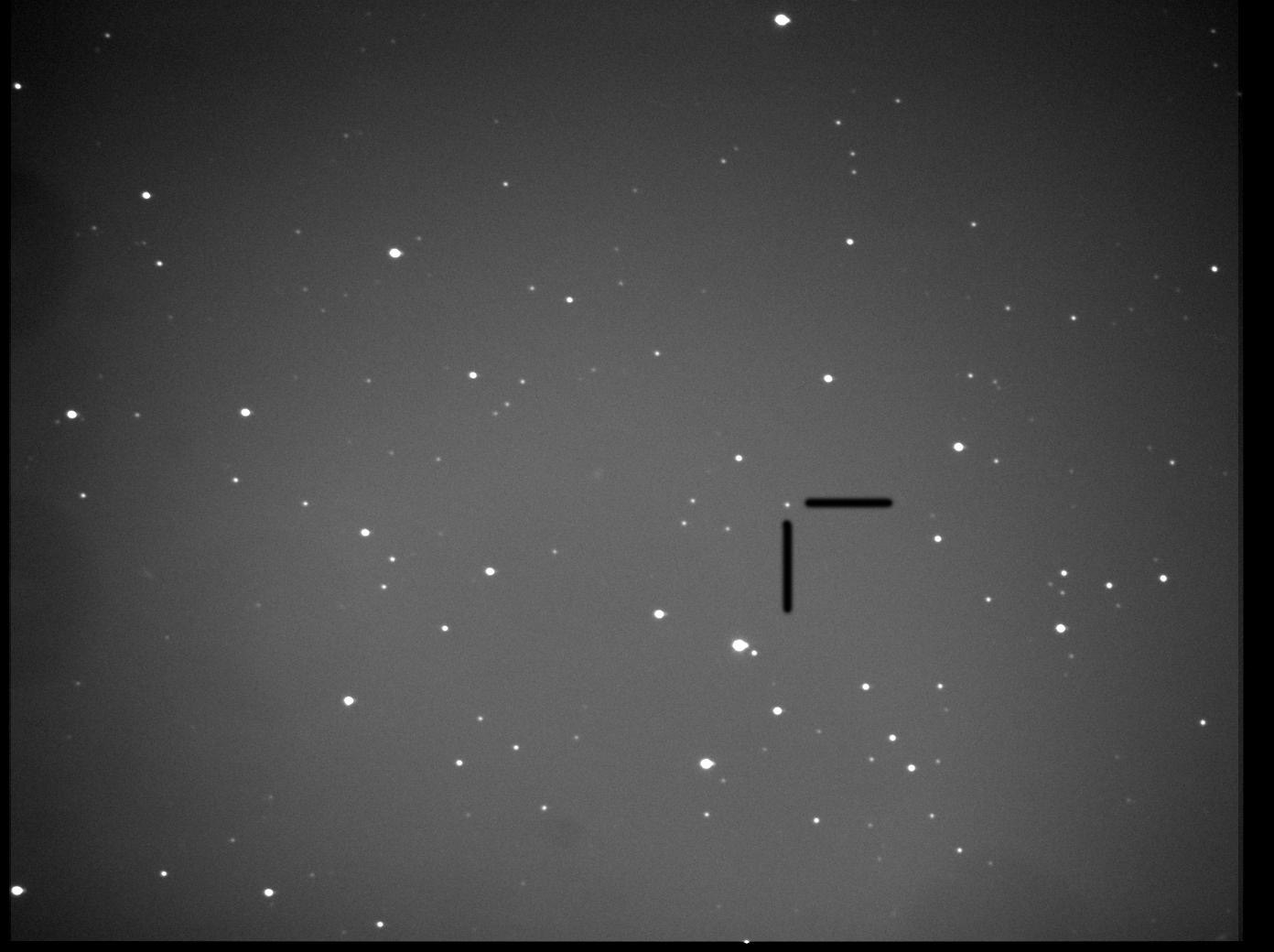
Quasar 3C48

It was clear on the Friday after Thanksgiving, so I spent a long evening imaging some neat targets.

The first was the quasar 3C 48 in Triangulum, one of the first to be identified as such--as a "quasi-stellar object", a radio source coming from an apparently point source, and yet stronger than any radio emissions previously identified from stars.

In 1960-62, using two radio telescopes in Owens Valley, astronomers Thomas Matthews and Allan Sandage were able to zero in on the location of the radio source to within 10 arcseconds, and the only object in the field was a 16th magnitude "star". And for two years, they noted its optical variability, its lack of any motion across the sky, and a very faint nebulosity associated with it, with a non-descript spectra. And yet, the QSO remained to the astronomers studying it only a potentially Milky Way object, something obviously further than "close" in the galactic sense, but far enough away to be stellar in appearance and non-moveable.

After submitting a paper about three of these objects in 1963, Matthews and Sandage get word that Schmidt has discovered that another QSO has a significant redshift (which is published in Nature in March 1963), and this allows them the scientific freedom to reinterpret their own spectra as a high-redshift spectrum of z=0.367.
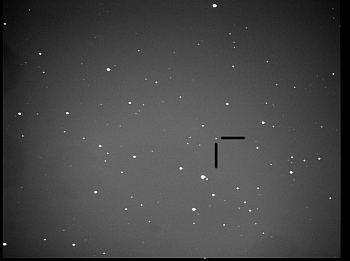

22 minutes total exposure, Click to enlarge. 10-inch f/6 reflector and Starlight Express SXV-H9 camera


Here's another CCD image from Anthony Ayiomamitis of the quasar.

Wednesday, November 26, 2008

Wednesday, November 19, 2008

Andromeda Galaxy

The Andromeda Galaxy, imaged on October 31st, 2007. 11 minutes exposure.
Andromeda Galaxy
Click to enlarge

Sunday, October 19, 2008

Scanner Camera color

If you could synchronize a tri-color set of filters with the RGB set of LEDs in the Canon Canoscan scanner, you could produce color images with a single scan of the diy scanner cameras out there.

Thursday, October 16, 2008

National Geographic on Light Pollution

The End of Night: Why we need Darkness

National Geographic Magazine brings the issue of light pollution (or expressed for concerns outside astronomy, Light At Night) to the cover of the November issue.

Monday, October 06, 2008

Inbound bolide: 2008 TC3

Astronomers have discovered a small inbound object a few meters across that appears to be on an impact course with the Earth. The object may enter the Earth's atmosphere somewhere over Europe or North Africa just after 2:30AM UT Tuesday (9:30PM CDT tonight). The orbit is uncertain enough to have a number of possible interactions with the Earth, including missing entirely. It is small enough, based on its brightness, to cause no concern, but should be a nice bright fireball and might drop some meteorites. The self-assigned ID is 8TA9D69, and it was discovered on Mt. Lemmon near Tucson, Arizona by the Mt. Lemmon Sky Survey.
http://tech.groups.yahoo.com/group/mpml/message/21070

Update: It's now designated 2008 TC3
http://cfa-www.harvard.edu/mpec/K08/K08T50.html

Sunday, October 05, 2008

I showed some RAS folks how to use the CCD camera last night. We couldn't get the drivers installed on the new laptop, despite tweaking the INF files to identify the USB device (at least in Windows, when you first connect a USB device, the device sends an ID number down, and Windows looks in the INFs to locate the driver). Unfortunately the manufacturer of the Starlight Xpress SXV-H9 camera changed the camera and the driver without changing the name or offering the old driver for download--the result is old camera owners can't get it working at all. Having to ask for the driver when it could just be on a website someone is really dumb.

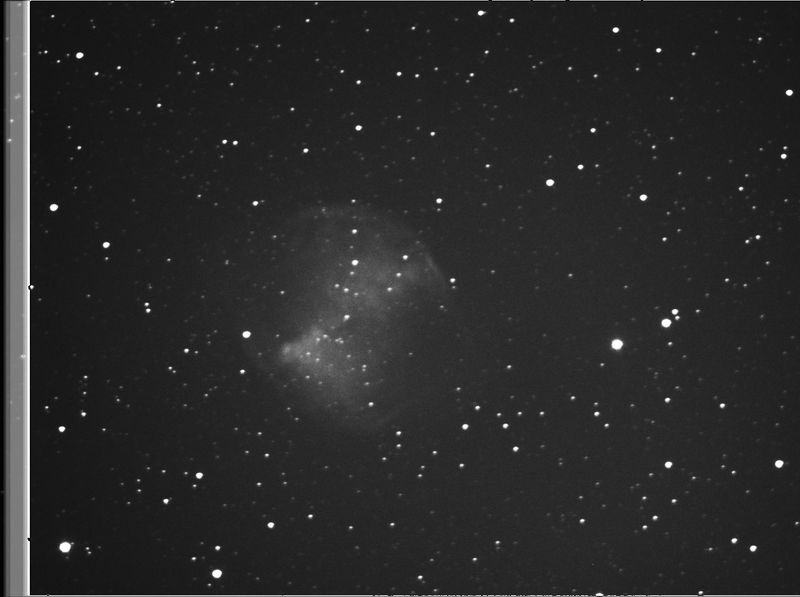
Anyways, we got the camera working on the ancient soon to die laptop (94MB of RAM!) and took this 3 minute (12x 15sec) exposure of the Dumbbell Nebula. Enjoy.

Dumbbell Nebula M27

Friday, October 03, 2008

Article in Sun-Times about Light Pollution

Yes, Light pollution does affect the ecology of the region.

http://www.suntimes.com/lifestyles/1199598,CST-NWS-night03.article.

Do I believe "A spokeswoman for the Chicago Bureau of Electricity said the city "has been actively pursing different methods to address the issue of light pollution."? Not in a second.

The University of Chicago just added over $7000 in electrical costs a year in extra, non-effective lights on campus. Is that sustainable?

Thursday, September 25, 2008

Raft part 2

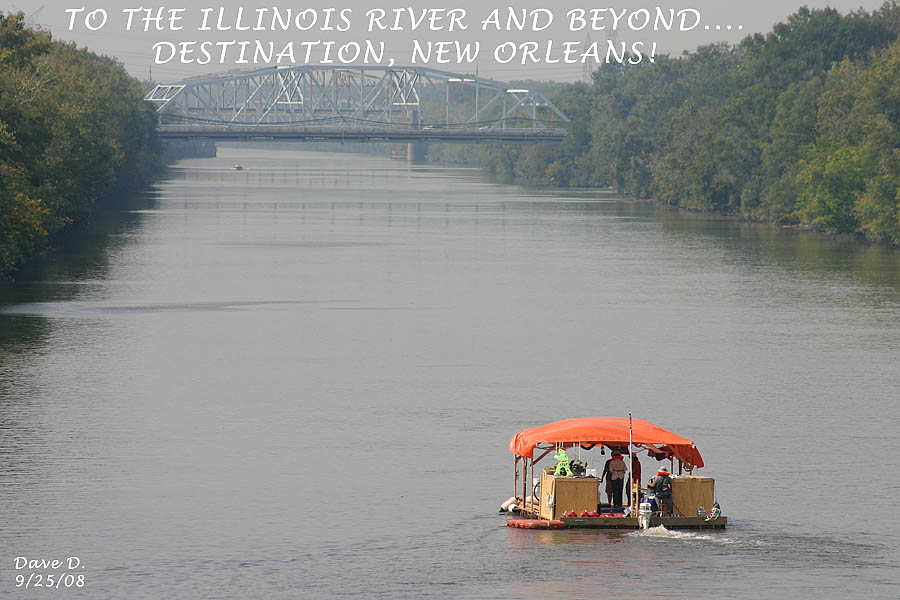
They finally got underway again, after a stop at the Riverdale Marina. They ended up replacing their outboard with a newer and slightly more powerful model. This then tripped them up as it tried to tear away from the raft. Suitability reinforced, they left this morning down the Cal-Sag to parts south.

This image is really the best, caught by Dave D., a boater who had seen them earlier while at the Riverdale Marina, he just happened to see them while crossing the 127th St. bridge, and he then headed further west to the Ridgeland Ave. bridge and caught some great shots.


Update: I just got a call from Igor; they've docked for the night near the last SEPA station right at the junction of the Cal-Sag and the Chicago Ship and Sanitary Canal, just a touch past the Illinois and Michigan Canal remnants and will be walking a mile up and across the river to the nearest gas station to pick up some gas.

Friday, September 19, 2008

Ah, panic

Nonrational behavior cleans out the gasoline supply in Nashville. No reasonable reason, of course, but panic takes out the gas supply of an American city. A minor problem with the US gasoline supply is that it is unable to handle panic buying or hoarding of gasoline. We've relied on the fact that most Americans haven't freaked out at any particular moment.

Sunday, September 14, 2008

Raft

IMG_2091

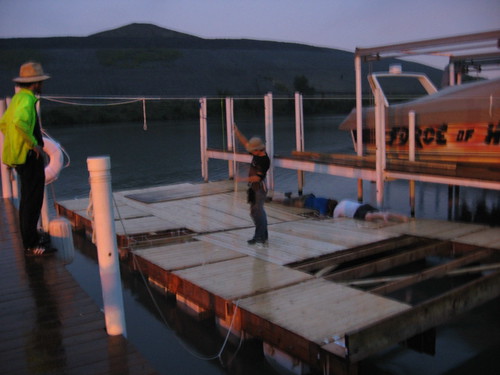
My time has been taken up with four friends of mine who are building a raft. Building a raft to travel from Chicago to New Orleans. I've been helping out as my schedule allows, although I took a few days off recently to help out on moving the preassembled parts from the backyard of a Hyde Park apartment to the Croissant Marina on the Little Calumet River. (This marina is a great spot--amazing for the friendliness, the methane purgers on the other side of the river, and the barges passing silently by). The weather gods have not been kind though. The majority of the water on the Little Calumet is effluent, and this weekend Chicago received the highest one-day precipitation event ever, AND the remnants of Hurricane Ike, in two separate rain events. In the scheme of things, it was so bad they opened all the normally closed locks that keep the Chicago river and canals from flowing into Lake Michigan. So, our previous spot at the marina is now covered in combined sewage and storm output by ten feet. It put a damper on the weekend for a lot of people; a lot of people are flooded out of their basements and apartments. Ryerson Observatory reports almost 11 inches of rain in the past seven days.

While we now have a 16ftx32ft raft, we still need to mount the 35hp motor and construct the cabins and hammock supports for the travelers. Try this link for construction photos. You might be able to see it without a facebook account--I'm just dumping stuff without much editing.

Tuesday, September 02, 2008

Volcanic sunsets part 2

Jennifer points out the local Chicago view from 8/31. Last night the colors were all there without any crepscular rays. Another image at WGN Weather. Spaceweather says the cloud is moving off from North America, but I still thought last night's was great.