The WSJ has an article on light pollution: http://online.wsj.com/article/SB121692767218982013.html?mod=googlenews_wsj
Light pollution has tripled since 1970, according to Italian astronomer Fabio Falchi.
Not mentioned in the article is the billions of dollars this light represents in wasted energy costs in the U.S. Every business should be aware that some large percentage of their lighting bill goes out without making a cent for them if they aren't using fully shielded lights. Using those clichéd acorns to light your lot? You are losing some 70% of your electric bill for lighting straight into the sky and into the pained, scrunched, unhappy eyes of the customers who can't see beyond your lights, who can't see into otherwise well-lit areas in your lot because of the glare from the acorns.
Saturday, July 26, 2008

Thursday, July 24, 2008
Granite counters: the claim of radiation risk

The New York Times has a surprising article today about the radiation risks of granite counters.
Granite is an intrusive rock--slowly cooled from magma several kilometers below the surface, the rock grows large crystals from the hundred-thousand to million year cooling period. It is also chemically more "continental"; that is, more quartz, more "felsic" minerals, as opposed to the "mafic" minerals that contain much olivine and pyroxene, two minerals rich in iron and magnesium. True granite is a chemically specific intrusive, and much of what is called granite isn't, but a cousin of it. Roughly you can say to expect quartz, feldspar (of some type, there are several), and a sheet silicate like mica or biotite.
Despite the popular image of the Earth's crust riding on an ocean of molten magma, there is little liquid under our feet. While it's hot, there is enough pressure to keep things solid. Occasionally something will upset that balance and allow the rock to melt, whether by bringing hot material up to a lower pressure (like at the mid-ocean ridges) or by adding a special ingredient to make it melt (like water released by ocean sediments subducting under a continent). Melting is complicated and rarely complete, and some minerals melt at a lower temperature than others, leaving behind and chemically changing what sort of rock it is. Granite is like this. It melts at a lower temperature than basaltic materials. It often contains more water. And it brings with it certain compatible elements including uranium and thorium. This is why granites are more radioactive than most rocks. They can contain 10-20x more uranium and thorium than the solid left behind. Some of the more exotic "granites" are pegmatites--the extremely large crystal remnants of the last little bits of liquid at the end of solidification--and they contain the highest amounts of these elements.
But is this a hazard? Granites I've encountered have rates ranging from nothing to about 10x background. This isn't that much. Time spent at cruising altitude is about 40x background at 500ft. It certainly wouldn't be worth the fuss of ripping up a kitchen, unless it was proven to be the source of elevated radon levels. After reading the literature about naturally occurring radon sources, I have difficulty assigning the radon to just a small granite piece. Any soil or rock within 4 gas-diffusion-days of the basement or slab can be a source of radon for a home, and the total amount of uranium in that quantity is going to exceed the amount in the countertop (especially the part of the countertop that is within radon's half-life time of the surface). If you covered your walls in granite it might be different.
Wednesday, July 09, 2008
Walker Lake, Nevada
Will we have the political fortitude to solve the problem of a oversubscribed watershed before all native fish die in the second largest natural lake fully in Nevada?
The cost of mitigating the health issues of a completely dry lake bed must be more expensive than a few water rights purchases, yes?
http://www.lasvegassun.com/news/2008/jul/08/lakefront-homes-while-lake-lasts/
The cost of mitigating the health issues of a completely dry lake bed must be more expensive than a few water rights purchases, yes?
http://www.lasvegassun.com/news/2008/jul/08/lakefront-homes-while-lake-lasts/
Tuesday, July 01, 2008
elements in glass
Ever wondered about the elemental composition of the differently colored versions of glass? Or what exactly does "crystal" glass contain that regular glass doesn't? Have a geochemist bring back last night's empties to the lab. To first order, be careful with the fancy-ware. More iron means more color. And if you need white, try some zinc oxide.
Trace elemental analysis of a big night out
P.S. Of course this is just about these particular elements, and doesn't count the bulk silicon, oxygen, sodium and such.
Trace elemental analysis of a big night out
P.S. Of course this is just about these particular elements, and doesn't count the bulk silicon, oxygen, sodium and such.
Saturday, June 14, 2008
Aurora activity

Despite still being in the dregs of the solar cycle the aurora occasionally really activates, and it's doing so right now. While it's daytime here in North America, the aurora is detectable by the way it distorts radio signals, producing a warbling effect on ionospherically bounced waves. The enhanced ionization also provides the ability to bounce much higher frequency radio signals than is usual, although everything is still subject to that pesky warbling.
Current observed aurora here via a NOAA satellite--it takes some time to refresh in orbit.

Spaceweather.com will have updates at some point soon; they are usually on the ball with sightings of neat events.
See the aurora forecast at UAF; which is useful, although long-term forecasts are always tough.
This alert was brought to my attention by the DXrobot, which monitors radio amateur's contacts for notes about unusual VHF radio conditions. Click here for the arcane info.
P.S. It would seem unlikely for this to be an "event" for Chicago city folk--the moon is out, light pollution is as bad as ever, clouds are coming in, and sometimes these events are short-lived.
Friday, June 06, 2008
Updates: Tesla coil and light bulb
Updates.
I tried to help Igor out on his Tesla coil. It's a traditional spark-gap variety coil. The problem was the secondary kept arcing over to the primary or elsewhere from near the bottom, nowhere near the top, and we didn't see any streamers or such from the top. Nothing we tried would insulate the primary from the secondary--styrofoam, electrical tape, plastic cups. When we changed where we connected to the primary the sparks would change their behavior--sometimes we would get a single spark or sometimes we would get what we think was called "racing sparks"--the ones that jump a few inches on the secondary. Also we tried grounding, although we were up on a third story. All this, plus the fun of a spark gap that literally was too loud to operate. Bang-bang-bang! We need to enclose the spark gap in something to absorb the sound, but to do that would mean we'd also have to set up an air flow via a fan to break the arc. No photos of this work.
The other is a revisit to a Scav Hunt item, a homemade light bulb. This was a success on our part. We used a 0.5mm mechanical pencil lead, connected it to a pair of 6V latern batteries wired in series, giving 12V. The filament was enclosed in a Snapple bottle with wire passed through a hole in the cap sealed with hot glue. To remove oxygen in the air we lit a match or two in the bottle until it went out and sealed quickly. This bulb had a nice ruddy glow to it. We only ran it for thirty seconds or so before it was passed on for the judges to see. I don't know where it is now, so I decided to make another one. The basics were the same except for the power source. I used a 15V AC 1A power supply. I put the filament in a Starbucks glass container that I had worries about being airtight enough. This time it lit nicely, but within ten seconds one side of the graphite became brighter. A post-mortem showed it got brighter because the lead got narrower, and more power was dissipated there, increasing the erosion. It got brighter and brighter and then narrowed to nothing, when it broke.

Graphite filament assembly

Light bulb lit

Lightbulb movie -- Click to play -- sorry for the poor aspect ratio
I tried to help Igor out on his Tesla coil. It's a traditional spark-gap variety coil. The problem was the secondary kept arcing over to the primary or elsewhere from near the bottom, nowhere near the top, and we didn't see any streamers or such from the top. Nothing we tried would insulate the primary from the secondary--styrofoam, electrical tape, plastic cups. When we changed where we connected to the primary the sparks would change their behavior--sometimes we would get a single spark or sometimes we would get what we think was called "racing sparks"--the ones that jump a few inches on the secondary. Also we tried grounding, although we were up on a third story. All this, plus the fun of a spark gap that literally was too loud to operate. Bang-bang-bang! We need to enclose the spark gap in something to absorb the sound, but to do that would mean we'd also have to set up an air flow via a fan to break the arc. No photos of this work.
The other is a revisit to a Scav Hunt item, a homemade light bulb. This was a success on our part. We used a 0.5mm mechanical pencil lead, connected it to a pair of 6V latern batteries wired in series, giving 12V. The filament was enclosed in a Snapple bottle with wire passed through a hole in the cap sealed with hot glue. To remove oxygen in the air we lit a match or two in the bottle until it went out and sealed quickly. This bulb had a nice ruddy glow to it. We only ran it for thirty seconds or so before it was passed on for the judges to see. I don't know where it is now, so I decided to make another one. The basics were the same except for the power source. I used a 15V AC 1A power supply. I put the filament in a Starbucks glass container that I had worries about being airtight enough. This time it lit nicely, but within ten seconds one side of the graphite became brighter. A post-mortem showed it got brighter because the lead got narrower, and more power was dissipated there, increasing the erosion. It got brighter and brighter and then narrowed to nothing, when it broke.

Graphite filament assembly

Light bulb lit
Lightbulb movie -- Click to play -- sorry for the poor aspect ratio
Monday, June 02, 2008
Space Shuttle and ISS space station visibility this week in Chicago
UPDATE 7/06/2009: Here's the current set of passes.
It's June, the day is nearly as long as it gets, and at night the sunlight streams over the north pole and lights up many low earth orbit satellites even in the middle of the night above Chicago. The International Space Station and the Space Shuttle are well aligned to be visible all this week for Chicago.
See the schedule here at Heavens-Above;
For the next few nights you can see the ISS and Shuttle twice in one evening; literally, on the next orbit.
UPDATE 5/13/2009: Looking for the current Shuttle passes?
It's June, the day is nearly as long as it gets, and at night the sunlight streams over the north pole and lights up many low earth orbit satellites even in the middle of the night above Chicago. The International Space Station and the Space Shuttle are well aligned to be visible all this week for Chicago.
See the schedule here at Heavens-Above;
| Date | Mag | Starts | Max. altitude | Ends | ||||||
| Time | Alt. | Az. | Time | Alt. | Az. | Time | Alt. | Az. | ||
| 2 Jun | 0.1 | 21:26:21 | 10 | NNW | 21:28:30 | 19 | NNE | 21:30:39 | 10 | ENE |
| 2 Jun | -0.9 | 23:00:58 | 10 | WNW | 23:02:49 | 35 | WNW | 23:02:49 | 35 | WNW |
| 3 Jun | -1.1 | 21:48:13 | 10 | NW | 21:50:55 | 34 | NNE | 21:52:32 | 19 | E |
| 3 Jun | 0.6 | 23:23:28 | 10 | W | 23:23:51 | 12 | W | 23:23:51 | 12 | W |
| 4 Jun | 0.0 | 20:35:37 | 10 | NNW | 20:37:44 | 18 | NNE | 20:39:51 | 10 | ENE |
| 4 Jun | -2.5 | 22:10:13 | 10 | NW | 22:13:06 | 84 | SW | 22:13:35 | 58 | SE |
| 5 Jun | -1.0 | 20:57:26 | 10 | NW | 21:00:06 | 33 | NNE | 21:02:45 | 10 | E |
| 5 Jun | -0.7 | 22:32:38 | 10 | WNW | 22:34:39 | 24 | WSW | 22:34:39 | 24 | WSW |
| 6 Jun | -2.4 | 21:19:21 | 10 | NW | 21:22:15 | 89 | WSW | 21:24:26 | 16 | SE |
| 7 Jun | -0.8 | 21:41:41 | 10 | WNW | 21:44:11 | 26 | SW | 21:45:33 | 18 | S |
| 9 Jun | -0.8 | 20:50:39 | 10 | WNW | 20:53:12 | 28 | SW | 20:55:44 | 10 | SSE |
For the next few nights you can see the ISS and Shuttle twice in one evening; literally, on the next orbit.
UPDATE 5/13/2009: Looking for the current Shuttle passes?
Tuesday, May 27, 2008
Re: Even more awesome Mars images?
As rumored, here's the awesome Mars Phoenix image. An image later in the descent as the spacecraft nears the surface. Heimdall crater is within twenty kilometers of the landing site but just in the background in the image (You can't see it from the landing site).

Via Planetary Society Blog.
P.S. Also see the image of Phoenix on the ground at HiRISE blog. Heck, see the full image to see the parachute and heat shield as well.

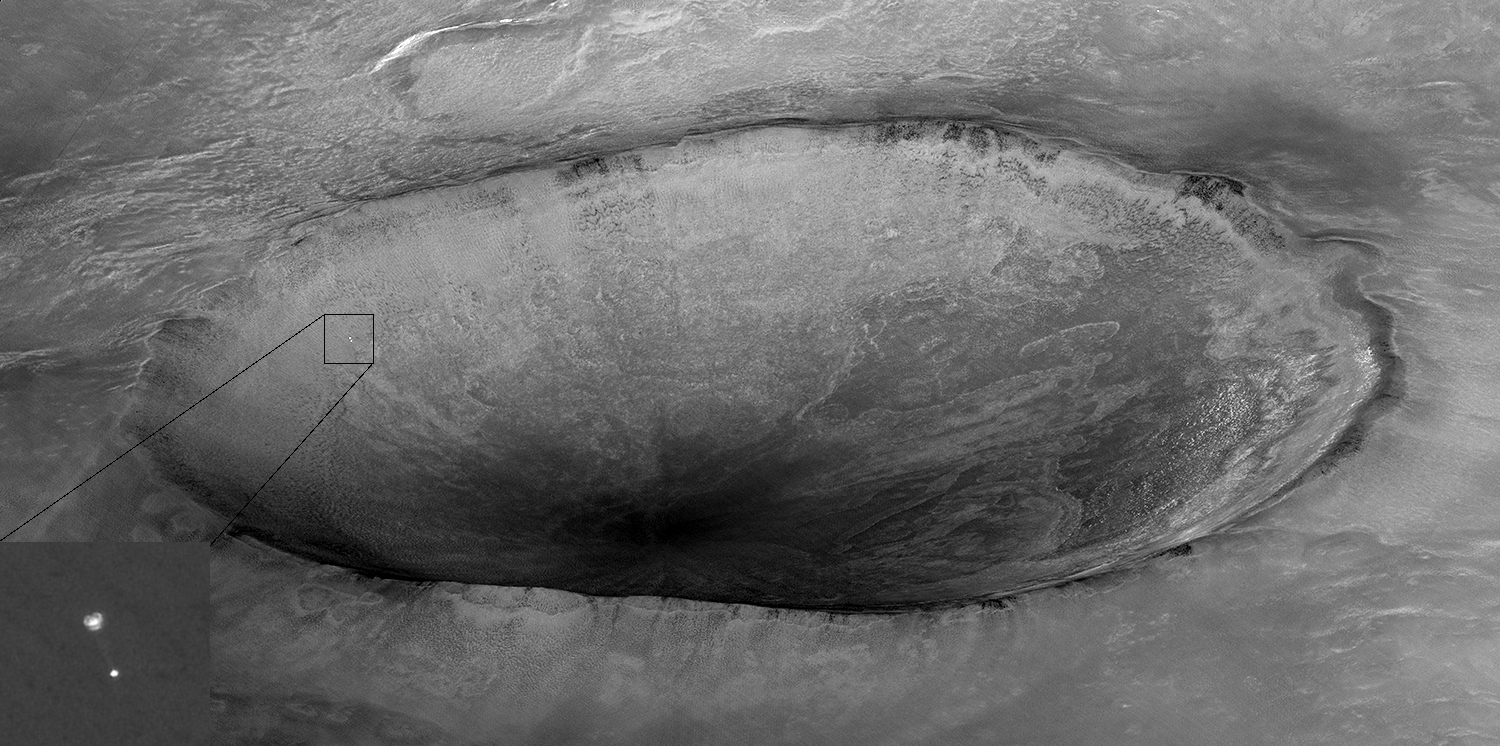
Via Planetary Society Blog.
P.S. Also see the image of Phoenix on the ground at HiRISE blog. Heck, see the full image to see the parachute and heat shield as well.

Sudden cold front temperature change
A fantastic wind shift and cold front passage last night dropped temperatures by twenty degrees Fahrenheit in the course of a few minutes. As is common here, the cold front used the lake as an expressway south to accelerate and end an otherwise warm and humid Memorial Day. As experienced by me, a quiet warm night suddenly grew loud as the trees shook, then a blast of cold air blew through my open windows in a gust. Another account.
This data is from the Ryerson weather station.
--Timestamp--- Temp Humid Dewpt Wind HiWind WindDir
20080526 19:30 80.6 57 63.9 8 18 247
20080526 20:00 79.8 58 63.7 6 15 247
20080526 20:30 79.0 61 64.4 5 13 270
20080526 21:00 78.2 63 64.6 4 13 247
20080526 21:30 77.6 66 65.3 5 11 247
20080526 22:00 76.8 67 65.0 5 11 247
20080526 22:30 76.1 69 65.2 4 11 270
20080526 23:00 54.3 73 45.8 10 35 270
20080526 23:30 51.9 78 45.3 18 41 0
20080526 24:00 48.8 82 43.6 18 33 0

One of the few storms that popped up on the warm side earlier that evening
Is this cloud from the cold air bumping the warm humid air up and out of the way?
This data is from the Ryerson weather station.
--Timestamp--- Temp Humid Dewpt Wind HiWind WindDir
20080526 19:30 80.6 57 63.9 8 18 247
20080526 20:00 79.8 58 63.7 6 15 247
20080526 20:30 79.0 61 64.4 5 13 270
20080526 21:00 78.2 63 64.6 4 13 247
20080526 21:30 77.6 66 65.3 5 11 247
20080526 22:00 76.8 67 65.0 5 11 247
20080526 22:30 76.1 69 65.2 4 11 270
20080526 23:00 54.3 73 45.8 10 35 270
20080526 23:30 51.9 78 45.3 18 41 0
20080526 24:00 48.8 82 43.6 18 33 0
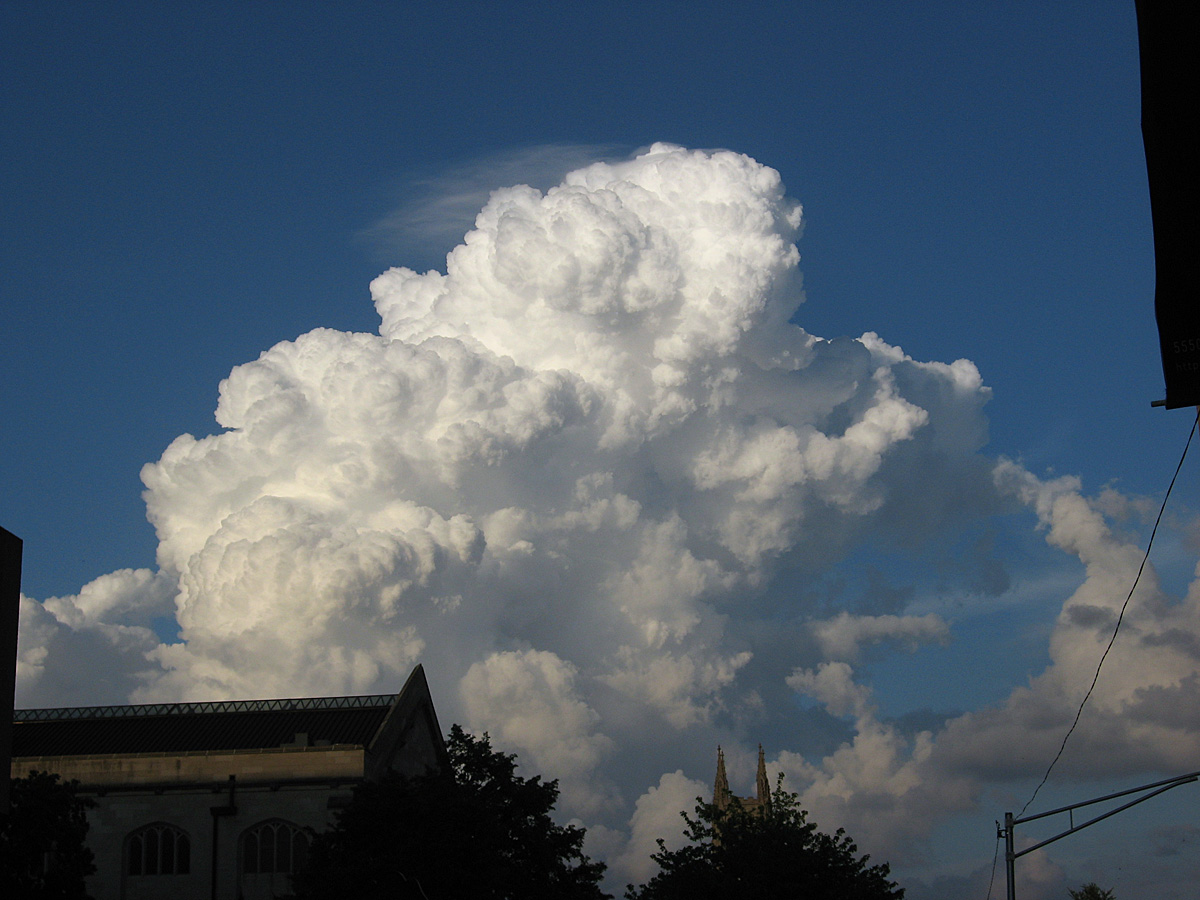
One of the few storms that popped up on the warm side earlier that evening
Is this cloud from the cold air bumping the warm humid air up and out of the way?

Even more awesome Mars images?
You've seen the amazing image of Phoenix descending in the Martian atmosphere as taken from MRO's HiRISE. (As Emily Lakdawalla puts it: "OMG!! Parachute!!!! Photo !!!!!" You might have seen the first false-color images. But now there is a rumor about another HiRISE image of Phoenix while it was still descending in front of Heimdall Crater.
Is this that image? Not spectacular enough after the first image.
Is this that image? Not spectacular enough after the first image.
Sunday, May 25, 2008
Wednesday, May 14, 2008
The newest supernova in the Milky Way
The last supernova in the galaxy was Kepler's star of 1604 in Ophiuchus. Or was it? You'd expect a supernova in a barred spiral of our size every 50-100 years. We haven't seen any, and it's because of that pesky dust in the way, blocking our optical view. But it looks like follow-up x-ray work from Chandra has found evidence of a 150-year old supernova in Sagittarius!

X-rays in orange, radio in blue. Reminds me of the firefox logo.
It looks like the impetus for revisiting the radio work in 1985 was that the x-rays detected by Chandra were significantly outside the 1985 radio contours implying rapid expansion. See the paper here.
P.S. Tip to General Carlessness and Bad Astronomer
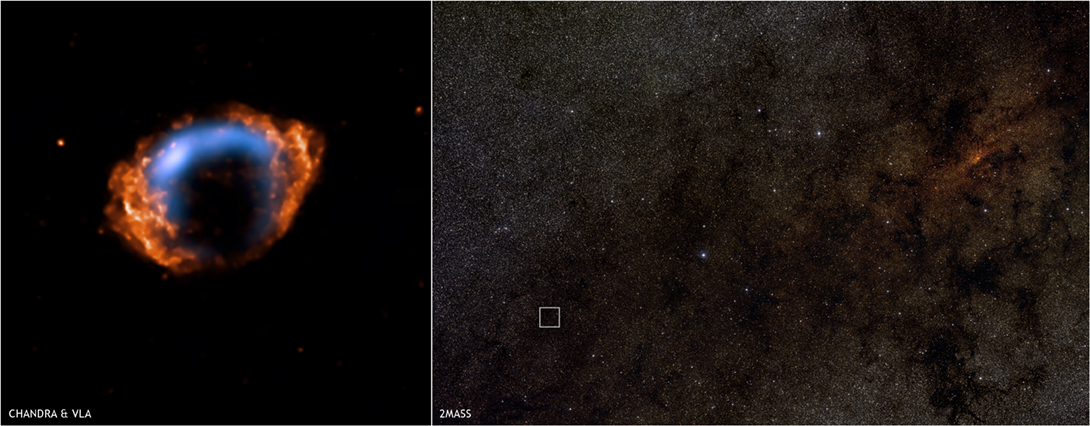
X-rays in orange, radio in blue. Reminds me of the firefox logo.
It looks like the impetus for revisiting the radio work in 1985 was that the x-rays detected by Chandra were significantly outside the 1985 radio contours implying rapid expansion. See the paper here.
P.S. Tip to General Carlessness and Bad Astronomer
Thursday, May 08, 2008
Adventures in large format digital photography: part 5
I got the camera working again, kinda of. It doesn't work with TWAIN enabled stuff. It will work just fine using Vuescan on Windows and XSane on Ubuntu. Exposures are weird with Vuescan--I seemingly lost 3 stops of speed with it.
I also dremeled open the highly vignetting slot that previously limited the images to that narrow vertical view. I can now scan 7x11 inches. (Somehow I lost an inch and a half--the sensor is dead below 7 inches). There is also a band of vignetting and/or low sensitivity right across the central-top of the frame.


I also dremeled open the highly vignetting slot that previously limited the images to that narrow vertical view. I can now scan 7x11 inches. (Somehow I lost an inch and a half--the sensor is dead below 7 inches). There is also a band of vignetting and/or low sensitivity right across the central-top of the frame.
Tuesday, May 06, 2008
Kaguya: Color on the Moon
I was perusing (as best as possible without reading Japanese) the currently released images of the Moon from the Japanese spacecraft Kaguya when I encountered this one. You nearly forget all the images are in color when all you are looking at is the nearly monochrome Moon.

Click to enlarge to HDTV resolution

Click to enlarge to HDTV resolution
Wednesday, April 30, 2008
The bad idea of a gas tax holiday
Tom Friedman points out the obvious stupidity of McCain's and Clinton's idea of a gas tax holiday for the summer.
Subscribe to:
Posts (Atom)