
Showing posts with label lighting. Show all posts
Showing posts with label lighting. Show all posts
Saturday, July 24, 2021
Compact Fluorescent Lifetime report #4
As previously mentioned, I've tried to keep track of CFL bulbs I used and how long they have lasted. Some have outlived some of the newer LED lights I now buy, which is related to the reduction of manufacturing cost by the makers of them. My early LEDs are still running from 2011, including the famous L-prize bulb won by Philips, in a torchiere conversion I did a long time ago and still use.
This bulb was used for a several hours each day from 2008-2011, pretty much not used for two years, then was used for a short time daily and at most an hour or two weekly from 2013-2021 in the laundry room in a horizontal position. So, it probably lasted about 5000 hours. The bulb warranty was set as "guaranteed for 5 years at 4 hours each day" and labeled as 8000hrs.


Monday, January 21, 2013
CFL lifetime report #2
A third CFL failed in my torchiere conversion I did back in the winter of 2008. I used this light about 7 hours a day consistently until mid 2011, then for about 4 hours daily since then, which gave a lifetime of this compact fluorescent bulb from n:vision of about 11000 hours. I'm starting to evaluate and switch to LED bulbs as circumstances warrant--I went out and bought the Philips L-prize winning 10W EnduraLED bulb as a birthday present for myself. Whether to get more is a good question given its cost of $40 (it currently is cheaper to buy them at a big box store like Home Depot than online). I really do like the 92 CRI; the question is it that sufficient enough reason to buy it versus the previous generation of 80 CRI AmbientLED? The cost of electricity isn't a reason: 10W for the Endura versus 12.5W for the Ambient means a couple of dollars a year if left on 24/7. The lumen ouput might be--only 800 for the AmbientLED versus a bountiful 930 lumens for the EnduraLED. If I went by cost only for 80-ish CRI the CFLs still win for the short-term. But I am tempted by color accuracy, which is somewhat important for me, at least in food prep and photography viewing.
None of this moves into the realm of other home lighting, which I'm running into the questions of dimmers, recessed cans, appliance bulbs, and the aesthetics of bathroom fixtures. And not to mention essentially lighting doesn't really cost that much for me annually, compared to other costs.
Saturday, May 14, 2011
CFL lifetime report
I just noticed that a second CFL failed in my torchiere conversion I did back in the winter of 2008. I use this light about 7 hours a day consistently. That makes it just under 8000 hours. The first CFL failure I seem to have not mentioned; I think it happened about a year ago.
Monday, September 20, 2010
fluorescent light runs at 25kHz
The newish fluorescent light (well, added in 1999 to make up for a lost skylight) fixture in the RAS office must have an electronic ballast that runs at 25kHz, as that is a strong signal that pops up on the oscilloscope & antenna when that light circuit is running. The older fluorescent lights are probably ancient magnetic ballasts.
...I'm sure y'all care.
...I'm sure y'all care.
Thursday, December 24, 2009
Halogen resistance
If you are curious, the resistance of a 300W type J halogen bulb, the ones you would find in those halogen torchiere lamps, is 3.3 ohms when cold. When it's hot it is 48 ohms, but that's a calculation only based on the wattage.

A warm halogen bulb in the near infrared
Since converting such a torchiere to CFL (but not in this project), I had an extra halogen bulb and debated throwing it out, but I figured they might make a decent power resistor. I used it in a project converting a PC ATX power supply to a benchtop 12V source. It works--but the hassle of cleaning the contacts for soldering, soldering, and placing such a large object in the case was enough to decide buying a power resistor in the first place is probably easier.
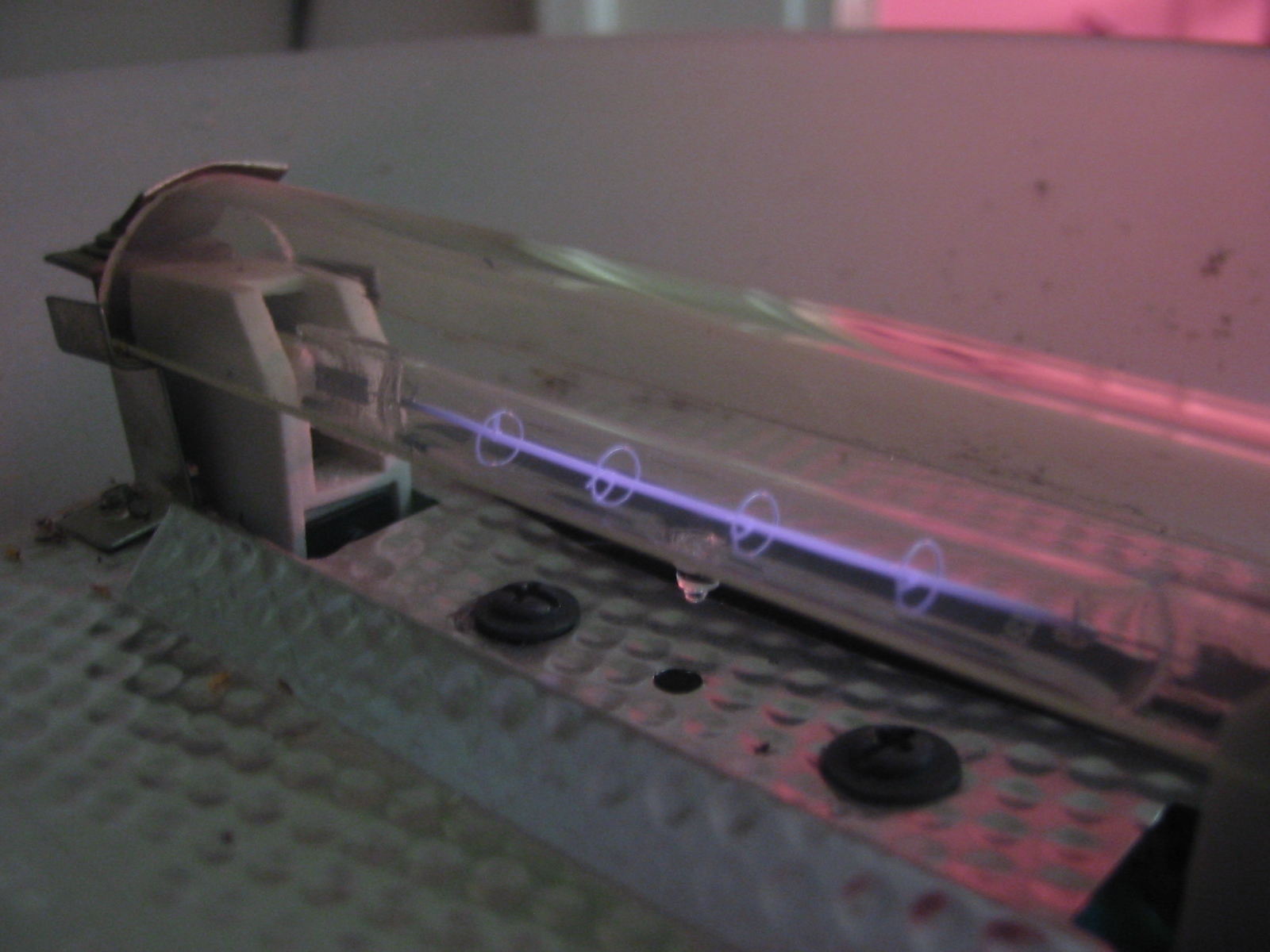
A warm halogen bulb in the near infrared
Since converting such a torchiere to CFL (but not in this project), I had an extra halogen bulb and debated throwing it out, but I figured they might make a decent power resistor. I used it in a project converting a PC ATX power supply to a benchtop 12V source. It works--but the hassle of cleaning the contacts for soldering, soldering, and placing such a large object in the case was enough to decide buying a power resistor in the first place is probably easier.
Monday, August 04, 2008
Stanley Fish doesn't get it on lighting
Stanley Fish writes in the NYTimes:
Clearly he didn't read the article in his own newspaper about the importance of choosing the right CFL for each location.
Buy a higher rated CF wattage than the so-called equivalent, pick the right color, and don't give up. There are acceptable CFLs for high-usage, non-wet, non-dimmable locations. You've got to get the right one for each situation and not give up because one "cheap" size does not fit all.
But my house is now full of environmentally approved lightbulbs. They are dim, ugly and expensive, but I am told that they will last beyond my lifetime. (That’s supposed to be reassuring?) A neighbor told me today that he is planning to stockpile incandescent bulbs in the face of a prediction that they will be phased out by 2012.
Meanwhile, by the weak light shed by the virtuous bulbs, ...
Clearly he didn't read the article in his own newspaper about the importance of choosing the right CFL for each location.
Buy a higher rated CF wattage than the so-called equivalent, pick the right color, and don't give up. There are acceptable CFLs for high-usage, non-wet, non-dimmable locations. You've got to get the right one for each situation and not give up because one "cheap" size does not fit all.
Saturday, July 26, 2008
Wall Street Journal on Light Pollution
The WSJ has an article on light pollution: http://online.wsj.com/article/SB121692767218982013.html?mod=googlenews_wsj
Light pollution has tripled since 1970, according to Italian astronomer Fabio Falchi.
Not mentioned in the article is the billions of dollars this light represents in wasted energy costs in the U.S. Every business should be aware that some large percentage of their lighting bill goes out without making a cent for them if they aren't using fully shielded lights. Using those clichéd acorns to light your lot? You are losing some 70% of your electric bill for lighting straight into the sky and into the pained, scrunched, unhappy eyes of the customers who can't see beyond your lights, who can't see into otherwise well-lit areas in your lot because of the glare from the acorns.
Light pollution has tripled since 1970, according to Italian astronomer Fabio Falchi.
Not mentioned in the article is the billions of dollars this light represents in wasted energy costs in the U.S. Every business should be aware that some large percentage of their lighting bill goes out without making a cent for them if they aren't using fully shielded lights. Using those clichéd acorns to light your lot? You are losing some 70% of your electric bill for lighting straight into the sky and into the pained, scrunched, unhappy eyes of the customers who can't see beyond your lights, who can't see into otherwise well-lit areas in your lot because of the glare from the acorns.
Friday, June 06, 2008
Updates: Tesla coil and light bulb
Updates.
I tried to help Igor out on his Tesla coil. It's a traditional spark-gap variety coil. The problem was the secondary kept arcing over to the primary or elsewhere from near the bottom, nowhere near the top, and we didn't see any streamers or such from the top. Nothing we tried would insulate the primary from the secondary--styrofoam, electrical tape, plastic cups. When we changed where we connected to the primary the sparks would change their behavior--sometimes we would get a single spark or sometimes we would get what we think was called "racing sparks"--the ones that jump a few inches on the secondary. Also we tried grounding, although we were up on a third story. All this, plus the fun of a spark gap that literally was too loud to operate. Bang-bang-bang! We need to enclose the spark gap in something to absorb the sound, but to do that would mean we'd also have to set up an air flow via a fan to break the arc. No photos of this work.
The other is a revisit to a Scav Hunt item, a homemade light bulb. This was a success on our part. We used a 0.5mm mechanical pencil lead, connected it to a pair of 6V latern batteries wired in series, giving 12V. The filament was enclosed in a Snapple bottle with wire passed through a hole in the cap sealed with hot glue. To remove oxygen in the air we lit a match or two in the bottle until it went out and sealed quickly. This bulb had a nice ruddy glow to it. We only ran it for thirty seconds or so before it was passed on for the judges to see. I don't know where it is now, so I decided to make another one. The basics were the same except for the power source. I used a 15V AC 1A power supply. I put the filament in a Starbucks glass container that I had worries about being airtight enough. This time it lit nicely, but within ten seconds one side of the graphite became brighter. A post-mortem showed it got brighter because the lead got narrower, and more power was dissipated there, increasing the erosion. It got brighter and brighter and then narrowed to nothing, when it broke.

Graphite filament assembly

Light bulb lit

Lightbulb movie -- Click to play -- sorry for the poor aspect ratio
I tried to help Igor out on his Tesla coil. It's a traditional spark-gap variety coil. The problem was the secondary kept arcing over to the primary or elsewhere from near the bottom, nowhere near the top, and we didn't see any streamers or such from the top. Nothing we tried would insulate the primary from the secondary--styrofoam, electrical tape, plastic cups. When we changed where we connected to the primary the sparks would change their behavior--sometimes we would get a single spark or sometimes we would get what we think was called "racing sparks"--the ones that jump a few inches on the secondary. Also we tried grounding, although we were up on a third story. All this, plus the fun of a spark gap that literally was too loud to operate. Bang-bang-bang! We need to enclose the spark gap in something to absorb the sound, but to do that would mean we'd also have to set up an air flow via a fan to break the arc. No photos of this work.
The other is a revisit to a Scav Hunt item, a homemade light bulb. This was a success on our part. We used a 0.5mm mechanical pencil lead, connected it to a pair of 6V latern batteries wired in series, giving 12V. The filament was enclosed in a Snapple bottle with wire passed through a hole in the cap sealed with hot glue. To remove oxygen in the air we lit a match or two in the bottle until it went out and sealed quickly. This bulb had a nice ruddy glow to it. We only ran it for thirty seconds or so before it was passed on for the judges to see. I don't know where it is now, so I decided to make another one. The basics were the same except for the power source. I used a 15V AC 1A power supply. I put the filament in a Starbucks glass container that I had worries about being airtight enough. This time it lit nicely, but within ten seconds one side of the graphite became brighter. A post-mortem showed it got brighter because the lead got narrower, and more power was dissipated there, increasing the erosion. It got brighter and brighter and then narrowed to nothing, when it broke.

Graphite filament assembly

Light bulb lit
Lightbulb movie -- Click to play -- sorry for the poor aspect ratio
Tuesday, April 22, 2008
CF Torchiere replacement
Compact Fluorescents are all hot right now. And it's Earth Week.
I bought a floor lamp from Home Depot that used a single standard bulb and didn't have any fancy dimmer system: it just had a hi/lo switch (I'm still not sure what it does with it--the CFLs flicker on the low setting, so I quickly turn the lamp to high when flipping the switch. It could be a simple rectifier to provide 50% of the power). I then bought three lamp socket splitters. These screw into a standard lamp socket and provide two sockets. So, with three splitters, a single socket becomes four. This is OK because the CFLs use so much less power--with four of them, I'm only using 100W, and the floor lamp suggests using a 150W standard bulb. The sockets themselves are rated higher, so I think the 150W max is for thermal/fire issues (high wattage bulbs can start fires if drapery or other flammables fall on them).

Taking pictures of lighting fixtures is hard--either the fixture looks dim and the room dark, or the fixture is overexposed.

If you think the color temperature is off, you can adjust by using different color CF bulbs. Here was an experiment with a 2:1 warm:daylight ratio.

an even ratio between warm and daylight. This was too cool for evening use. The color is way exaggerated here--the yellow bulbs are nearly white to the eye.

The color of the photographs is too strong--your eye does not see such strong color in the fixture.
In any case, I made this fixture 100% n:vision 100W soft white bulbs, and use it all the time. I have a second fixture where I replaced the dimmer switch with a standard push switch (it's tough to find a switch that fits in small diameter torchieres) so I could use compact fluorescents in it. I put 3 GE 100W daylight bulbs in the latter fixture and use it only during the day.
Now the caveat: the splitters stick the bulbs higher than where an incandescent would be in the fixture. Ideally the rim of the lamp shade would be a touch higher, but I've yet experimented with the right material to make one. Doing so would improve the fixture and reduce glare from it.
The end result is I've increased the lighting in my otherwise dark apartment (north facing windows on the first floor) and decreased my lighting energy usage by 50%, even more on average since I don't use the second fixture at night. I'm already being paid back on my electricity bill: some $10 a month less.
I bought a floor lamp from Home Depot that used a single standard bulb and didn't have any fancy dimmer system: it just had a hi/lo switch (I'm still not sure what it does with it--the CFLs flicker on the low setting, so I quickly turn the lamp to high when flipping the switch. It could be a simple rectifier to provide 50% of the power). I then bought three lamp socket splitters. These screw into a standard lamp socket and provide two sockets. So, with three splitters, a single socket becomes four. This is OK because the CFLs use so much less power--with four of them, I'm only using 100W, and the floor lamp suggests using a 150W standard bulb. The sockets themselves are rated higher, so I think the 150W max is for thermal/fire issues (high wattage bulbs can start fires if drapery or other flammables fall on them).

Taking pictures of lighting fixtures is hard--either the fixture looks dim and the room dark, or the fixture is overexposed.
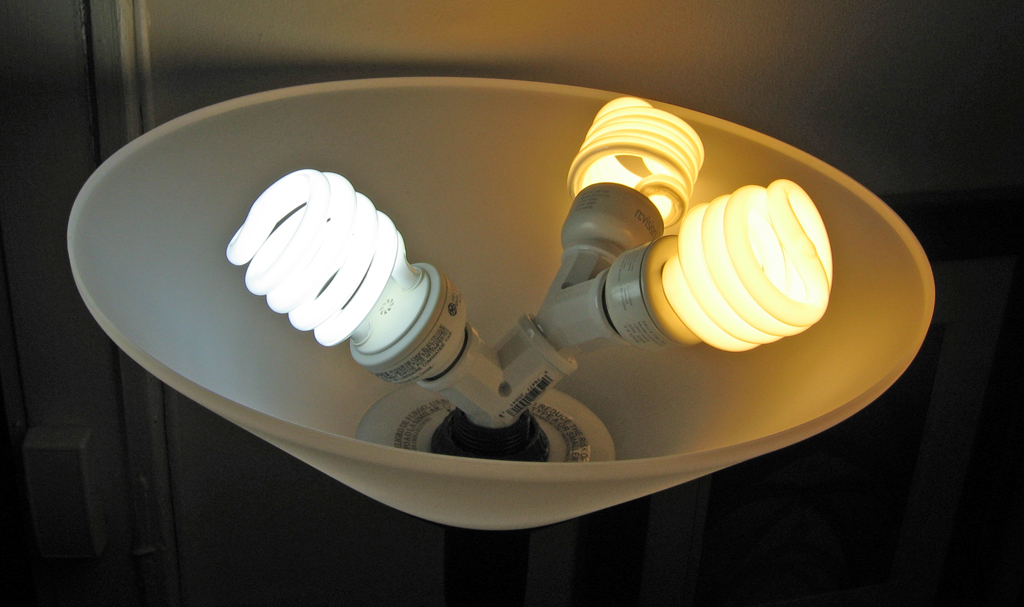
If you think the color temperature is off, you can adjust by using different color CF bulbs. Here was an experiment with a 2:1 warm:daylight ratio.
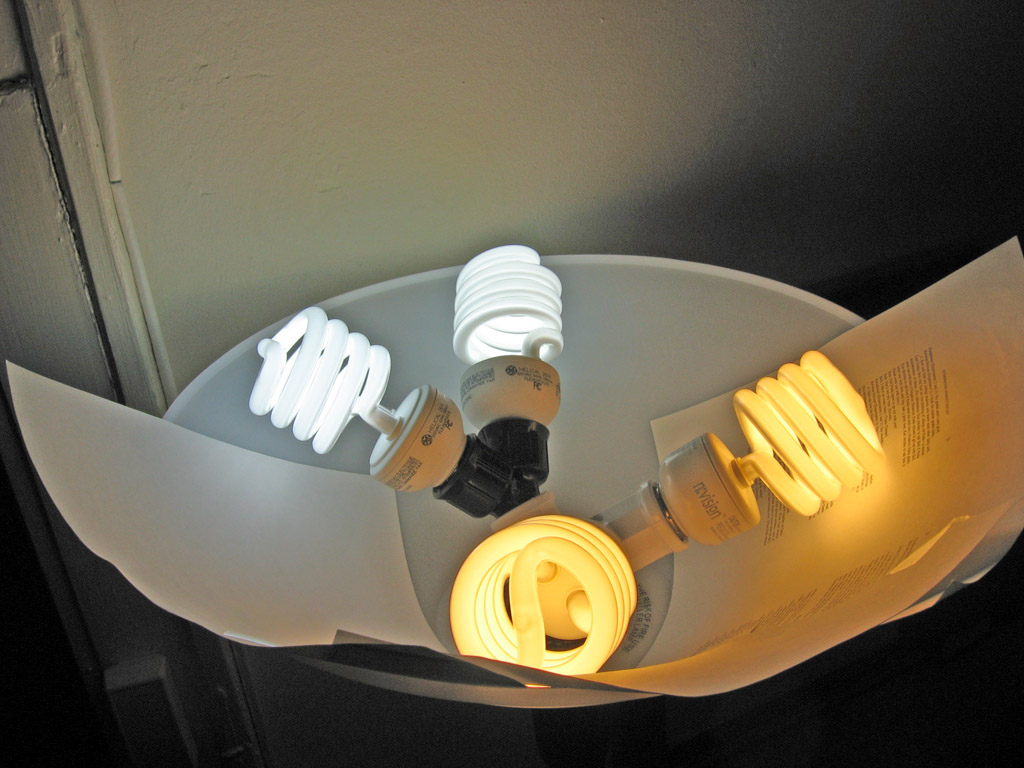
an even ratio between warm and daylight. This was too cool for evening use. The color is way exaggerated here--the yellow bulbs are nearly white to the eye.

The color of the photographs is too strong--your eye does not see such strong color in the fixture.
In any case, I made this fixture 100% n:vision 100W soft white bulbs, and use it all the time. I have a second fixture where I replaced the dimmer switch with a standard push switch (it's tough to find a switch that fits in small diameter torchieres) so I could use compact fluorescents in it. I put 3 GE 100W daylight bulbs in the latter fixture and use it only during the day.
Now the caveat: the splitters stick the bulbs higher than where an incandescent would be in the fixture. Ideally the rim of the lamp shade would be a touch higher, but I've yet experimented with the right material to make one. Doing so would improve the fixture and reduce glare from it.
The end result is I've increased the lighting in my otherwise dark apartment (north facing windows on the first floor) and decreased my lighting energy usage by 50%, even more on average since I don't use the second fixture at night. I'm already being paid back on my electricity bill: some $10 a month less.
Saturday, March 29, 2008
near infrared lights
When I need good near-infrared lighting, I turn to the broadband sources called the Sun and incandescents. They are the closest thing to a blackbody we see on a regular basis.

I presumed on this post that I was seeing an intense sodium line from high-pressure sodium lighting while taking daytime near-IR images. What I didn't realize while speculating at that point was that every high-intensity discharge light has a very hot envelope--for high-pressure sodium, a bulb of aluminum oxide (all jokes about transparent aluminum aside, of course). For metal halide and mercury vapor it's usually fused quartz, but sometimes it's the above alumina or sapphire. The tough requirements of dealing with a circa 3500K corrosive plasma dictate the choice of material. Have you ever seen a cycling HPS streetlight? As soon as the arc extinguishes you can see the pure blackbody glow of the very hot bulb window which is at or just below 1200K. That's what I'm detecting in the infrared shots--any HID light that is on is a great IR source. See this shot of the Chicago Theological Union / Oriental Institute or this one on the central quad of the University of Chicago -- the metal halide lights are on in the early evening with sunlight still streaming in. (Don't get me started on energy decisions here). Or here.

Or this HPS streetlight here at Hull Gate.
Compare that with fluorescents: they on the other hand are very poor in near-IR light, as expected from an efficiency standpoint--visible light is what you want in an efficient system. (The HID lights are highly efficient despite emitting copious near-IR light because the arc is incredibly bright and efficient in the visible. But you can't get such efficiencies in a low wattage bulb).
You can see fluorescents glowing a bit in this test focus shot of the first floor of the Reg:

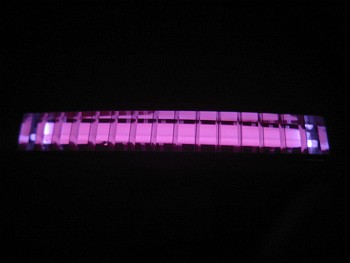
Around the edges of the room are fluorescents, dimly adding some near-IR that is red or very near red. Notice that the ends of the fluorescent tubes are purple: this is further into the IR, and what you're seeing is the thermal glow of the little filaments that heat up and emit electrons. When I need near-IR indoors, I use old-fashioned tungsten: a single 60W incandescent bulb will outlight a room of fluorescents.
I presumed on this post that I was seeing an intense sodium line from high-pressure sodium lighting while taking daytime near-IR images. What I didn't realize while speculating at that point was that every high-intensity discharge light has a very hot envelope--for high-pressure sodium, a bulb of aluminum oxide (all jokes about transparent aluminum aside, of course). For metal halide and mercury vapor it's usually fused quartz, but sometimes it's the above alumina or sapphire. The tough requirements of dealing with a circa 3500K corrosive plasma dictate the choice of material. Have you ever seen a cycling HPS streetlight? As soon as the arc extinguishes you can see the pure blackbody glow of the very hot bulb window which is at or just below 1200K. That's what I'm detecting in the infrared shots--any HID light that is on is a great IR source. See this shot of the Chicago Theological Union / Oriental Institute or this one on the central quad of the University of Chicago -- the metal halide lights are on in the early evening with sunlight still streaming in. (Don't get me started on energy decisions here). Or here.
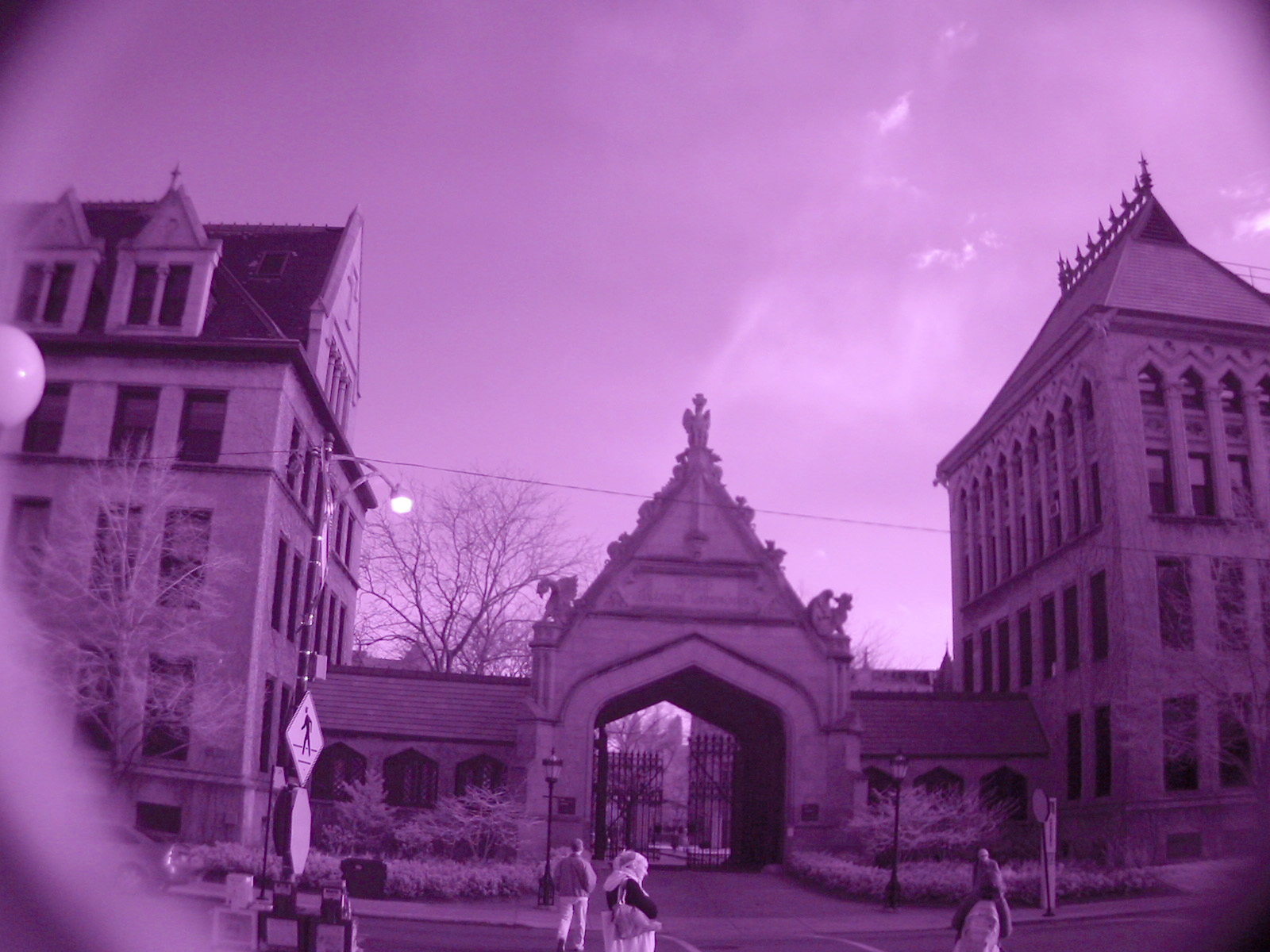
Or this HPS streetlight here at Hull Gate.
Compare that with fluorescents: they on the other hand are very poor in near-IR light, as expected from an efficiency standpoint--visible light is what you want in an efficient system. (The HID lights are highly efficient despite emitting copious near-IR light because the arc is incredibly bright and efficient in the visible. But you can't get such efficiencies in a low wattage bulb).
You can see fluorescents glowing a bit in this test focus shot of the first floor of the Reg:

Around the edges of the room are fluorescents, dimly adding some near-IR that is red or very near red. Notice that the ends of the fluorescent tubes are purple: this is further into the IR, and what you're seeing is the thermal glow of the little filaments that heat up and emit electrons. When I need near-IR indoors, I use old-fashioned tungsten: a single 60W incandescent bulb will outlight a room of fluorescents.
Friday, February 08, 2008
Maroon article on campus lights
New lights dim club's stargazing
Claims that these lights are shielded and only hit the first 25 feet of the facade are false. Here's a few images:

Do these lights only hit the first floor? No. View from the six-story roof.
The inverse view, lighting up the turret.
Blinding glare around the corner of Ryerson
Coverage of "shielded" light extends to nearly the zenith.
This light directly hits the dome and is much brighter in person.
Additional images at http://www.lib.uchicago.edu/~dean/lights/
The new lights have created extensive light pollution in the local sky, a phenomenon that occurs when light scatters off air molecules. As a result, distant stars and galaxies disappear in the uniform glow of the overlit sky. Dean Armstrong, a longtime RAS member and University staff member, recalls a time when the stars were more easily visible from Ryerson.
“We used to show galaxies as part of a standard observation,” he said. “We don’t do it anymore. Either people can’t see them, or they’re just unimpressive.”
Located immediately below the Ryerson telescope, the new lights have brought the hurt home. A new light installed last week shines directly on the dome topping the telescope, and many others shine directly into the sky surrounding it.
Claims that these lights are shielded and only hit the first 25 feet of the facade are false. Here's a few images:

Do these lights only hit the first floor? No. View from the six-story roof.

The inverse view, lighting up the turret.
Blinding glare around the corner of Ryerson

Coverage of "shielded" light extends to nearly the zenith.

This light directly hits the dome and is much brighter in person.

Additional images at http://www.lib.uchicago.edu/~dean/lights/
Wednesday, January 16, 2008
New star in a box
I received my latest box of goodies from Jameco, and in it was a particular weakness of mine.

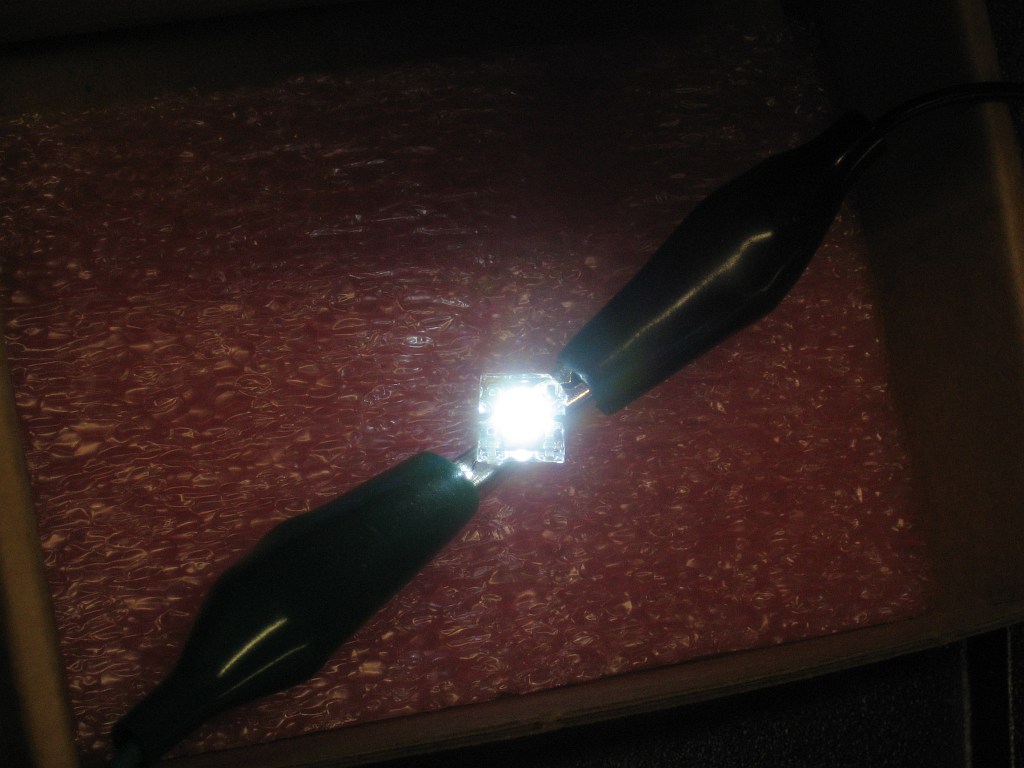
I'm a sucker for the latest and greatest LEDs. This particular white LED is named "Piranha" by the manufacturer. In the picture I am running it at half-brightness.

Slightly underexposed to highlight the brightness

I'm a sucker for the latest and greatest LEDs. This particular white LED is named "Piranha" by the manufacturer. In the picture I am running it at half-brightness.
Slightly underexposed to highlight the brightness
Friday, January 11, 2008
Compact Fluorescents
Compact fluorescent lighting is a hot topic in the media right now. Repeated utility and environmental group campaigns have encouraged people to switch to them, and the Energy Independence and Security Act of 2007 will phase out the sale of incandescents in 2012. Economically speaking, there are real incentives for consumers to switch to them. But... people who have done so often come right back to incandescents. Why is that?
1. Quantity of light. CF manufacturers are blatantly over-reporting the luminosity of the CFs. This will probably not be resolved until a lawsuit occurs over the false advertising. To get an equivalent amount of light I always recommend getting the CFL that is a step-up: so if you are replacing a 60W incandescent, buy a "75W" CF. You'll be much happier, and don't fret the increase in energy use, since you are still using less energy than before (60W vs 20W for a "75W" CF), it's still a win.
2. Quality of light. This is the most legitimate complaint, and most of it stems from failure of manufacturers to label the color temperature of their bulbs. For most consumer applications, getting the color to match tungsten (2700K) is critical for acceptance. Some of the cheaper CFs have poor color rendition: they are too pink or too green and it turns off people. This is the fault of using the wrong phosphor blends. Take a gander at this quote from yesterday's NYTimes article on CFs:
Get the right color for your application. I use GE 6500K daylight bulbs during the day to completely match outside light--you would be hard pressed to figure out if the light from the other room was from a window or the bulb. I also have some old tube "full-spectrum" fluorescents to wake up to in the morning in my bedroom. Again, these have fantastic matching color rendition to daylight.
For nighttime, it's best to limit your exposure to blue light, as it disrupts the production of melatonin and hence your sleepiness. I switch to tungsten matching lights at night as much as possible. For matching incandescents, both the n:vision soft white and GE series match the color. The n:vision lights instantaneously, whereas the the GE takes too long to light (and has other objections below).
3. Noise. A false objection is the claim that compact fluorescents buzz like old magnetic ballast fluorescent tubes. This is just wrong--CFs haven't used magnetic ballasts for a long time. Electronic ballasts, as used in CFs, can make noise if components in them aren't physically attached as well as they can be, and if certain cheaper circuits are used. The fundamental switching frequencies are ultrasonic, so you can't hear the old buzz that magnetics do. But with the design issues mentioned you can have a variety of whines and higher frequency buzzes.
4. Time to light
Many CF bulbs take a delay to light. This is annoying and a common complaint for many brands of bulbs. I've found that GE's Soft White 20W(75W) has a 1/2 second light time that drives me insane.
In addition, every CF I've ever owned takes time to warm to full brightness. I don't mind a short delay. I've had no problem with the the warm-up time, but in hotels I've seen lights that have taken literally minutes to light up to full brightness.
5. Short lifetimes
A lot of people have reported the CFs aren't lasting as long as claimed. I can believe this, especially if they bought by price. The compact fluorescents also are very intolerant of cycling--don't use them in closets and places you don't need the lights on for hours at a time. The lights are also sensitive to overheating--so don't stick them in unventilated fixtures, or recessed ceiling cans, or in general any upside-down fixture.
Now for long life. In 1991 or so I bought a very early CF. It was underpowered--I think it's a 7W. I used it for a few years and then went to college. It's still sitting in my old room at my parent's place, and I use it whenever I visit. Granted, this means it doesn't have many hours on it, but that CF bulb is older than many people I know.
My own specific recommendations are to get N:Vision soft white CFs for general use. I can say they are as close to an incandescent as I've seen in CFs.
I built an awesome "halogen torchiere killer" that I'll describe in another post.
In the living room, for example, where there are four recessed lights along one wall, Mr. Chipman tested six dimmable bulbs and determined that one made by Greenlite with the same hue as incandescents worked best in certain spots, attractively lighting an exposed brick wall and maple bookshelves. A Satco brand bulb with a slightly whiter hue made a limestone-tiled fireplace in the middle of the wall look best, so he installed one above it. Mr. Chipman’s wife, Liz Diamond, 53, a theater director who considers herself even more particular about aesthetics than her husband, said investing time in trying multiple bulbs made a big difference. “There was one bulb that made the limestone look really freaky, ugly and moldy,” she said, but the Satco bulb now in place makes the space look “fabulous.” “I was amazed at how much variation there was, but you can really get a color that you like,” she said. Mr. Chipman agreed. “You really have to experiment with different bulbs to find the ones that work for you,” he said. “But they exist.”
Get the right color for your application. I use GE 6500K daylight bulbs during the day to completely match outside light--you would be hard pressed to figure out if the light from the other room was from a window or the bulb. I also have some old tube "full-spectrum" fluorescents to wake up to in the morning in my bedroom. Again, these have fantastic matching color rendition to daylight.
For nighttime, it's best to limit your exposure to blue light, as it disrupts the production of melatonin and hence your sleepiness. I switch to tungsten matching lights at night as much as possible. For matching incandescents, both the n:vision soft white and GE series match the color. The n:vision lights instantaneously, whereas the the GE takes too long to light (and has other objections below).
Many CF bulbs take a delay to light. This is annoying and a common complaint for many brands of bulbs. I've found that GE's Soft White 20W(75W) has a 1/2 second light time that drives me insane.
In addition, every CF I've ever owned takes time to warm to full brightness. I don't mind a short delay. I've had no problem with the the warm-up time, but in hotels I've seen lights that have taken literally minutes to light up to full brightness.
A lot of people have reported the CFs aren't lasting as long as claimed. I can believe this, especially if they bought by price. The compact fluorescents also are very intolerant of cycling--don't use them in closets and places you don't need the lights on for hours at a time. The lights are also sensitive to overheating--so don't stick them in unventilated fixtures, or recessed ceiling cans, or in general any upside-down fixture.
Now for long life. In 1991 or so I bought a very early CF. It was underpowered--I think it's a 7W. I used it for a few years and then went to college. It's still sitting in my old room at my parent's place, and I use it whenever I visit. Granted, this means it doesn't have many hours on it, but that CF bulb is older than many people I know.
My own specific recommendations are to get N:Vision soft white CFs for general use. I can say they are as close to an incandescent as I've seen in CFs.
I built an awesome "halogen torchiere killer" that I'll describe in another post.
Thursday, January 10, 2008
Will the Green House at MSI be green at night?
Via Chicagoist comes news of a green house exhibit at the Museum of Science and Industry for springtime. I have to ask a serious question: if after all the work creating this low-energy house, will they light up the outside poorly (by poorly I mean by lighting it to excess and waste to the sky) to advertise it and destroy the night environment? Here at the U of C, we've squandered any savings during the Battle of the Bulbs and such by increasing the nighttime lighting by 1000% (this number is accurate) in the last year.
Thursday, August 16, 2007
New Yorker article on light pollution
Here's a reason to go out and buy the August 20th issue of the New Yorker: An article on light pollution!

I sincerely hope you've seen the Milky Way lately. I fear for you if you've never ever seen it.
I can count the few times I've been awed in my life on my fingers -- and several of those were seeing the Milky Way in a dark sky.
Planetary Society Blog article #1
Planetary Society Blog article #2


I sincerely hope you've seen the Milky Way lately. I fear for you if you've never ever seen it.
I can count the few times I've been awed in my life on my fingers -- and several of those were seeing the Milky Way in a dark sky.
Planetary Society Blog article #1
Planetary Society Blog article #2
Wednesday, July 25, 2007
Astronomy communities

The media has globbed onto the existence of planned astronomical communities where bad lighting design is not allowed by rules and housing covenants. These are new places, places only needed in the recent past, because of the horrendous growth of light pollution. Continued light pollution increases of 5-10% per year mean the end of the visibility of the stars in just a few decades. Already 2/3rds of Americans haven't seen the Milky Way. By 2025 there will simply be no more dark sky in the United States. Simply no place. Current arguments about "why don't you move your scopes to a dark place" are ignorant by this measure and besides, are the people who created the light pollution paying for relocation? Destruction of useful observatories like Mt. Wilson and the current degradation of Palomar by misinformed politicians who'd rather be concerned about aesthetics than efficiency and science:
(Mayor Dick Murphy) said he also supports the change for aesthetic reasons: "People think they're ugly."
Astronomers also are concerned about a plan before the council to replace some hooded streetlights with decorative acorn-shaped lamps in various historic districts. The acorn lamps allow most of their light to shine upward, to the sky.
"They are blantantly inefficient," said Paul B. Etzel, director of the nearby Mount Laguna Observatory. "It's a 19th century solution to a 21st century problem."
Critics also point to higher costs. Getting rid of the low-sodium lights would cost nearly $2.8 million and raise the city's power bill by a half-million dollars a year, according to a city report.
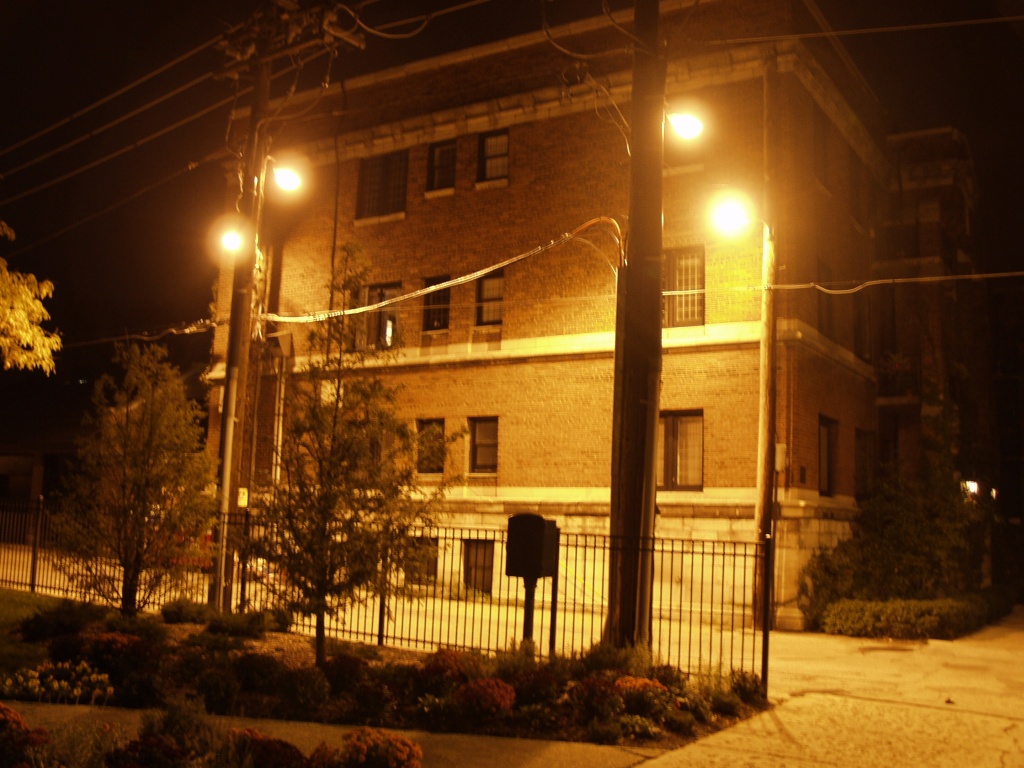
This alley has 4 250W lights plus a 150W streetlight within a thirty foot radius. A resident of this building can't get the city to remove or shield any of the lights.
Which constellation lost will make people realize the sky is gone? Orion? The asterism of the Big Dipper? Already seeing the Pleiades is tough in Chicago, and the faintest star of the Big Dipper is getting difficult to see.
I've seen it first hand in a place that doesn't need anymore light, yet we in Chicago increase the energy use in lighting by leaps and bounds whenever the mayor needs re-election or a University president feels to rule by fiat. I can only hope people will eventually realize spending tens of thousands of dollars for just the light that goes up into the sky (yes, really) is not smart for a campus nor the millions of dollars per year for a city like Chicago. The nation as a whole wastes--not uses, but wastes--$5 billion a year or more in outdoor lighting that doesn't hit its target.

Would you want to live with this light outside your bedroom, giving you breast cancer?
People think that brighter lighting decrease crime--but it doesn't, period, and in fact, I was shocked to discover someone actually checked: Brighter alley lights in Chicago increased crime in the alleys by 21% percent: Each of the three crime categories experienced an increase in the number of
reported incidents between the pre and post- installation period. Violent Index offenses
increased 14 percent (119 to 136), property Index offenses increased 20 percent (30 to
36) and non-Index offenses increased 24 percent (279 to 347). All this, using 160W more per fixture (there's 175,000 of them in the city), adding 28 Megawatts to the "Greenest" city.
Wednesday, June 20, 2007
Animation and images of ISS and Shuttle pass in Chicago
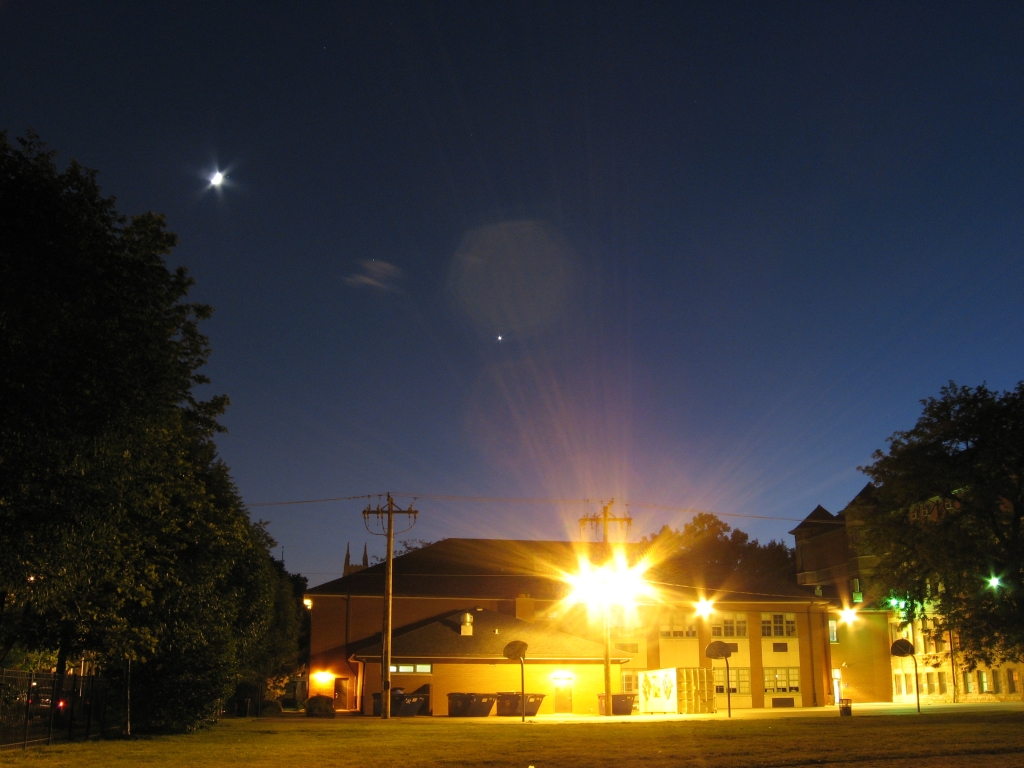
A fine night in Chicago, the Moon near Regulus, with Saturn halfway between the Moon and Venus.
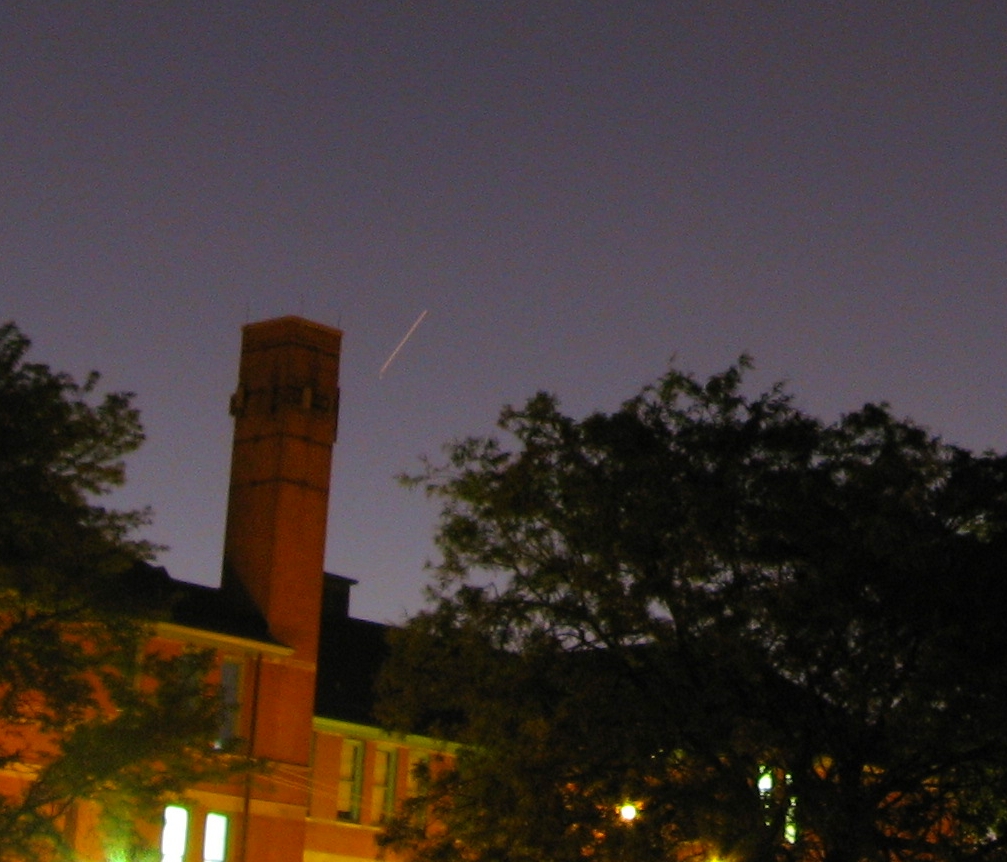
Space Shuttle Atlantis and the International Space Station passed Chicago last night. Rising in the NW, the newly brightened ISS shone orange against the Chicago light pollution, its solar panels dominating the light. In binoculars the Shuttle was visible trailing by half a degree. As they got higher, the Shuttle became visible to the naked eye and the ISS changed color into a pure white.
Check out this awesome animation of the pass:
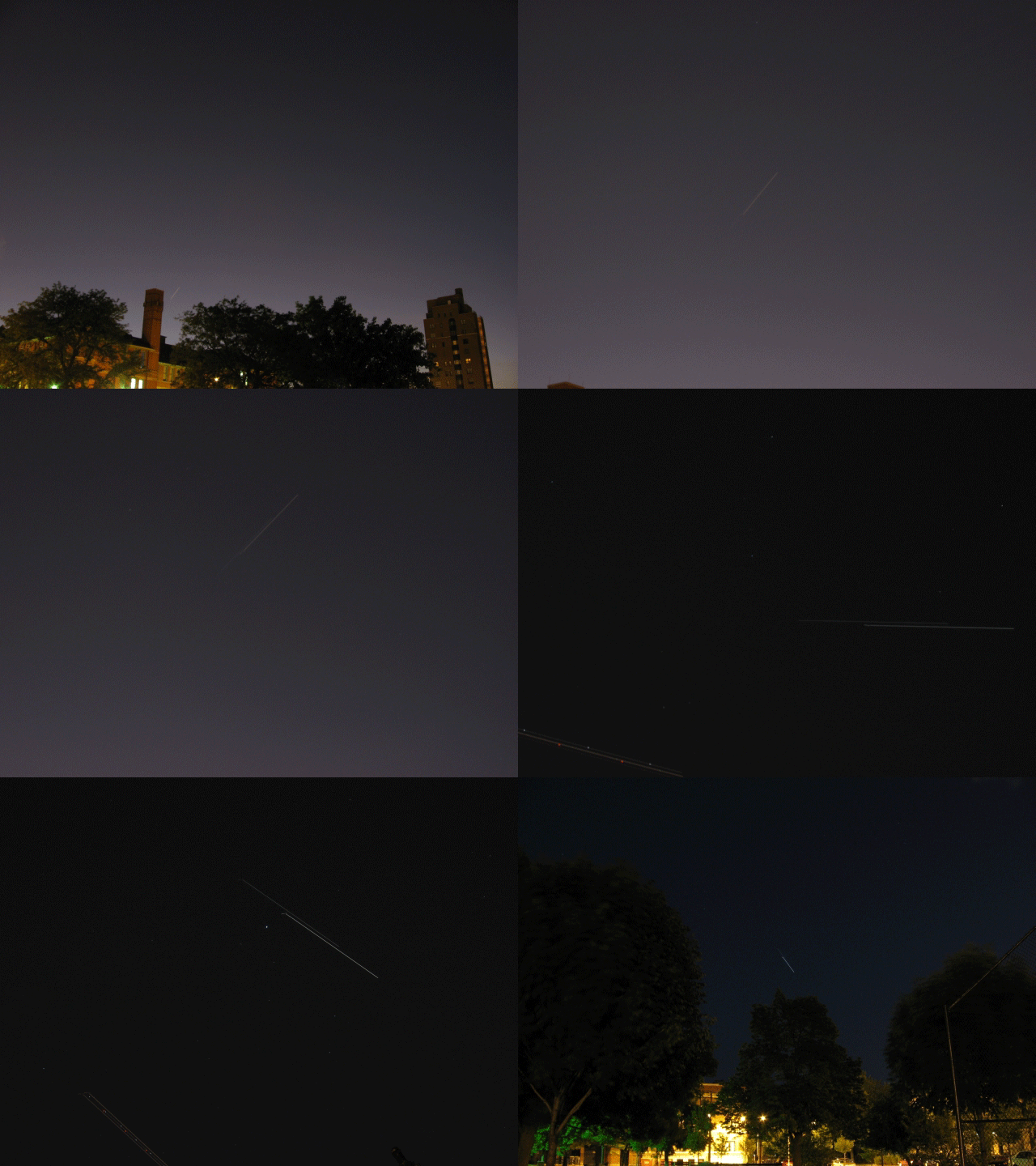
A single image of that animation is here, with an additional airplane trail.

See them tonight as well.
Friday, May 04, 2007
Monday, April 30, 2007
Mercury in compact fluorescents
Ah drat. A slashdot article appeared about some poor lady in Maine broke a compact fluorescent lamp and freaked out about the small amount of mercury in it. A questionable journalist wrote an article about the freakout.
I had a draft article about the issue: Compact fluorescents contain mercury. How does this amount compare to the amount of mercury released by using a standard incandescent lamp? So enjoy my sketchy calculations below.
Lamp Amount (mg.)
Pre 1988 T-12:~45
Post 1988 T-12: ~11.6
Typical T8: ~4 to 5
Low Mercury T8: ~3
CFL: ~4 to 5
Type Mercury content mg/unit*
Fluorescent lamp: 10
Straight fluorescent with diffusion barrier coating: 6
Compact fluorescent lamp: 4 - 23 W: 5
26 - 55 W: 10
Source: http://www.helcom.fi/Recommendations/en_GB/rec23_4/
26 watt CF: 8 hours a day, per year uses 75.92 kWh. At roughly 10 cents/kwh (new IL prices), $7.59 a year.
100 watt incandescent 8 hours a day, per year: 292 kWh. $29.20.
every 1000kWh produces 619lbs CO2 for ComEd power, which was 27% coal. (12 months prior to march 2004) Excelon environmental release
(Although recently it's been very highly nuclear, up to 92% in fall 2006).
2/3 of mercury in coal escapes to air http://www.epa.gov/mercury/control_emissions/index.htm
0.17ppm average Hg content in US Coal http://igs.indiana.edu/Geology/coalOilGas/mercuryInCoal/index.cfm
Indiana coal varied from 0.31ppm to 0.02ppm
# The thermal energy content of coal is 6,150 kWh/ton. Even though coal-fired power generators are very efficient, only about 40% of the thermal energy in coal converts to electricity. So the electricity generated per ton of coal is (0.4 ton)(6,150 kWh) = 2,460 kWh/ton.
(ISA: Maximize energy buck with efficient bang)
For our 100W incandescent, it burns 292kWh per year, of which 27% is coal, which means 64lbs (29kg) of coal is burned in IL. 0.17ppm of that is 4.93mg Hg, which 66% escapes: 3.29mg Hg.
Our compact fluorescent will produce 26% of that much mercury, or 0.86mg Hg. At 8000 hours lifetime, that's roughly just short of three years of 8hrs/day. So we'd release 2.37mg of Hg for the lifetime of the bulb, while the incandescent would release 9mg over that same time period. Add the existing 4 to 5mg per CFL, and the CF still is releasing less mercury into the environment.
This calculation gets worse and worse the more coal your power is made from. Illinois has the highest production of nuclear power of any state, so using compact fluorescents reduce the release of mercury into the environment, if you ignore renewables like hydroelectric. The nation as a whole uses 50% coal as its power source.
I had a draft article about the issue: Compact fluorescents contain mercury. How does this amount compare to the amount of mercury released by using a standard incandescent lamp? So enjoy my sketchy calculations below.
Lamp Amount (mg.)
Pre 1988 T-12:~45
Post 1988 T-12: ~11.6
Typical T8: ~4 to 5
Low Mercury T8: ~3
CFL: ~4 to 5
Type Mercury content mg/unit*
Fluorescent lamp: 10
Straight fluorescent with diffusion barrier coating: 6
Compact fluorescent lamp: 4 - 23 W: 5
26 - 55 W: 10
Source: http://www.helcom.fi/Recommendations/en_GB/rec23_4/
26 watt CF: 8 hours a day, per year uses 75.92 kWh. At roughly 10 cents/kwh (new IL prices), $7.59 a year.
100 watt incandescent 8 hours a day, per year: 292 kWh. $29.20.
every 1000kWh produces 619lbs CO2 for ComEd power, which was 27% coal. (12 months prior to march 2004) Excelon environmental release
(Although recently it's been very highly nuclear, up to 92% in fall 2006).
2/3 of mercury in coal escapes to air http://www.epa.gov/mercury/control_emissions/index.htm
0.17ppm average Hg content in US Coal http://igs.indiana.edu/Geology/coalOilGas/mercuryInCoal/index.cfm
Indiana coal varied from 0.31ppm to 0.02ppm
# The thermal energy content of coal is 6,150 kWh/ton. Even though coal-fired power generators are very efficient, only about 40% of the thermal energy in coal converts to electricity. So the electricity generated per ton of coal is (0.4 ton)(6,150 kWh) = 2,460 kWh/ton.
(ISA: Maximize energy buck with efficient bang)
For our 100W incandescent, it burns 292kWh per year, of which 27% is coal, which means 64lbs (29kg) of coal is burned in IL. 0.17ppm of that is 4.93mg Hg, which 66% escapes: 3.29mg Hg.
Our compact fluorescent will produce 26% of that much mercury, or 0.86mg Hg. At 8000 hours lifetime, that's roughly just short of three years of 8hrs/day. So we'd release 2.37mg of Hg for the lifetime of the bulb, while the incandescent would release 9mg over that same time period. Add the existing 4 to 5mg per CFL, and the CF still is releasing less mercury into the environment.
This calculation gets worse and worse the more coal your power is made from. Illinois has the highest production of nuclear power of any state, so using compact fluorescents reduce the release of mercury into the environment, if you ignore renewables like hydroelectric. The nation as a whole uses 50% coal as its power source.
Subscribe to:
Posts (Atom)