Source: http://www.informationisbeautiful.net/2010/planes-or-volcano/
Showing posts with label global warming. Show all posts
Sunday, April 18, 2010
Eyjafjallajökull eruption: planes vs. volcano
An interesting data point about the Eyjafjallajökull eruption: the disruption of the European aviation market reduces the CO2 output by an order of magnitude more than the CO2 released by the volcano itself,

Source: http://www.informationisbeautiful.net/2010/planes-or-volcano/
Wednesday, July 25, 2007
Astronomy communities
The media has globbed onto the existence of planned astronomical communities where bad lighting design is not allowed by rules and housing covenants. These are new places, places only needed in the recent past, because of the horrendous growth of light pollution. Continued light pollution increases of 5-10% per year mean the end of the visibility of the stars in just a few decades. Already 2/3rds of Americans haven't seen the Milky Way. By 2025 there will simply be no more dark sky in the United States. Simply no place. Current arguments about "why don't you move your scopes to a dark place" are ignorant by this measure and besides, are the people who created the light pollution paying for relocation? Destruction of useful observatories like Mt. Wilson and the current degradation of Palomar by misinformed politicians who'd rather be concerned about aesthetics than efficiency and science:
(Mayor Dick Murphy) said he also supports the change for aesthetic reasons: "People think they're ugly."
Astronomers also are concerned about a plan before the council to replace some hooded streetlights with decorative acorn-shaped lamps in various historic districts. The acorn lamps allow most of their light to shine upward, to the sky.
"They are blantantly inefficient," said Paul B. Etzel, director of the nearby Mount Laguna Observatory. "It's a 19th century solution to a 21st century problem."
Critics also point to higher costs. Getting rid of the low-sodium lights would cost nearly $2.8 million and raise the city's power bill by a half-million dollars a year, according to a city report.
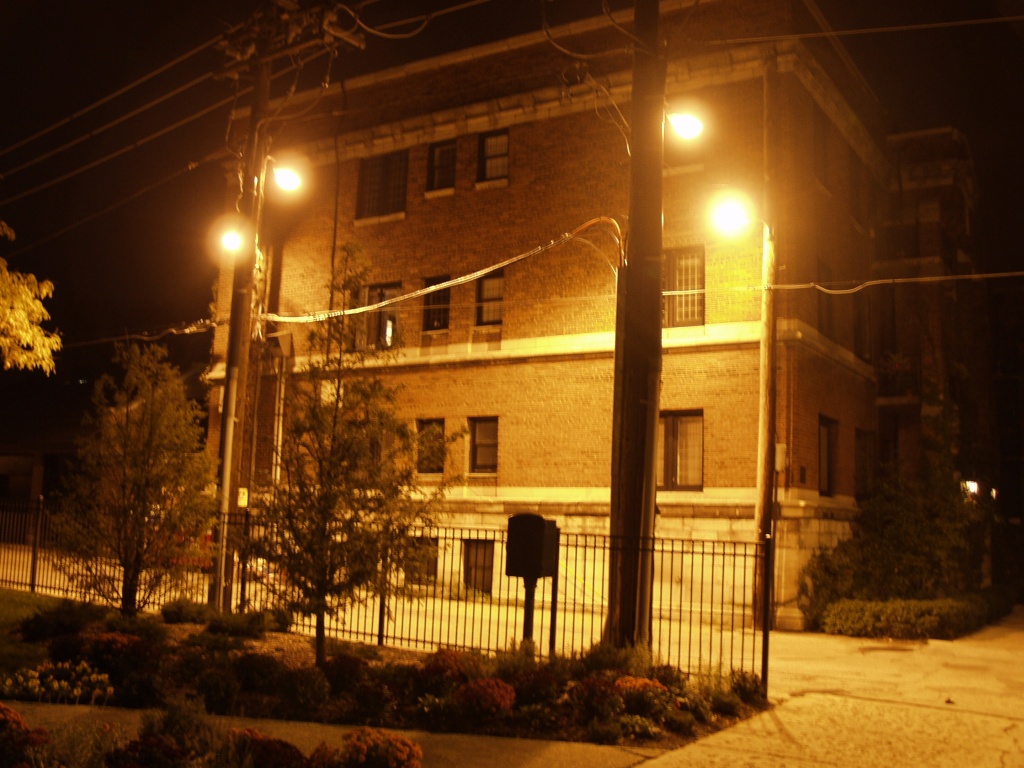
This alley has 4 250W lights plus a 150W streetlight within a thirty foot radius. A resident of this building can't get the city to remove or shield any of the lights.
Which constellation lost will make people realize the sky is gone? Orion? The asterism of the Big Dipper? Already seeing the Pleiades is tough in Chicago, and the faintest star of the Big Dipper is getting difficult to see.
I've seen it first hand in a place that doesn't need anymore light, yet we in Chicago increase the energy use in lighting by leaps and bounds whenever the mayor needs re-election or a University president feels to rule by fiat. I can only hope people will eventually realize spending tens of thousands of dollars for just the light that goes up into the sky (yes, really) is not smart for a campus nor the millions of dollars per year for a city like Chicago. The nation as a whole wastes--not uses, but wastes--$5 billion a year or more in outdoor lighting that doesn't hit its target.
Would you want to live with this light outside your bedroom, giving you breast cancer?
People think that brighter lighting decrease crime--but it doesn't, period, and in fact, I was shocked to discover someone actually checked: Brighter alley lights in Chicago increased crime in the alleys by 21% percent: Each of the three crime categories experienced an increase in the number of
reported incidents between the pre and post- installation period. Violent Index offenses
increased 14 percent (119 to 136), property Index offenses increased 20 percent (30 to
36) and non-Index offenses increased 24 percent (279 to 347). All this, using 160W more per fixture (there's 175,000 of them in the city), adding 28 Megawatts to the "Greenest" city.
Tuesday, April 24, 2007
Biodiesel vs. petroleum: greenhouse gas emissions and N2O
A press release recently reported research that claims biodiesel will cause more greenhouse gas effect than using petroleum oil. The gist is that agriculture with industrial fertilizers release some N2O unintentionally as part of nitrogen fertilization, and that nitrous oxide has a much stronger effect on global warming because it has a long lifetime in the atmosphere. The UN defines a "Global Warming Potential" for each greenhouse gas. Lifetime in the atmosphere is the primary factor (perhaps the only factor?), so nonreactive gases like CFCs, which live nearly forever, have incredible numbers (50000) for their "effect". CO2, though, is just defined as 1, even though it has a variable lifetime in the atmosphere of 5-200 years (page 38). I don't know if the spectral absorption of each gas was taken into effect for these--I see no information that it is. N2O lives for about 120 years in the atmosphere, a fairly nonreactive gas, and it is this multiplication factor, (296x), that drives the conclusion about how biodiesel via rapeseed is worse than petroleum in greenhouse gas emissions.
I would have liked to read the actual paper via my institutional subscription, but it's not available yet online or in paper.
The linked press release is actually from a tropical conservation group, and interestingly they happened to add a graph with yields of biodiesel per acre, showing rapeseed as middle of the pack in terms of yield. What would happen to the analysis with other crops? What if we didn't use so much nitrogen fertilizer or didn't exclusively produce rapeseed? (You can nitrogenate with legumes to avoid using some fertilizer). Was the absorption of CO2 from the atmosphere into the plant matter taken into consideration during the analysis? Questions I have, answers I can't find.
You might know rapeseed by another name: a special variety breed called canola (CANadian Oil Low Acid), which has much lower amounts of a naturally occurring toxic acid in it.
I would have liked to read the actual paper via my institutional subscription, but it's not available yet online or in paper.
The linked press release is actually from a tropical conservation group, and interestingly they happened to add a graph with yields of biodiesel per acre, showing rapeseed as middle of the pack in terms of yield. What would happen to the analysis with other crops? What if we didn't use so much nitrogen fertilizer or didn't exclusively produce rapeseed? (You can nitrogenate with legumes to avoid using some fertilizer). Was the absorption of CO2 from the atmosphere into the plant matter taken into consideration during the analysis? Questions I have, answers I can't find.
You might know rapeseed by another name: a special variety breed called canola (CANadian Oil Low Acid), which has much lower amounts of a naturally occurring toxic acid in it.
Subscribe to:
Posts (Atom)