
Showing posts with label LED. Show all posts
Showing posts with label LED. Show all posts
Saturday, July 24, 2021
Compact Fluorescent Lifetime report #4
As previously mentioned, I've tried to keep track of CFL bulbs I used and how long they have lasted. Some have outlived some of the newer LED lights I now buy, which is related to the reduction of manufacturing cost by the makers of them. My early LEDs are still running from 2011, including the famous L-prize bulb won by Philips, in a torchiere conversion I did a long time ago and still use.
This bulb was used for a several hours each day from 2008-2011, pretty much not used for two years, then was used for a short time daily and at most an hour or two weekly from 2013-2021 in the laundry room in a horizontal position. So, it probably lasted about 5000 hours. The bulb warranty was set as "guaranteed for 5 years at 4 hours each day" and labeled as 8000hrs.


Tuesday, November 20, 2018
CFL lifetime report #3
As seen previously, a series of CFLs I used starting around 2008 onwards failed at varying lifetimes. I report a third failure, of a Nvision 14W installed in June of 2011. It failed in May of 2018. That's just about 7 years of roughly 3-4 hrs of use daily. The lifetime estimate ranges around 8000 hours for that one.
Wednesday, January 16, 2008
New star in a box
I received my latest box of goodies from Jameco, and in it was a particular weakness of mine.

I'm a sucker for the latest and greatest LEDs. This particular white LED is named "Piranha" by the manufacturer. In the picture I am running it at half-brightness.

Slightly underexposed to highlight the brightness

I'm a sucker for the latest and greatest LEDs. This particular white LED is named "Piranha" by the manufacturer. In the picture I am running it at half-brightness.
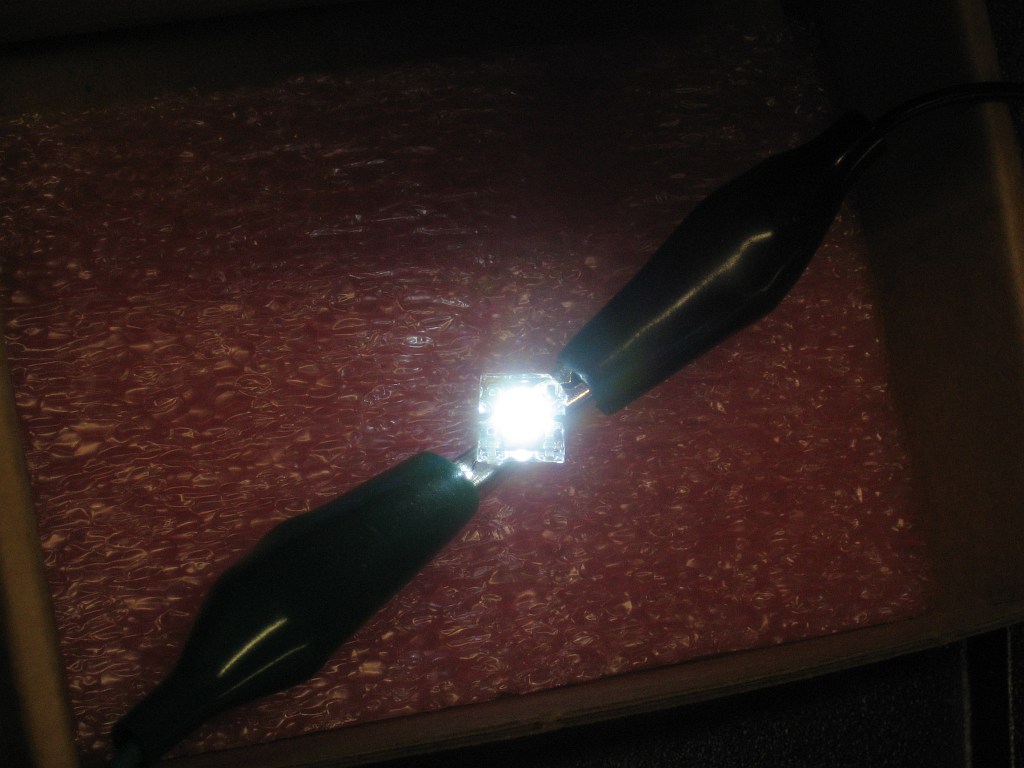
Slightly underexposed to highlight the brightness
Friday, February 17, 2006
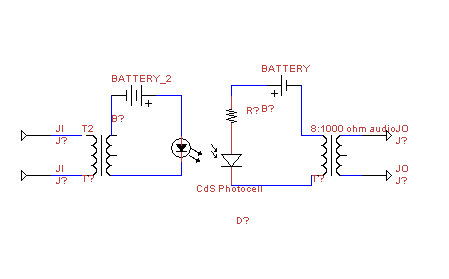
Transmitting audio over light (laser or LED)
Want to send your audio information via a light wave across the room? I built this simple circuit with some modifications that transmits an audio signal via light. The signal simply amplitude modulates the light intensity (aka AM) of a LED and a receiving cadmium sulfide photocell changes its resistance as the intensity varies. Both sides have 8 to 1000 ohm audio transformers, although on my circuit I ended up using the transformer on the receiving side as a voltage booster. I also added a battery and resistor to the photocell receiving side.
Be careful--I used an LED because I destroyed a cheap laser pointer when trying the first circuit. The problem with it is the sound card audio is approximately 1 Volt AC at max, and this gets converted to ~12.5V on the other side (although I found output was usually around .5 V on the sound card and ~4 to 5V on the other side of the transformer). At least that's what I measured--I've seen people read 4V on sound cards, but I don't know which is correct.
I ended up using a white LED since it was my brightest LED, but I also have a superbright red LED that seems to work even better.


This is a 343KB video of the circuit in action. I block the beam and the sound volume dips.
I hate using the future tense on the web, so I'll say I promise to post a circuit diagram soon... --- and here it is! (keep in mind it's a CdS photocell, not a photodiode. I couldn't find the symbol in TinyCAD).
Forrest Mims wrote the book on this sort of thing, and there is a better circuit in Getting Started in Electronics, simply the best starter book for people interested in electronics and how things work.
Be careful--I used an LED because I destroyed a cheap laser pointer when trying the first circuit. The problem with it is the sound card audio is approximately 1 Volt AC at max, and this gets converted to ~12.5V on the other side (although I found output was usually around .5 V on the sound card and ~4 to 5V on the other side of the transformer). At least that's what I measured--I've seen people read 4V on sound cards, but I don't know which is correct.
I ended up using a white LED since it was my brightest LED, but I also have a superbright red LED that seems to work even better.
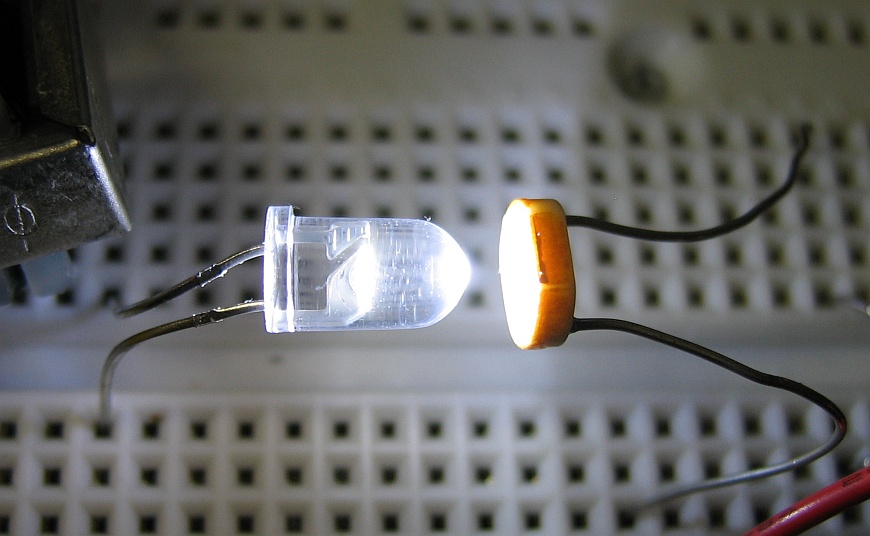
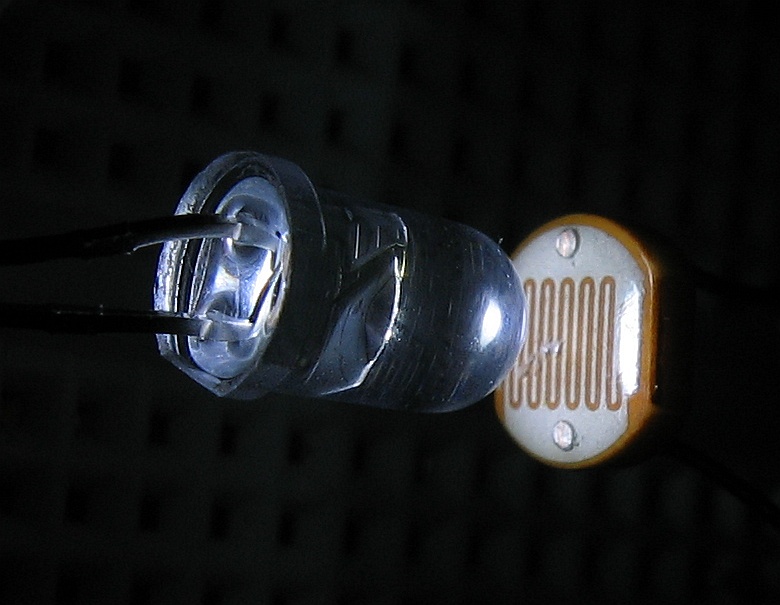
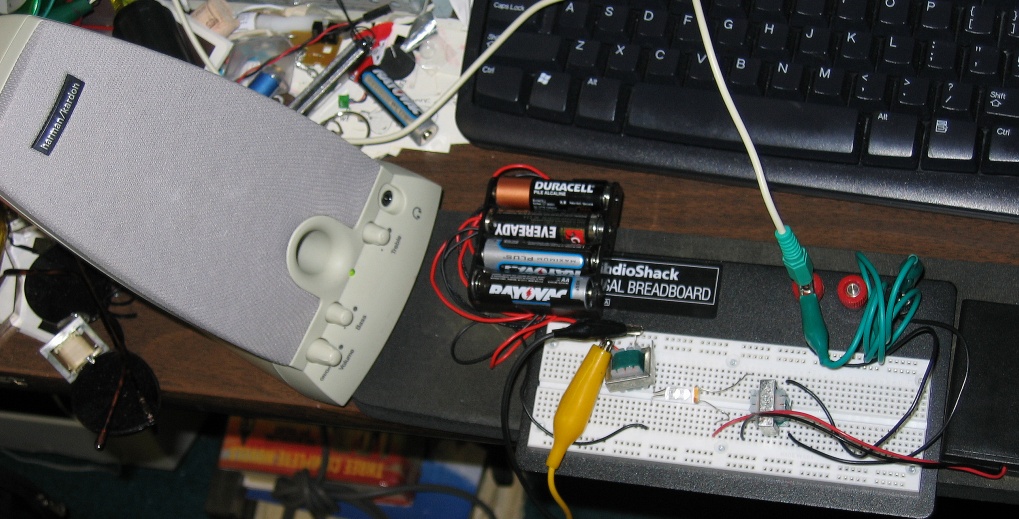
This is a 343KB video of the circuit in action. I block the beam and the sound volume dips.
I hate using the future tense on the web, so I'll say I promise to post a circuit diagram soon... --- and here it is! (keep in mind it's a CdS photocell, not a photodiode. I couldn't find the symbol in TinyCAD).
Forrest Mims wrote the book on this sort of thing, and there is a better circuit in Getting Started in Electronics, simply the best starter book for people interested in electronics and how things work.
Subscribe to:
Posts (Atom)