
Showing posts with label infrared. Show all posts
Showing posts with label infrared. Show all posts
Friday, May 21, 2010
Eyjafjallajökull eruption: webcam at midnight
It's midnight in Iceland and nearly midsummer with a volcano erupting, what do you do? Hang out in front of the thermal camera.


Thursday, December 24, 2009
Halogen resistance
If you are curious, the resistance of a 300W type J halogen bulb, the ones you would find in those halogen torchiere lamps, is 3.3 ohms when cold. When it's hot it is 48 ohms, but that's a calculation only based on the wattage.

A warm halogen bulb in the near infrared
Since converting such a torchiere to CFL (but not in this project), I had an extra halogen bulb and debated throwing it out, but I figured they might make a decent power resistor. I used it in a project converting a PC ATX power supply to a benchtop 12V source. It works--but the hassle of cleaning the contacts for soldering, soldering, and placing such a large object in the case was enough to decide buying a power resistor in the first place is probably easier.
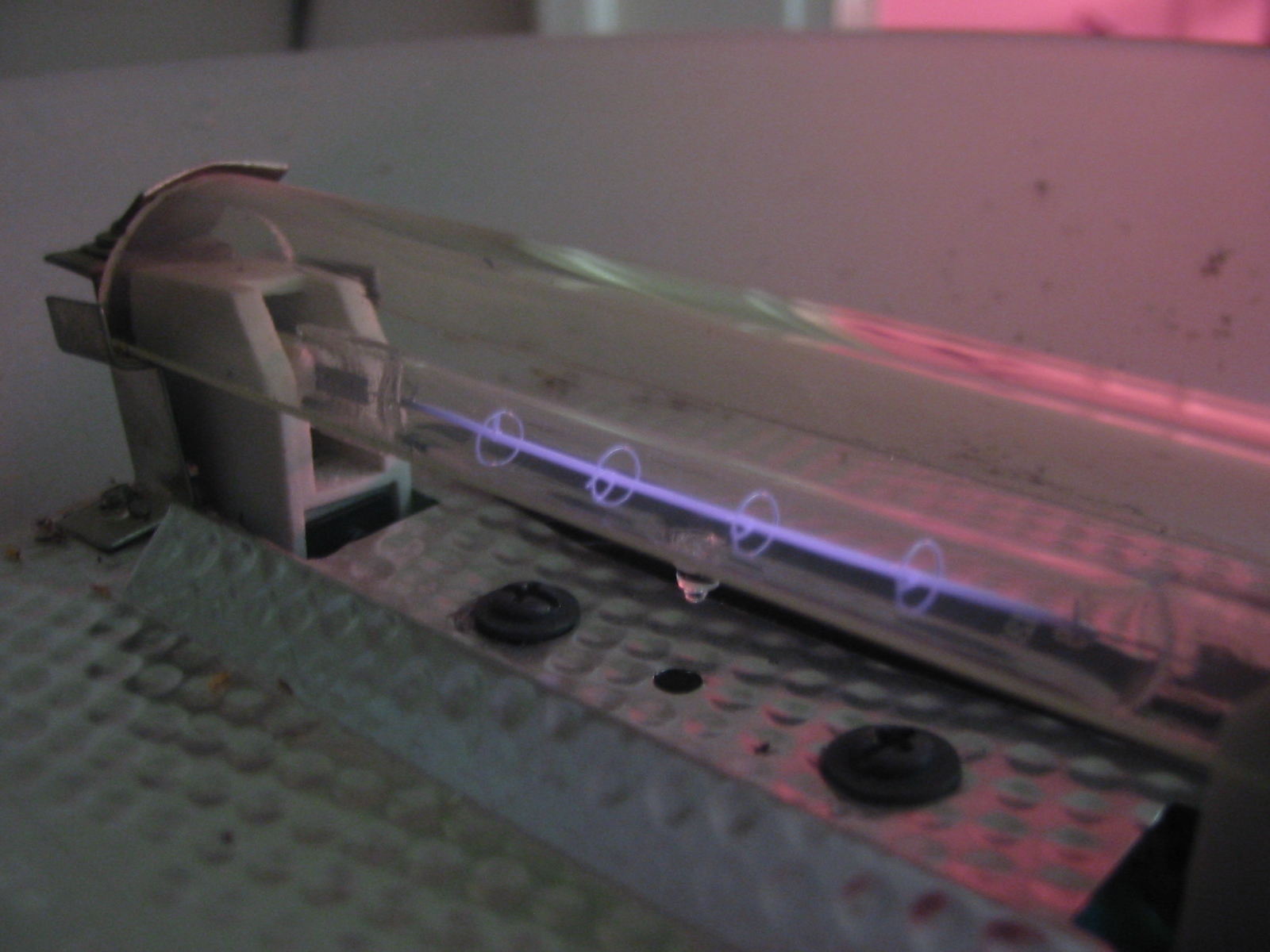
A warm halogen bulb in the near infrared
Since converting such a torchiere to CFL (but not in this project), I had an extra halogen bulb and debated throwing it out, but I figured they might make a decent power resistor. I used it in a project converting a PC ATX power supply to a benchtop 12V source. It works--but the hassle of cleaning the contacts for soldering, soldering, and placing such a large object in the case was enough to decide buying a power resistor in the first place is probably easier.
Friday, October 02, 2009
near-IR Yerkes Observatory
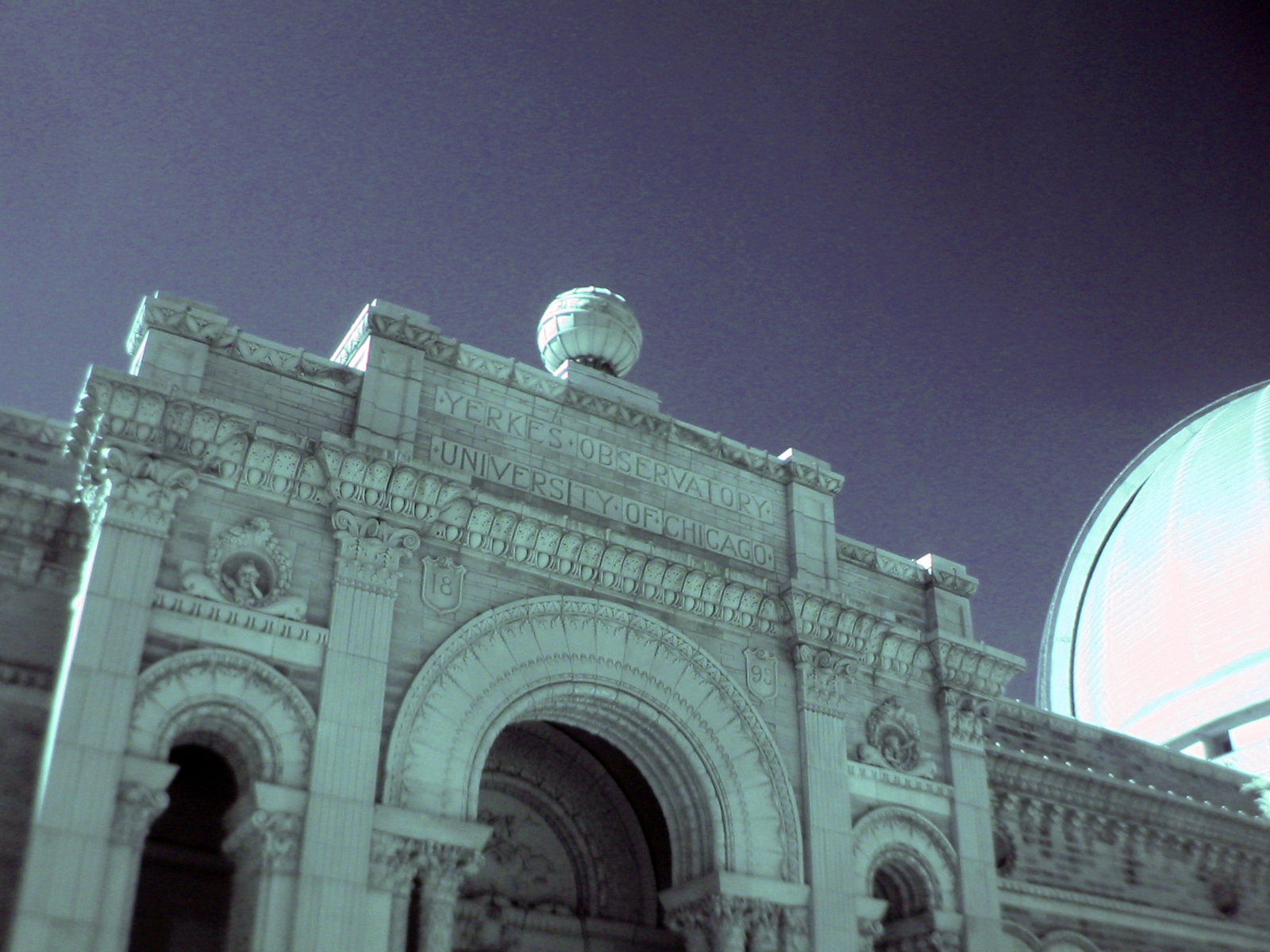
Click to enlarge. Image taken on April 22th, 2007 with Canon S300. Hue/Autolevels modified.
Friday, July 10, 2009
Friday, February 20, 2009
IR focus test: Regenstein Bartlett Quad
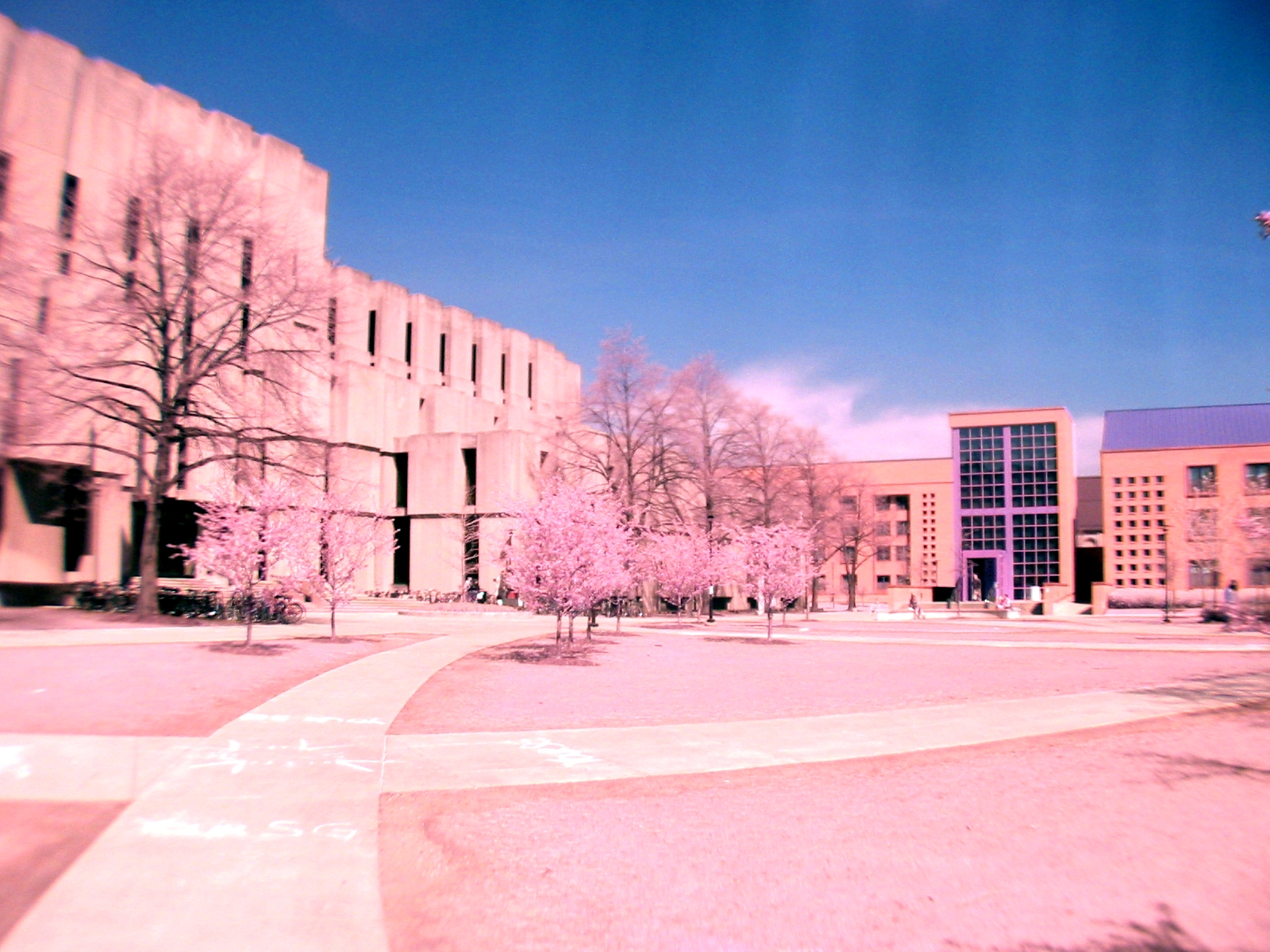
Combo visible / near IR image with a Canon S300.
I can't remember if I posted this in the past or not.
Monday, February 16, 2009
Thursday, April 03, 2008
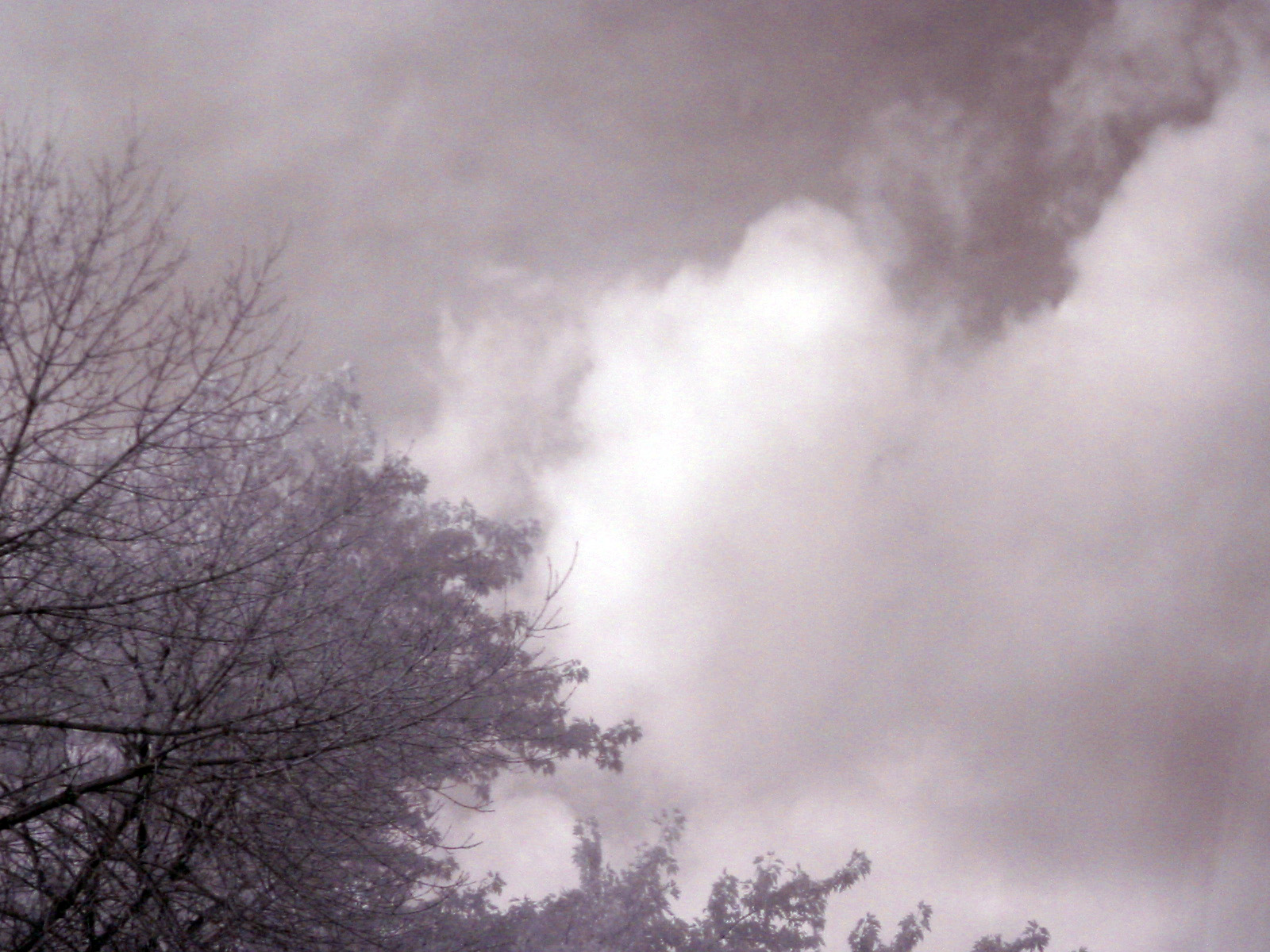
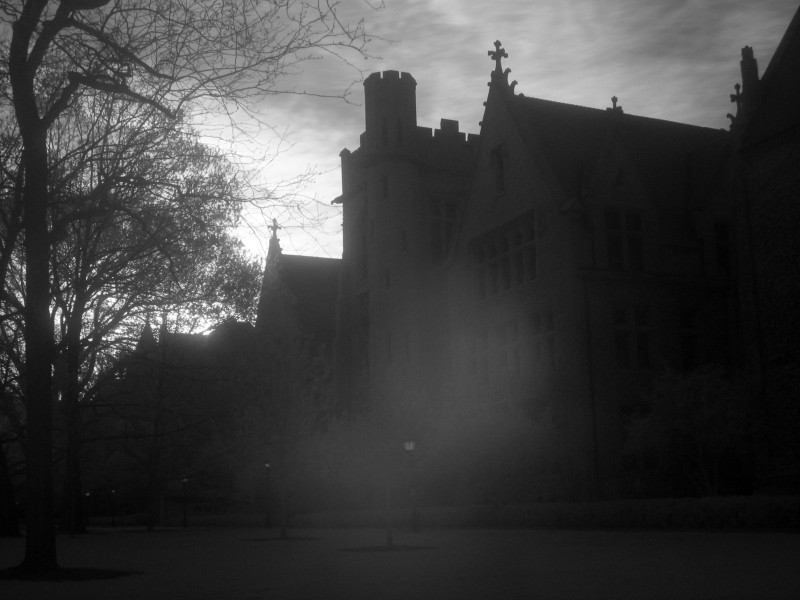
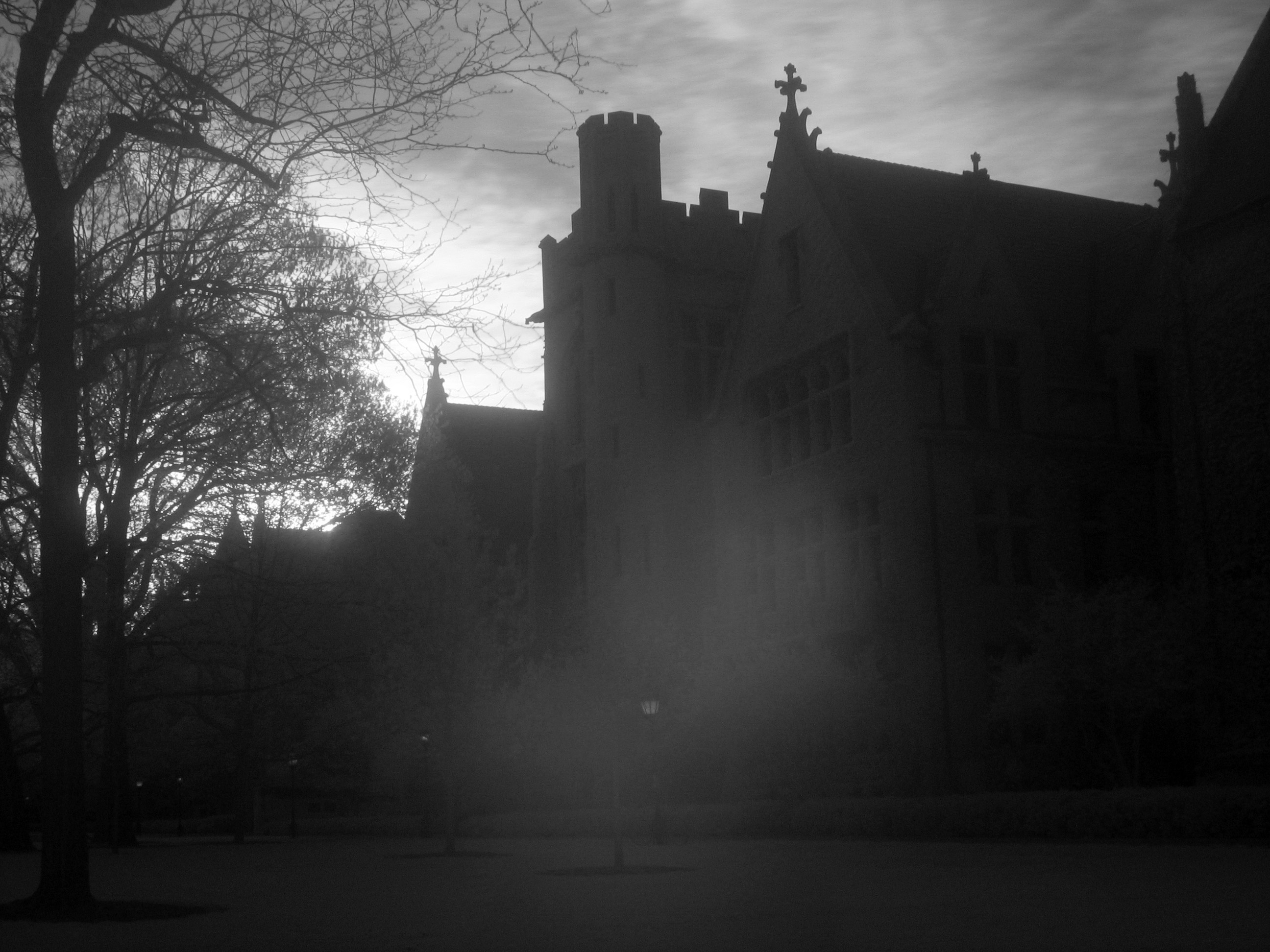
Ryerson Physical Laboratory: "Ghostly"
I originally passed over this image while taking a bunch of near infrared photos on campus. The underexposure from looking into the partially overcast sun killed all the shadow detail and the flare was a distraction; essentially I was looking at the image in the context of the shoot that day, which was finding scenes that exemplified some IR photographic ideal.
Back to the present day where I am reading up on William Henry Fox Talbot, one of the inventors of photography. His early images of Lacock Abbey are ghostly and fuzzy as he made his negatives on coated paper and made contact prints with the same process that made the positives even more dreamy and indistinct.
This makes this previous rejected image more desirable.

Taken on May 4th, 2005 with a Canon A95 and several layers of fully exposed color negative film as an IR filter. 10 second exposure.
Original size here.
Back to the present day where I am reading up on William Henry Fox Talbot, one of the inventors of photography. His early images of Lacock Abbey are ghostly and fuzzy as he made his negatives on coated paper and made contact prints with the same process that made the positives even more dreamy and indistinct.
This makes this previous rejected image more desirable.
Taken on May 4th, 2005 with a Canon A95 and several layers of fully exposed color negative film as an IR filter. 10 second exposure.
Original size here.
Saturday, March 29, 2008
near infrared lights
When I need good near-infrared lighting, I turn to the broadband sources called the Sun and incandescents. They are the closest thing to a blackbody we see on a regular basis.

I presumed on this post that I was seeing an intense sodium line from high-pressure sodium lighting while taking daytime near-IR images. What I didn't realize while speculating at that point was that every high-intensity discharge light has a very hot envelope--for high-pressure sodium, a bulb of aluminum oxide (all jokes about transparent aluminum aside, of course). For metal halide and mercury vapor it's usually fused quartz, but sometimes it's the above alumina or sapphire. The tough requirements of dealing with a circa 3500K corrosive plasma dictate the choice of material. Have you ever seen a cycling HPS streetlight? As soon as the arc extinguishes you can see the pure blackbody glow of the very hot bulb window which is at or just below 1200K. That's what I'm detecting in the infrared shots--any HID light that is on is a great IR source. See this shot of the Chicago Theological Union / Oriental Institute or this one on the central quad of the University of Chicago -- the metal halide lights are on in the early evening with sunlight still streaming in. (Don't get me started on energy decisions here). Or here.

Or this HPS streetlight here at Hull Gate.
Compare that with fluorescents: they on the other hand are very poor in near-IR light, as expected from an efficiency standpoint--visible light is what you want in an efficient system. (The HID lights are highly efficient despite emitting copious near-IR light because the arc is incredibly bright and efficient in the visible. But you can't get such efficiencies in a low wattage bulb).
You can see fluorescents glowing a bit in this test focus shot of the first floor of the Reg:

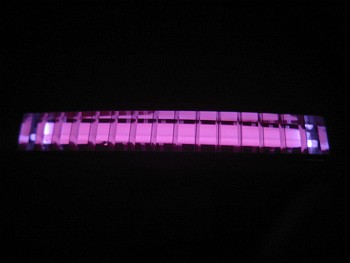
Around the edges of the room are fluorescents, dimly adding some near-IR that is red or very near red. Notice that the ends of the fluorescent tubes are purple: this is further into the IR, and what you're seeing is the thermal glow of the little filaments that heat up and emit electrons. When I need near-IR indoors, I use old-fashioned tungsten: a single 60W incandescent bulb will outlight a room of fluorescents.
I presumed on this post that I was seeing an intense sodium line from high-pressure sodium lighting while taking daytime near-IR images. What I didn't realize while speculating at that point was that every high-intensity discharge light has a very hot envelope--for high-pressure sodium, a bulb of aluminum oxide (all jokes about transparent aluminum aside, of course). For metal halide and mercury vapor it's usually fused quartz, but sometimes it's the above alumina or sapphire. The tough requirements of dealing with a circa 3500K corrosive plasma dictate the choice of material. Have you ever seen a cycling HPS streetlight? As soon as the arc extinguishes you can see the pure blackbody glow of the very hot bulb window which is at or just below 1200K. That's what I'm detecting in the infrared shots--any HID light that is on is a great IR source. See this shot of the Chicago Theological Union / Oriental Institute or this one on the central quad of the University of Chicago -- the metal halide lights are on in the early evening with sunlight still streaming in. (Don't get me started on energy decisions here). Or here.
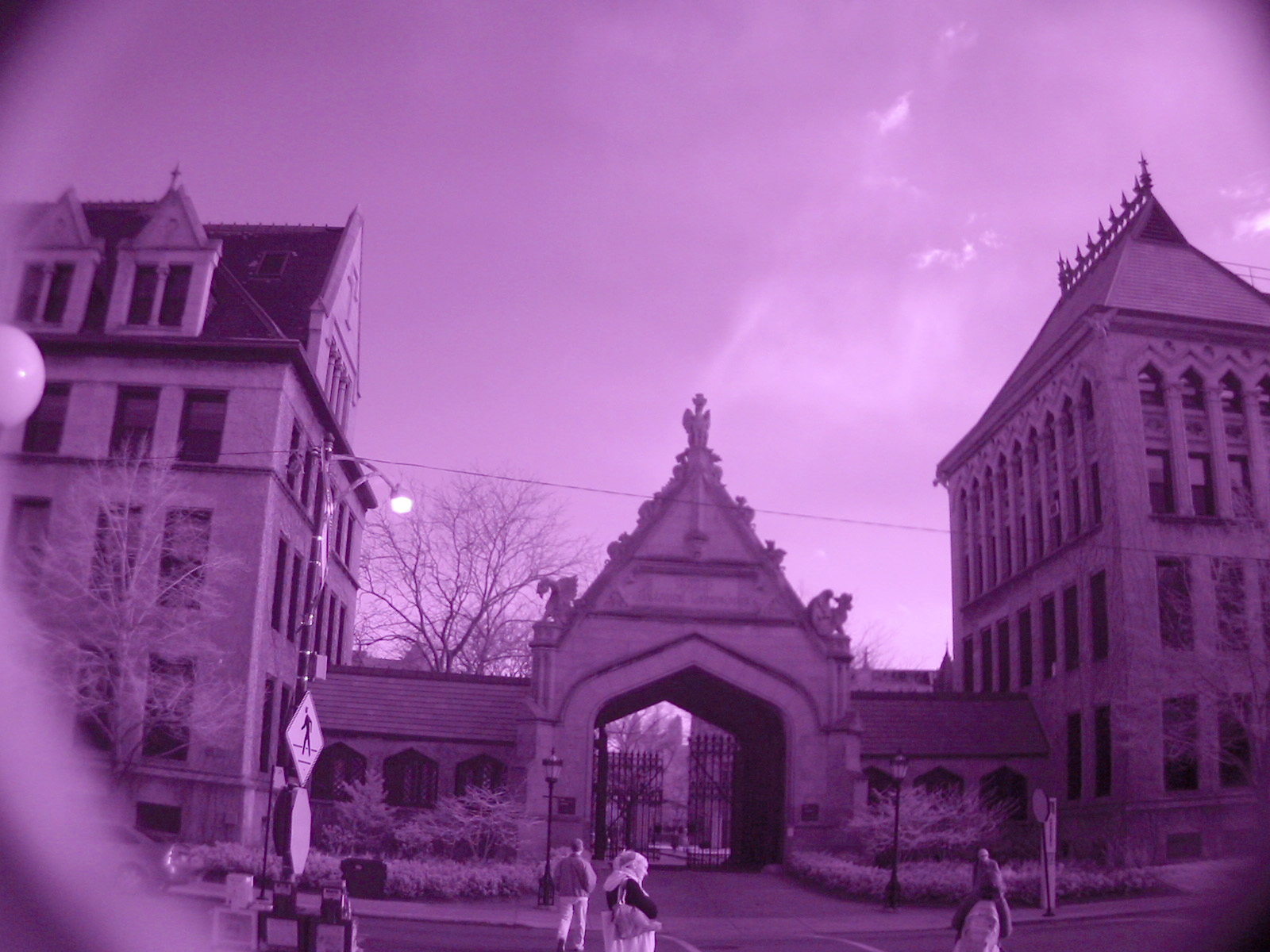
Or this HPS streetlight here at Hull Gate.
Compare that with fluorescents: they on the other hand are very poor in near-IR light, as expected from an efficiency standpoint--visible light is what you want in an efficient system. (The HID lights are highly efficient despite emitting copious near-IR light because the arc is incredibly bright and efficient in the visible. But you can't get such efficiencies in a low wattage bulb).
You can see fluorescents glowing a bit in this test focus shot of the first floor of the Reg:

Around the edges of the room are fluorescents, dimly adding some near-IR that is red or very near red. Notice that the ends of the fluorescent tubes are purple: this is further into the IR, and what you're seeing is the thermal glow of the little filaments that heat up and emit electrons. When I need near-IR indoors, I use old-fashioned tungsten: a single 60W incandescent bulb will outlight a room of fluorescents.
Thursday, March 13, 2008
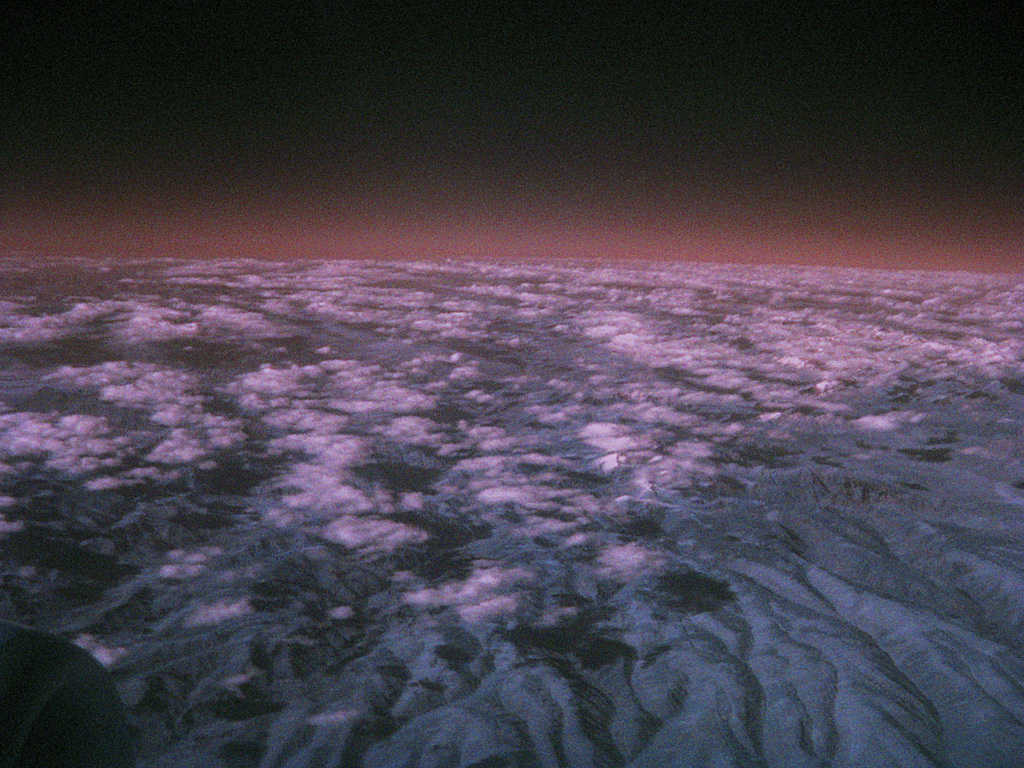
Flying over Colorado in the near infrared
Click to enlarge
Simply putting a double layer of fully-exposed color negative over a Canon A540 revealed it does have some decent near-IR leakage. Exposures were deliberately underexposed at 1/3 second to prevent image shake. I used some auto-leveling in Photoshop and faded it back a little.
You can see a number of interesting details in the image.
The first is the darkness of the sky above the horizon. Anyone from the old photography days with a red filter and black and white film is familiar with this effect. The blue sky is caused from Rayleigh scattering of photons by the molecules of air, and it's dependent on the inverse fourth power of the wavelength of light. So, blue photons of 450nm scatter 16 times more intensely than near-infrared light of 900nm. Right at the horizon the only scattering is visible in the red channel, which from previous posts we know is the nearest of the near-IR (i.e., just past 750nm). In the green there is no scattering---just a solid ball of earth with no haze. Like a planet with no atmosphere.
Expanding further on the RGB channels: the red is clearly a tail effect of the red filter--so we know the output is or around 700-750nm. It may have an additional output somewhere higher up if the coloring fades away in the IR. The blue should have a passband around 900nm, given that most bandpass filters will also pass double their wavelength (450nm being blue). Green would, if the doubling held, pass 1000nm, i.e. 1 micron, but at that point most CCDs made of silicon begin to really drop out and to get decent response you'd need an optically thick chip (as light absorption varies in depth in silicon in proportion to photon energy. See the Foveon chips for a practical use of this). And this seems to match the intensity of each channel: Red and Blue dominate, making a raw image very purple out of the camera. Green is always the weakest channel. It may either be passing generic IR from a weak filter or from the color negative filter.
I assume the clouds and the snow-covered peaks (right-center) reflect all wavelengths equally. Assuming that, the ground appears to reflect the lower-wavelength (i.e. deeper into the IR) IR better than the near-IR wavelengths.
The ground itself has some real variations in IR reflectivity, although it's difficult to see clearly: far-right center shows a redder response on a slope. I'd love to correlate some near-IR curves to some common mineral types. I do need to calibrate the wavelength response of the cameras. This isn't the image to do it with and I have some better ones with simultaneous visible light images.
P.S. The curvature of the horizon is just from the camera lens, not the real curvature of the earth.
Tuesday, November 20, 2007
infrared and visual split image
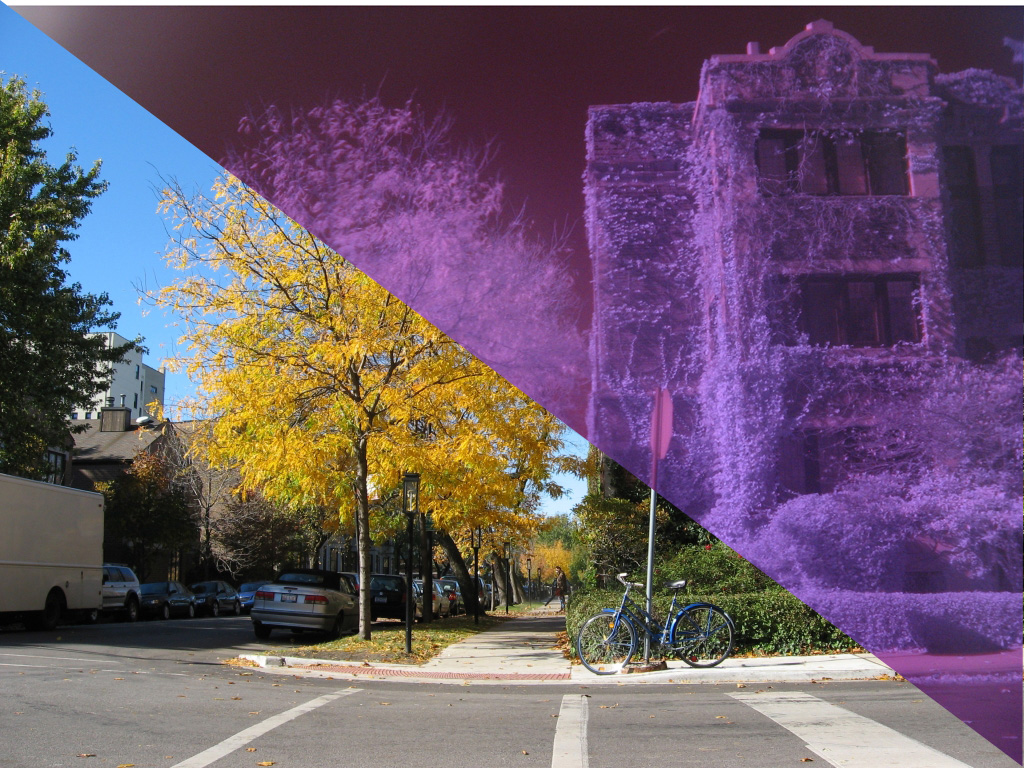
The Canon A540 does leak some near-infrared radiation through its IR blocking filter. I placed a two layer filter of exposed and developed color negative film in front of the camera for the infrared image.
1/2s at f/2.6 for the near-IR image.
1/400s at f/4.0 for the normal image.
That's about nine stops difference.
Link to the normal image
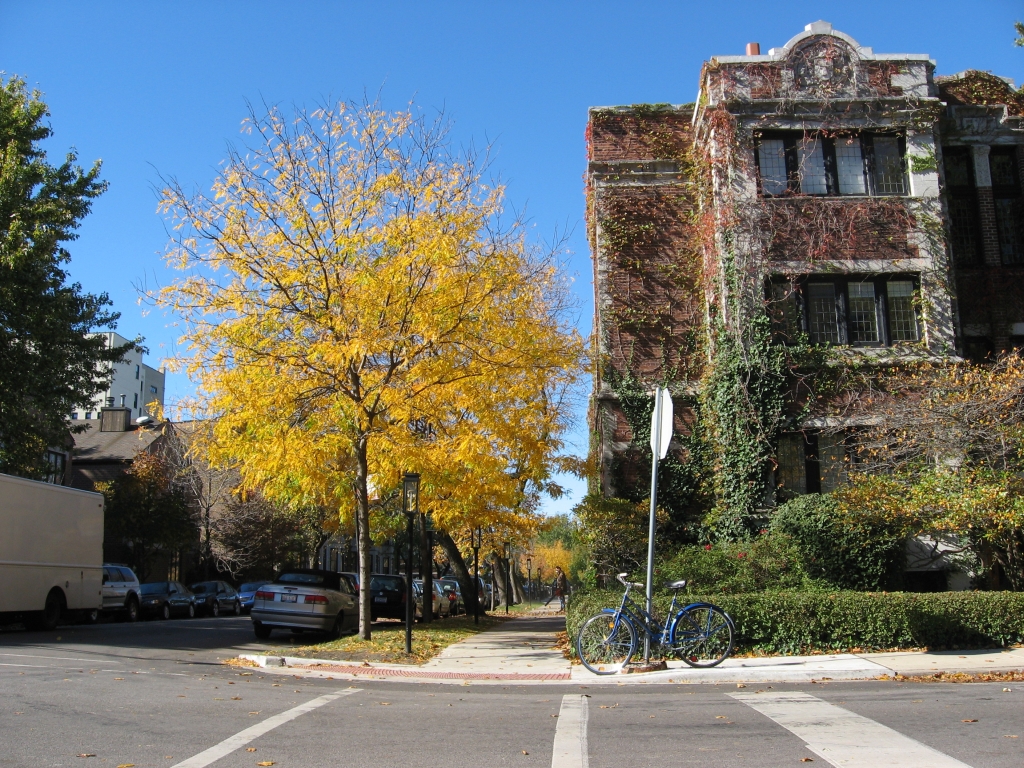
Link to the infrared image

P.S. Oh--here's a mouseover version.
Friday, August 03, 2007
Biometric veins in the near infrared
Another company claims to have created an unbeatable biometric authentication.
I have an image of my hand in the near-infrared, care to look?

heavy use of unsharp mask brings out the veins
I am sure it would only take an image like this and a master mold-maker to bypass such security.
Search this blog for posts containing "infrared".
I have an image of my hand in the near-infrared, care to look?
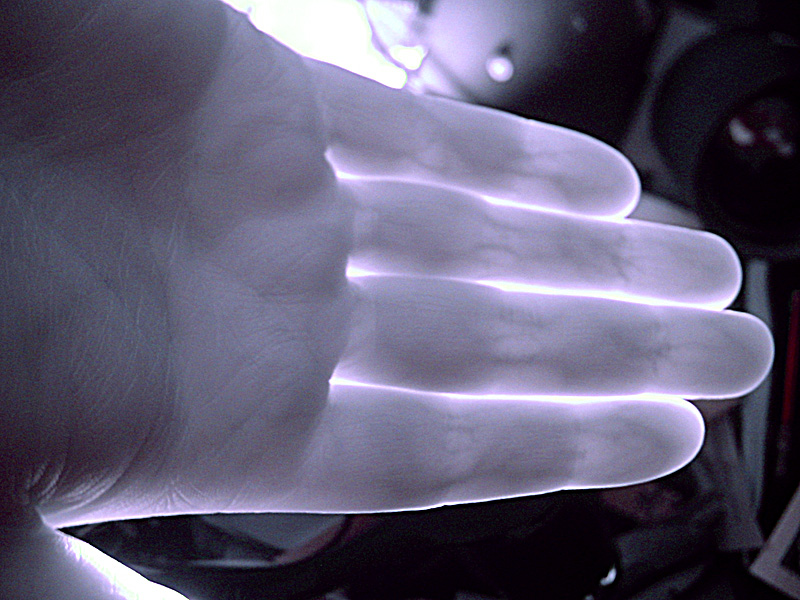
heavy use of unsharp mask brings out the veins
I am sure it would only take an image like this and a master mold-maker to bypass such security.
Search this blog for posts containing "infrared".
Wednesday, May 30, 2007
Martian caves
There are Martian Caves--large skylights into a world we nothing of.
The Planetary Society's Blog has the article.
The Mars Reconaissance Orbiter's HiRISE imager and the Mars Odyssey's THEMIS IR imager worked together to confirm these are caves--dark during the day, cooler than sunlit surfaces during the afternoon (but still warmer than surface shadows), warmer at night. These are huge skylights--over 300ft in size, and they overhang, meaning the cave is bigger than the skylight. The caves found are all big, partially because the THEMIS imager has a resolution limit of 100m, so they couldn't use it to refine candidate holes found in the visible HiRISE data. The diameters of the caves were from 100 to 252 meters.
One of the caves, on the northeast flank of Arsia Mons:

They were all found on the slopes of Arsia Mons, the southernmost Tharsis volcano. A global view here; it's the circular blob in 5 o'clock position from the center. These caves are likely the result of lava tubes, formed when lava cools on the surface and emptying out below.
On one of the seven skylights, they saw the floor lit; this allowed them to calculate the depth of the cave at 130 meters. The lit cave is shown below.

As Cushing, Titus, Wynne, and Christensen wrote in their conference paper, these caves offer sanctuary from all sorts of radiation, both UV and cosmic rays, that exist on the surface of Mars and would be the primary limiter of life at Mars. The caves' existence is enough to spring to life the imagines of the unseeable world inside of them; we will likely never know the wonders of what they contain in our lifetimes. It is unfortunate that they are currently only known on the slope of a Tharsis volcano--high in the thin Martian atmosphere, we are limited in our ability to land a spacecraft there easily.
Images courtesy NASA/JPL/University of Arizona
The Planetary Society's Blog has the article.
The Mars Reconaissance Orbiter's HiRISE imager and the Mars Odyssey's THEMIS IR imager worked together to confirm these are caves--dark during the day, cooler than sunlit surfaces during the afternoon (but still warmer than surface shadows), warmer at night. These are huge skylights--over 300ft in size, and they overhang, meaning the cave is bigger than the skylight. The caves found are all big, partially because the THEMIS imager has a resolution limit of 100m, so they couldn't use it to refine candidate holes found in the visible HiRISE data. The diameters of the caves were from 100 to 252 meters.
One of the caves, on the northeast flank of Arsia Mons:
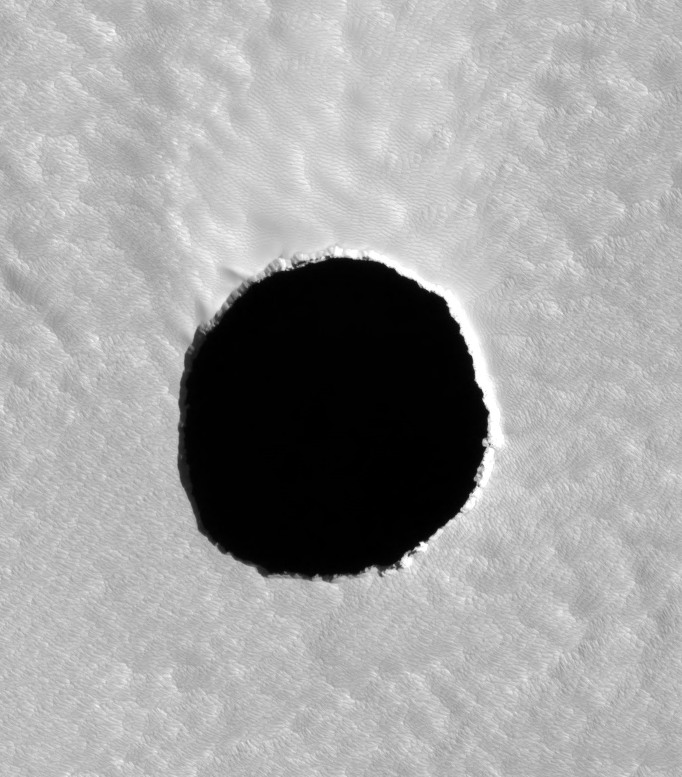
They were all found on the slopes of Arsia Mons, the southernmost Tharsis volcano. A global view here; it's the circular blob in 5 o'clock position from the center. These caves are likely the result of lava tubes, formed when lava cools on the surface and emptying out below.

On one of the seven skylights, they saw the floor lit; this allowed them to calculate the depth of the cave at 130 meters. The lit cave is shown below.
As Cushing, Titus, Wynne, and Christensen wrote in their conference paper, these caves offer sanctuary from all sorts of radiation, both UV and cosmic rays, that exist on the surface of Mars and would be the primary limiter of life at Mars. The caves' existence is enough to spring to life the imagines of the unseeable world inside of them; we will likely never know the wonders of what they contain in our lifetimes. It is unfortunate that they are currently only known on the slope of a Tharsis volcano--high in the thin Martian atmosphere, we are limited in our ability to land a spacecraft there easily.
Images courtesy NASA/JPL/University of Arizona
Wednesday, May 23, 2007
Happy 300th Birthday Linnaeus

Today marks the 300th anniversary of Carl Linnaeus aka Linné's birth.
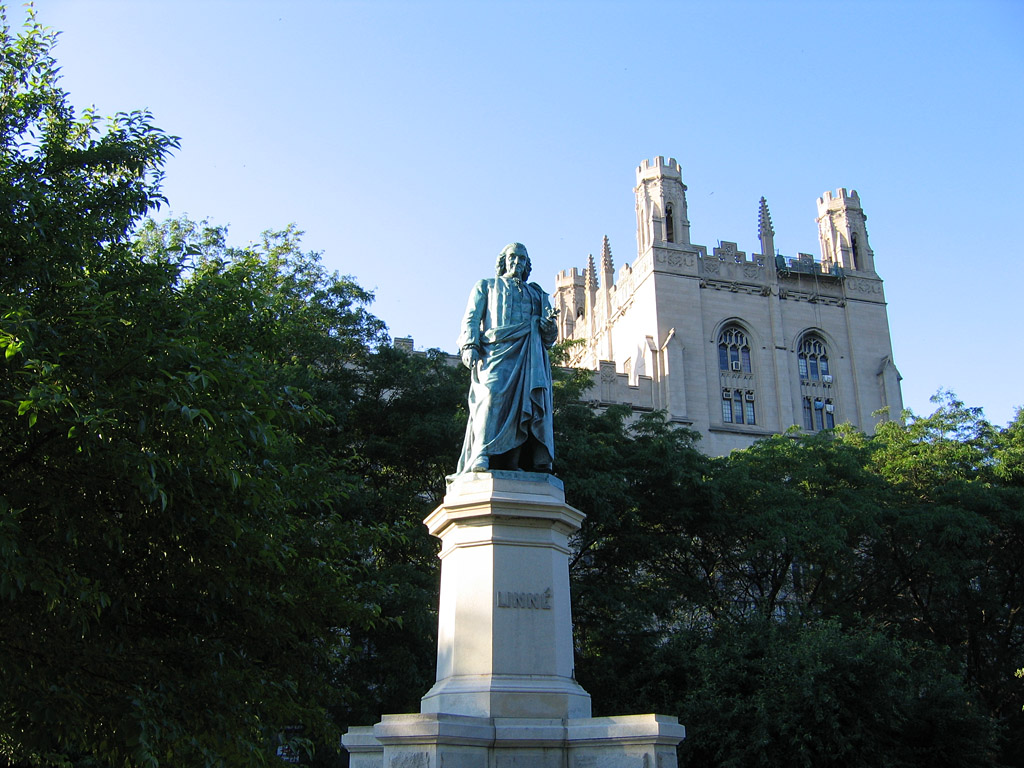
These two images are identical--open them up in two browser windows and switch between them to see the difference between near-IR and visible light.
A link to another infrared image of the Linné statue
Thursday, April 26, 2007
Yerkes Observatory trip
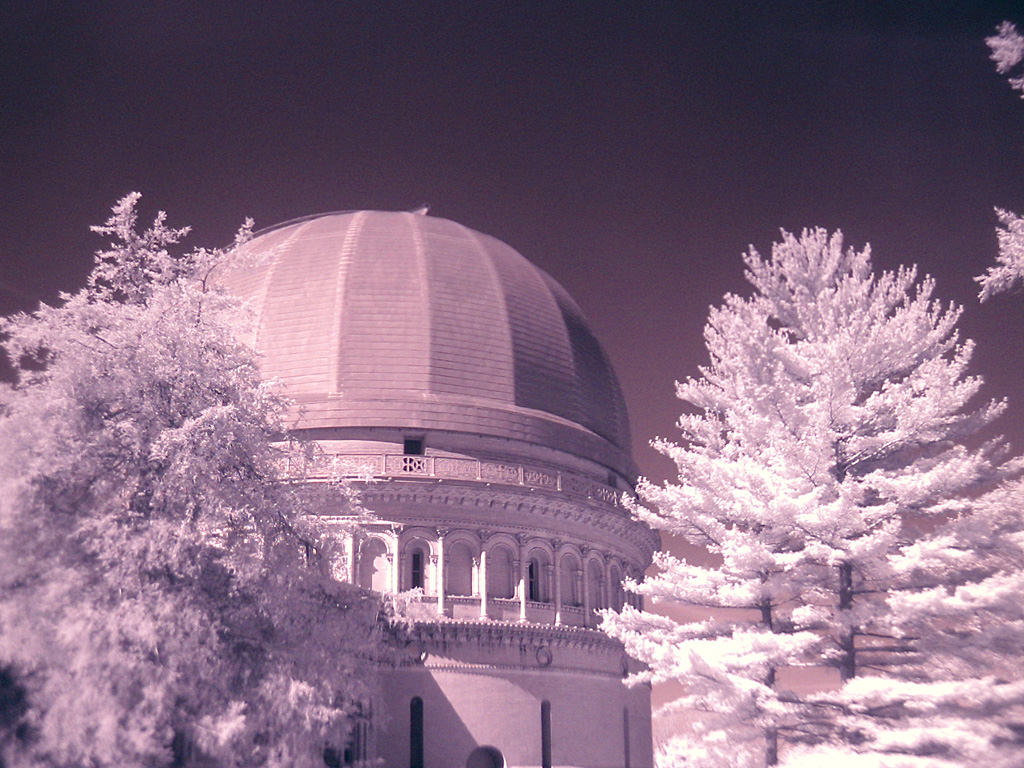
The Ryerson Astronomical Society sponsored a trip up to Yerkes Observatory this weekend. We split the 60-odd visitors into three groups and showed them the observatory through twilight. I got to show them the basement and the 24-inch reflector--fairly mundane things, and there is only so much you can opine about the difference between astronomy and astrophysics three times in a row. So, while talking about the infrared camera called HAWC on the second-generation flying telescope called SOFIA, scheduled for its first test flight today!, I tried my best to talk about light outside of our visible range. And I had to bring up near-infrared radiation and took some examples with each group. The above image is from the next morning. Everyone hopefully had fun looking through all the scopes, including the world's largest refractor, at various targets. Halfway through the observing I moved the 24-inch onto Messier 51, the spectacularly interacting galaxy pair in Canes Venatici, just off the handle of the Big Dipper. I would say some two-thirds or more of the visitors saw the spiral arms. After the big group left, the overnighters returned to the 24-inch at as M51 was transitting, the arms were much more evident.

(An example from Ryerson Observatory of M51).
Friday, April 20, 2007
IR-block windows
I cut a window out of a piece of polycarbonate to replace the IR-block filter in the modified Canon S300. It's 1.0mm thick, and the infrared block filter was 2mm, so it didn't solve my focus issues. But it helped. I realized today all I need to do is cut another one out and 1+1=2. Sure it won't be optical cement-glued together, or anti-reflective coated, but who cares. I cut the polycarbonate (which is really the protective cover of a package of CD-Rs) with a dremel and ground the sides to fit.

The windows. The cyan one is the original.
This blurry photo is an example. I include it because of the delightful color variations from the mixed lighting. Fluorescents around the periphery and metal halide in the center. The carpet in the center is nearly black to the eye.
UPDATE: Gah. Adding two windows pushes the CCD back too far, resulting in out of focus images.
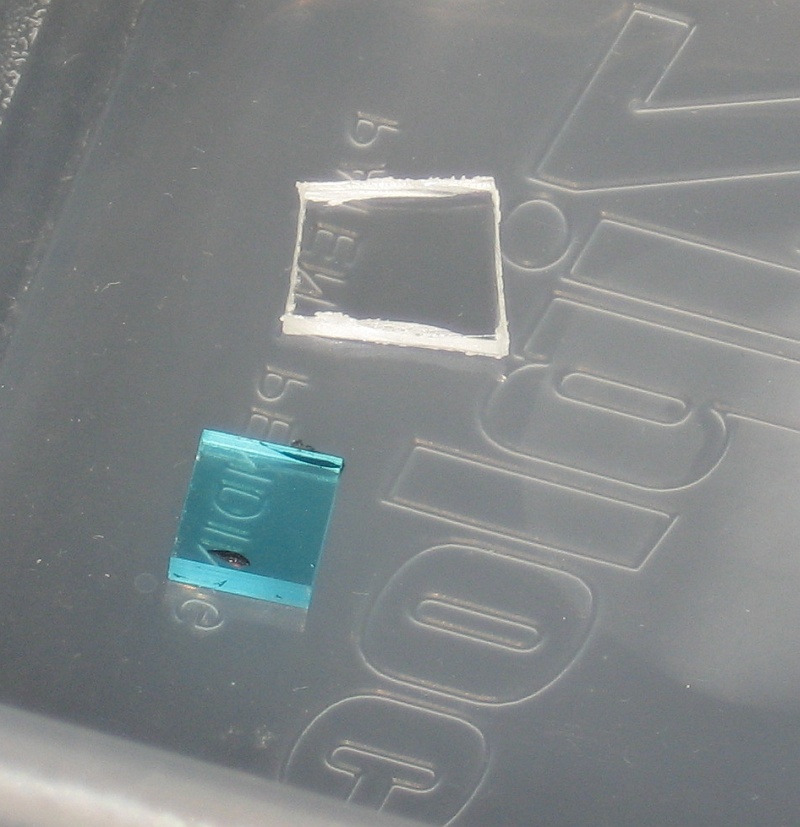
The windows. The cyan one is the original.
This blurry photo is an example. I include it because of the delightful color variations from the mixed lighting. Fluorescents around the periphery and metal halide in the center. The carpet in the center is nearly black to the eye.
UPDATE: Gah. Adding two windows pushes the CCD back too far, resulting in out of focus images.
Thursday, April 12, 2007
IR filtration
The two-layer color negative film sandwich is too strong of a filter for the IR modified Canon S300. It produces a virtually monochrome image, as seen below.

What I like and want is a duo-tone response, with red coming from a little visible red and the nearest of the near-IR, and blue coming from deeper in the IR--at least 800 to 900nm. Vegetation renders pastel blue and the sky and deep red. Most neutral items are a touch reddish, but not too much. Most black fabrics are pastel blue.
I can get it by removing one layer of the sandwich.

I believe the difference is greater when the sun is out and/or when tungsten illumination is being used.
P.S. For kicks here is the latter image with a boosted green channel, extra saturation and contrast: Cloudy Bartlett Quad, IR
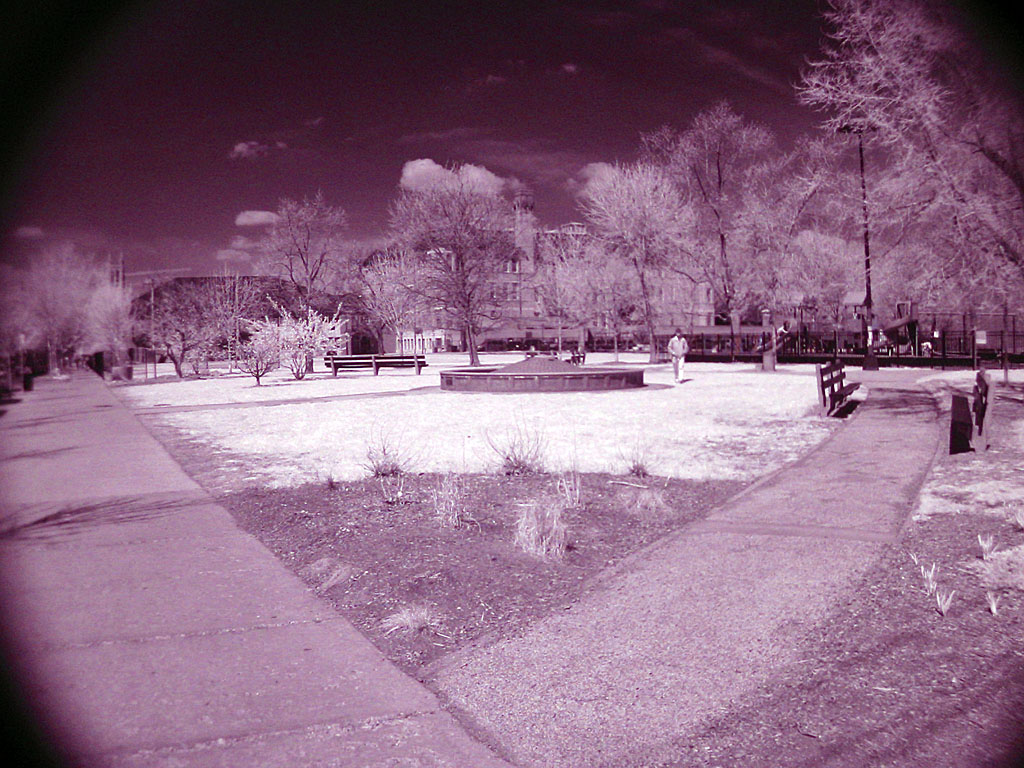
What I like and want is a duo-tone response, with red coming from a little visible red and the nearest of the near-IR, and blue coming from deeper in the IR--at least 800 to 900nm. Vegetation renders pastel blue and the sky and deep red. Most neutral items are a touch reddish, but not too much. Most black fabrics are pastel blue.
I can get it by removing one layer of the sandwich.
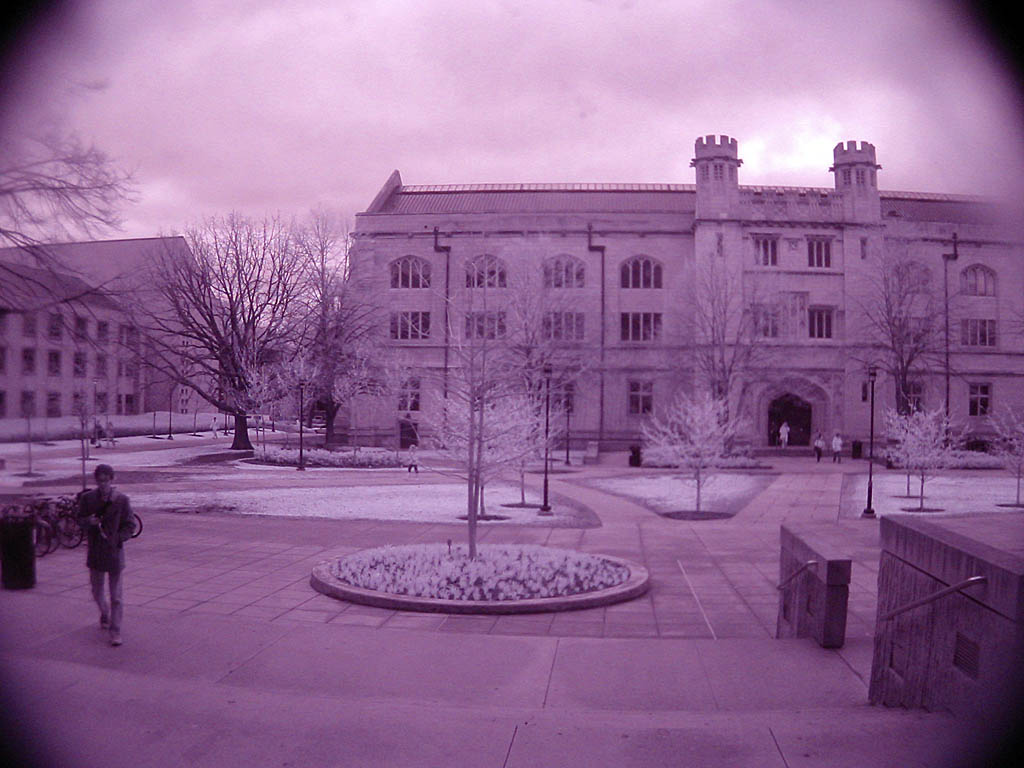
I believe the difference is greater when the sun is out and/or when tungsten illumination is being used.
P.S. For kicks here is the latter image with a boosted green channel, extra saturation and contrast: Cloudy Bartlett Quad, IR
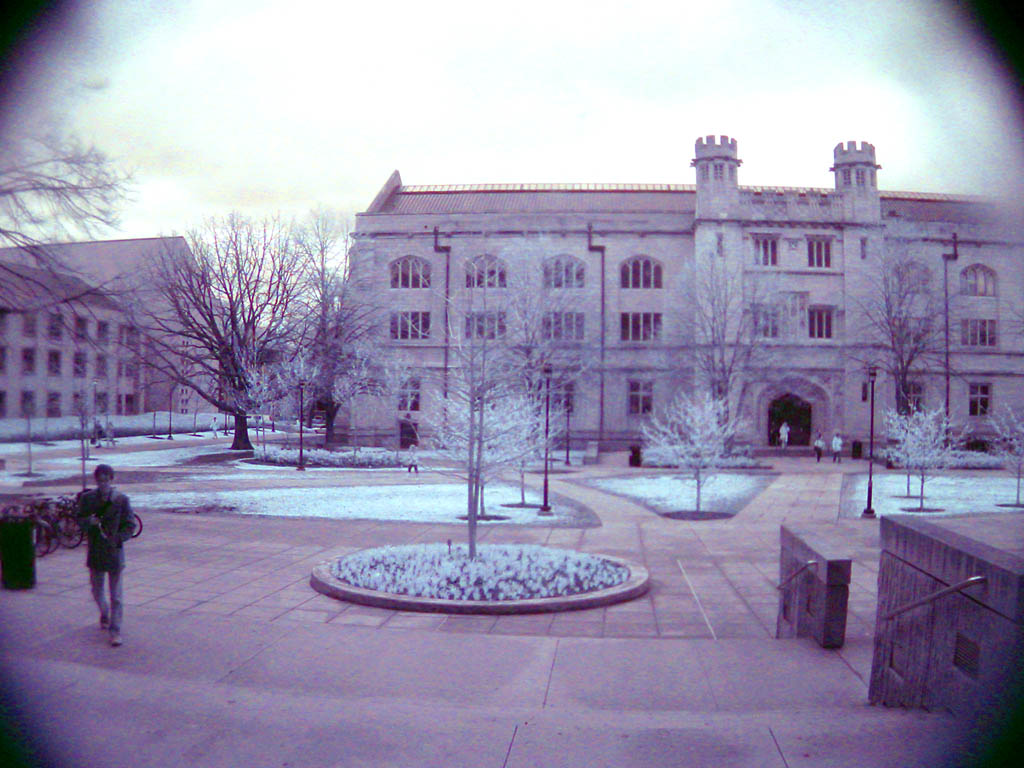
Wednesday, April 11, 2007
A blue hat day
A black felt hat, when seen in the near-infrared, is quite reflective.

This was taken with the Canon S300, with no IR-pass filter. It shows a combination of visible light and near-infrared, since the IR-block in the camera was removed. My lighting source was halogen incandescent, a rich source of near-IR light. The black felt is very light-colored in the near-infrared, as bright as the visible tan sweat band, and we see it is even more reflective the further into the IR we go. The blue channel is a combination of visible blue (on a black hat there is none) and infrared radiation leaking through the blue filters on the CCD. Most bandpass color filters also pass light of wavelength double of their design: so blue filters, with a peak transmission of about 450nm, will transmit at 900nm as well.
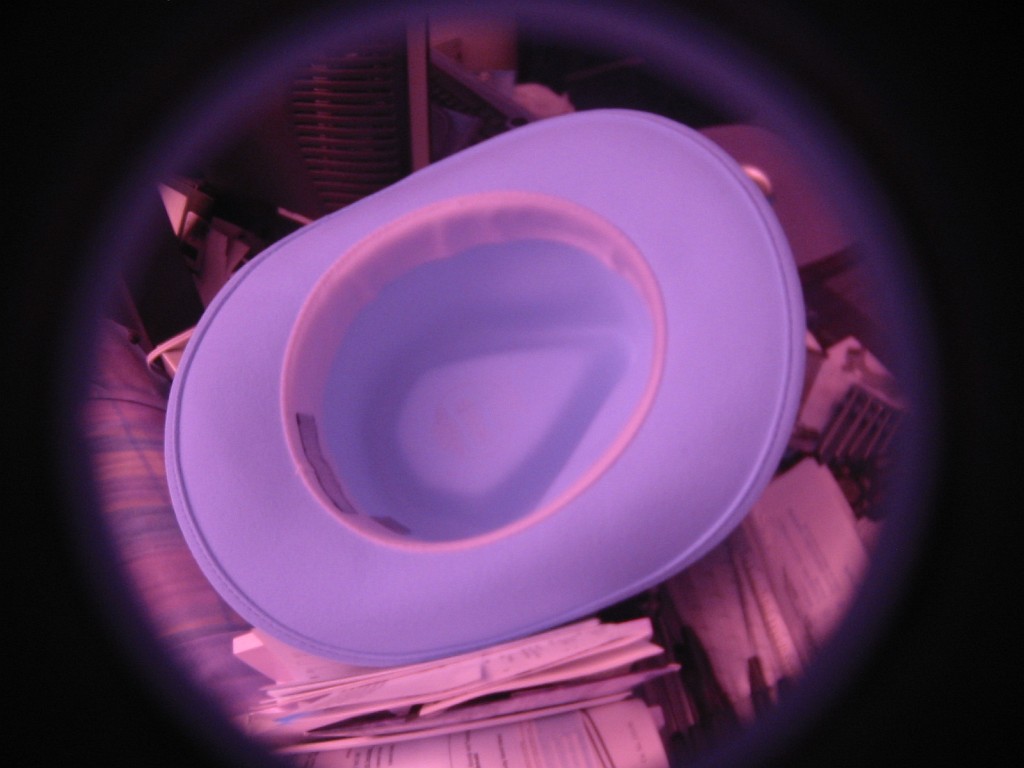
This was taken with the Canon S300, with no IR-pass filter. It shows a combination of visible light and near-infrared, since the IR-block in the camera was removed. My lighting source was halogen incandescent, a rich source of near-IR light. The black felt is very light-colored in the near-infrared, as bright as the visible tan sweat band, and we see it is even more reflective the further into the IR we go. The blue channel is a combination of visible blue (on a black hat there is none) and infrared radiation leaking through the blue filters on the CCD. Most bandpass color filters also pass light of wavelength double of their design: so blue filters, with a peak transmission of about 450nm, will transmit at 900nm as well.
Monday, April 09, 2007
Trying something different: IR mod for Canon Powershot S300
I've decided to increase posting frequency at the expense of creating fully developed and finished projects. A number of things I've been working on have been taking longer than expected to finish and they are all cool; but if they don't finish nicely, I haven't been posting them.
I previously wrote up some experimentation with my Canon Powershot A95 in the near-infrared; those were done with a stock camera and two or three layers of fully-exposed and developed color negative film. Exposure times were horrendous, though, as the camera's internal IR-block filter fought against the external IR-pass filter. In broad daylight exposures were often 5-10 seconds long.
Anyways, I removed the IR filter from an old Canon S300 and here is an early image.

The IR filter is 2mm thick and in a converging light path--therefore it needs to be replaced or adjusted for; I didn't do that, and instead stuck a very concave lens (a 2x teleconverter) in front of the camera. It gets the nearsighted camera to focus at infinity, for some of the frame. I found that I could take the lens out of the housing of the teleconverter, and place it closer to the camera lens, which helped. I can zoom in just a bit and the focus is at infinity and a lot of the vignetting is gone.
I previously wrote up some experimentation with my Canon Powershot A95 in the near-infrared; those were done with a stock camera and two or three layers of fully-exposed and developed color negative film. Exposure times were horrendous, though, as the camera's internal IR-block filter fought against the external IR-pass filter. In broad daylight exposures were often 5-10 seconds long.
Anyways, I removed the IR filter from an old Canon S300 and here is an early image.
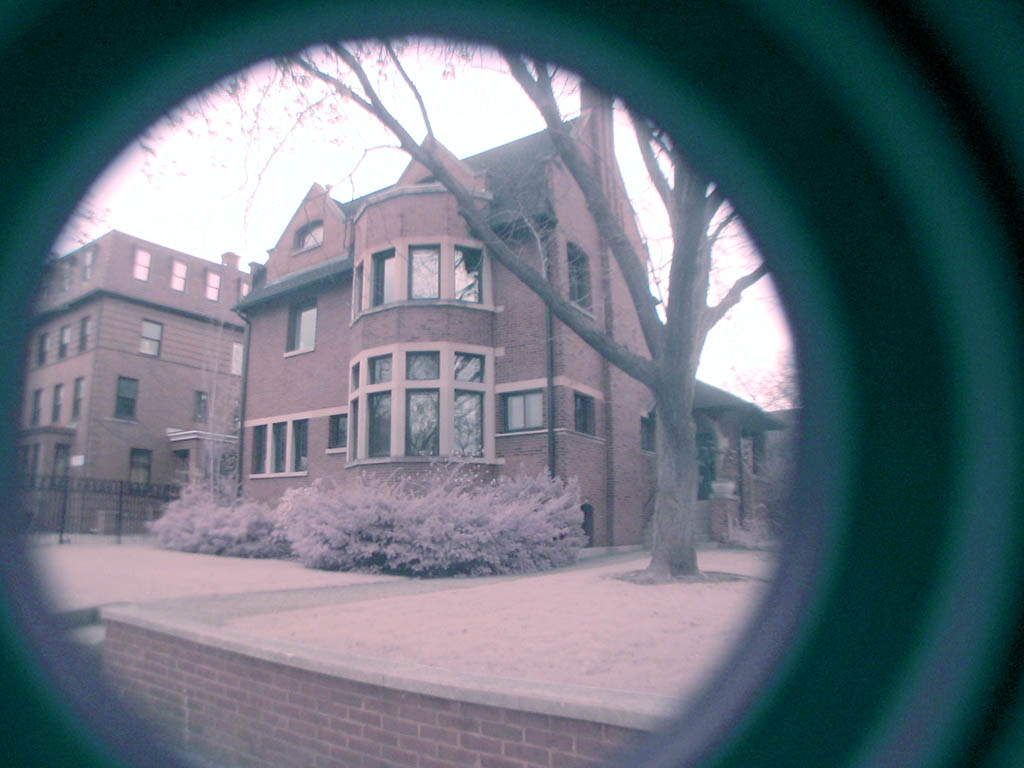
The IR filter is 2mm thick and in a converging light path--therefore it needs to be replaced or adjusted for; I didn't do that, and instead stuck a very concave lens (a 2x teleconverter) in front of the camera. It gets the nearsighted camera to focus at infinity, for some of the frame. I found that I could take the lens out of the housing of the teleconverter, and place it closer to the camera lens, which helped. I can zoom in just a bit and the focus is at infinity and a lot of the vignetting is gone.
Friday, February 03, 2006
IR hosta (plantain lily)

This is a near-infrared image of the leaf of the hosta plant, also known as a plantain lily. It was taken during the same session as this Linne image.
Previous discussion on why leaves are so white in the near infrared is at here.
I've talked about my setup a couple of times before:
http://dwarmstr.blogspot.com/2005/05/ir-bushes.html
http://dwarmstr.blogspot.com/2005/05/infrared-gallery.html
http://dwarmstr.blogspot.com/2005/05/visualinfrared-comparisons.html
Subscribe to:
Posts (Atom)