In my high school days I had a part-time job at a professional photo lab / studio called "Phillips' Photo Lab". I was hired as the black and white darkroom guy--I manually processed film, printed custom prints, shot copy negatives, and cleaned the color film and print processors. Later I branched into running the shop on Saturdays and once, just once, did a color print job.
I learned a lot from the pros whose lifeblood was photography: the tips and techniques that make life easier.
One of the things that I would not had believed unless I had personally experienced it was the magic of nose grease. The skin on the nose and to a lesser extent the neck near the back of the ears produces a hydrocarbon of about C30H50 called squalene. The only reason this is important was squalene had the same index of refraction as the gelatin used in photographic processes and hence could be used to fill in scratches on negatives and slides. You would acquire some nose grease, rub it gently into the scratch, and rewash the negative. Nearly as good as new, and it allowed prints and reproductions from otherwise damaged negatives.
This particular example is this blog's first mention of a principle I like to call "matching impedances". In the world there are a lot of interesting issues that in the end are solved or mitigated by taking two different systems and making them the same at the point they meet. In electronics, to maximize power transfer between two parts of a circuit, you match their electrical impedances (which is a function of their resistance at all frequencies).
You have encountered this when setting up a TV or stereo system; the speakers have an impedance rating on them, usually 8ohms for a home stereo and 4 for car audio. Your amplifier speaker outputs need to be designed to deal with a particular impedance; stick a 4ohm speaker on an amp designed for 8 and you might mess things up. On your TVs there used to be two terminals for antennas--one was coaxial and had an impedance of 75ohms and is now the de facto standard, and the other was two screws that had an impedance of 300ohms. To get the most signal you'd want all the impedances to match up: the TV, the cable, and the antenna. If they didn't, part of the precious signal would be reflected back towards the antenna and lost. For converting the impedances to match a little transformer was used, of which there may be a hundred million hiding behind the TVs of the world. Again, here the principle of matching the impedances came into play.
In the optical world reflections occur at surfaces that have differing indexes of refraction. The bigger the difference the higher the reflection ( I think it's a square of (n-n2/n+n2). For solar panels, for instance, the high index of refraction of silicon (4) compared to air (1) makes something like 50% of the incident light reflect off unless you use anti-reflective coatings to improve it. So even for something like a renewable energy resource you have to consider such details.
I use nose grease (n=1.45) to also try to fill in scratches in CDs/DVDs (made of polycarbonate, n=1.58). It's not perfect, but sometimes it makes it playable.
So, in the end: Match your impedances!
Wednesday, June 23, 2010

Wednesday, June 09, 2010
Hayabusa coming home
An amazing comeback for the little falcon that could--

Credit: ISAS / JAXA / Øyvind Guldbrandsen / Planetary Society Blog
The Japanese spacecraft Hayabusa will be returning to Earth with perhaps a sample of the asteroid Itokawa in just four days. This spacecraft has had as many setbacks in the seven years it's been running as you can have without losing the craft completely. When they released the data archive in 2007 I made a color image of Earth made by Hayabusa during a flyby and some more surface close-ups here.
Credit: ISAS / JAXA / Øyvind Guldbrandsen / Planetary Society Blog
The Japanese spacecraft Hayabusa will be returning to Earth with perhaps a sample of the asteroid Itokawa in just four days. This spacecraft has had as many setbacks in the seven years it's been running as you can have without losing the craft completely. When they released the data archive in 2007 I made a color image of Earth made by Hayabusa during a flyby and some more surface close-ups here.

Friday, June 04, 2010
Friday, May 21, 2010
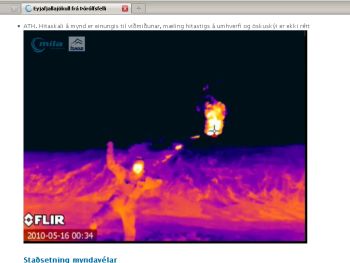
Eyjafjallajökull eruption: webcam at midnight
It's midnight in Iceland and nearly midsummer with a volcano erupting, what do you do? Hang out in front of the thermal camera.

Wednesday, May 12, 2010
Eyjafjallajökull eruption: webcams
There are several webcams watching the Ejyafjallajökull eruption; and at this time of year the plume is illuminated all the short night long. I watched the sunset at 10:30PM and am now watching the sun rise at 4:30AM. The eruption continues through the Arctic summer night.
http://eldgos.mila.is/english/eyjafjallajokull-fra-hvolsvelli/
http://eldgos.mila.is/english/eyjafjallajokull-fra-thorolfsfelli/
This one is closer and has a thermal IR camera as well; but it's also more often obscured by ash and fog.
http://eldgos.mila.is/english/eyjafjallajokull-fra-hvolsvelli/
http://eldgos.mila.is/english/eyjafjallajokull-fra-thorolfsfelli/
This one is closer and has a thermal IR camera as well; but it's also more often obscured by ash and fog.
Tuesday, May 11, 2010
Jupiter's SEB has gone pale
Jupiter's South Equatorial Belt, normally a brown-red, has gone as pale as the cream white zones surrounding it. Check out the report with images at the Planetary Society Blog: http://networkedblogs.com/3Jnoh. This is one of those things that happens every 5-10 years or so.
Thursday, April 29, 2010
Sunday, April 25, 2010
Friday, April 23, 2010
The view from Thorvaldseyri of the Eyjafjallajökull eruption
The view from Thorvaldseyri of Eyjafjallajökull
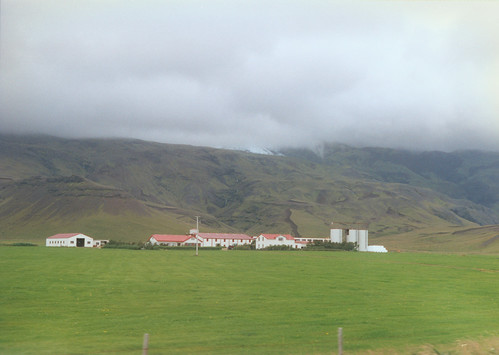
You can just pick out the ice sheet from underneath the clouds.
Compare this with the view the farmer had recently:
http://icelandreview.com/icelandreview/upload/images/news/almennt/thorvaldseyri_olafur_eggertsson.jpg
From:
http://icelandreview.com/icelandreview/daily_news/?cat_id=16539&ew_0_a_id=361234
You can just pick out the ice sheet from underneath the clouds.
Compare this with the view the farmer had recently:
http://icelandreview.com/icelandreview/upload/images/news/almennt/thorvaldseyri_olafur_eggertsson.jpg

From:
http://icelandreview.com/icelandreview/daily_news/?cat_id=16539&ew_0_a_id=361234
Sunday, April 18, 2010
Eyjafjallajökull eruption: gorgeous video
The NY Times Lede blog has linked to BBC Channel 4 video of the eruption. From the look of it, the videographer had one of the many excursion drivers take them up Thórsmörk (or Þórsmörk) valley on the north side up high enough to look at the eruption without dealing with the jokulhaup (or glacial flood) in the river. If you have ADD you will miss the active sub-Plinian eruption and great lightning in latter half of the video.
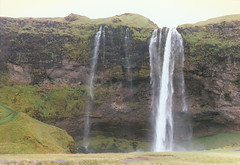
UPDATE: the waterfall at the beginning is Seljalandsfoss. I have a photo of it here: http://www.flickr.com/photos/dwarmstr/4532063271/.
EDIT: calling it sub-Plinian.
UPDATE: the waterfall at the beginning is Seljalandsfoss. I have a photo of it here: http://www.flickr.com/photos/dwarmstr/4532063271/.
EDIT: calling it sub-Plinian.
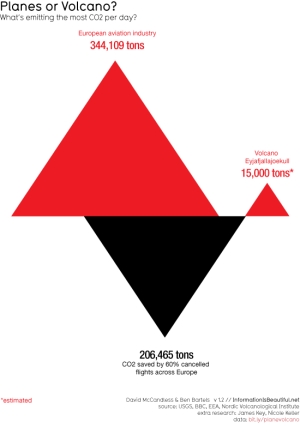
Eyjafjallajökull eruption: planes vs. volcano
An interesting data point about the Eyjafjallajökull eruption: the disruption of the European aviation market reduces the CO2 output by an order of magnitude more than the CO2 released by the volcano itself,
Source: http://www.informationisbeautiful.net/2010/planes-or-volcano/
Source: http://www.informationisbeautiful.net/2010/planes-or-volcano/
Saturday, April 17, 2010
Moments in spaceflight
Soichi Noguchi captures a poignant moment as the Shuttle leaves the International Space Station. Click to enlarge to a higher quality image.

Thursday, April 15, 2010
Eyjafjallajökull eruption
I was just reading about the Eyjafjallajökull eruption yesterday and the rather bold tourist enterprise sprung up to visit it, when I see it has erupted in an explosive manner. The new path to the surface for the magma opened under the ice sheet (jokull) instead of bare ground, and water/magma interactions produce copious amounts of gas. Gas is a bad thing when it comes to magma. It makes thing go boom. Instead of a lava fountain and a tourist stop in Iceland, now we have flooding as the glacier melts, and air travel restrictions as the volcano generates large plumes up into the atmosphere from the phreatic eruption. The Icelanders are concerned about the flooding and the fluorine from the ashfall. For the geology, the composition of the magma (how much silica is in it, how much gas is in it), its interaction with the surrounding rock, and how the magma changes in composition as time increases are the interesting things. For the British sitting waiting for the air to clear, realize that ash is just magma pulverized through explosive means. Blame the gas.
Here is some good information on the location and the inflation/deflation data.
Here is some good information on the location and the inflation/deflation data.
Thursday, April 01, 2010
Geiger counter problems interfacing with PC
I've been unable to get the DOS software AW-SRAD to work with the geiger counter for some time, on multiple machines, with Windows XP. It's a bummer. I can input the sound pulses from the clicker unit I made into a sound card, but I have no idea how to then get the PC to do something with that. I'm not a programmer. The original geiger counter set up was really simple: it toggled the RING indicator on the serial port.
Tuesday, March 30, 2010
For Photographers, the Image of a Shrinking Path
For Photographers, the Image of a Shrinking Path
By STEPHANIE CLIFFORD
Published: March 29, 2010
Amateur photographers, happy to accept small checks for snapshots, are underpricing professionals.
I made some comments about this issue last year in this post: http://dwarmstr.blogspot.com/2009/06/intersection-of-onlinesharing-culture.html. Since then, I made that Faustian bargain of getting an image of mine on a book cover without payment save a few copies of the book (although I haven't gotten them yet, CRC Press). The publisher said they had no budget for images, it would likely sell very few copies (a very technical book), etc... should I have done it?
Conversely, if you are a corporation, why shouldn't you find free or cheap photography instead of paying for it? Photography has been freelance for sometime, and never unionized that I am aware of.
By STEPHANIE CLIFFORD
Published: March 29, 2010
Amateur photographers, happy to accept small checks for snapshots, are underpricing professionals.
I made some comments about this issue last year in this post: http://dwarmstr.blogspot.com/2009/06/intersection-of-onlinesharing-culture.html. Since then, I made that Faustian bargain of getting an image of mine on a book cover without payment save a few copies of the book (although I haven't gotten them yet, CRC Press). The publisher said they had no budget for images, it would likely sell very few copies (a very technical book), etc... should I have done it?
Conversely, if you are a corporation, why shouldn't you find free or cheap photography instead of paying for it? Photography has been freelance for sometime, and never unionized that I am aware of.
Subscribe to:
Posts (Atom)