The New York Times has a surprising
article today about the radiation risks of granite counters.
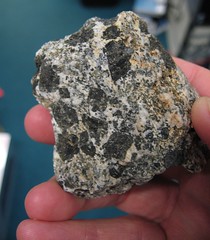
Granite is an intrusive rock--slowly cooled from magma several kilometers below the surface, the rock grows large crystals from the hundred-thousand to million year cooling period. It is also chemically more "continental"; that is, more quartz, more "felsic" minerals, as opposed to the "mafic" minerals that contain much olivine and pyroxene, two minerals rich in iron and magnesium. True granite is a chemically specific intrusive, and much of what is called granite isn't, but a cousin of it. Roughly you can say to expect quartz, feldspar (of some type, there are several), and a sheet silicate like mica or biotite.
Despite the popular image of the Earth's crust riding on an ocean of molten magma, there is little liquid under our feet. While it's hot, there is enough pressure to keep things solid. Occasionally something will upset that balance and allow the rock to melt, whether by bringing hot material up to a lower pressure (like at the mid-ocean ridges) or by adding a special ingredient to make it melt (like water released by ocean sediments subducting under a continent). Melting is complicated and rarely complete, and some minerals melt at a lower temperature than others, leaving behind and chemically changing what sort of rock it is. Granite is like this. It melts at a lower temperature than basaltic materials. It often contains more water. And it brings with it certain compatible elements including uranium and thorium. This is why granites are more radioactive than most rocks. They can contain 10-20x more uranium and thorium than the solid left behind. Some of the more exotic "granites" are pegmatites--the extremely large crystal remnants of the last little bits of liquid at the end of solidification--and they contain the highest amounts of these elements.
But is this a hazard? Granites I've encountered have rates ranging from nothing to about 10x background. This isn't that much. Time spent at cruising altitude is about
40x background at 500ft. It certainly wouldn't be worth the fuss of ripping up a kitchen, unless it was proven to be the source of elevated radon levels. After reading the literature about naturally occurring radon sources, I have difficulty assigning the radon to just a small granite piece. Any soil or rock within 4 gas-diffusion-days of the basement or slab can be a source of radon for a home, and the total amount of uranium in that quantity is going to exceed the amount in the countertop (especially the part of the countertop that is within radon's half-life time of the surface). If you covered your walls in granite it might be different.

