Thursday, January 28, 2010
The orange object next to the full moon tonight
The bright orange "star" next to the Full Moon tonight and Friday is the planet Mars, which happens to be closest to Earth tonight (ok last night) during this current cycle (Mars and Earth come close to each other every 2 years and 2 months). And closest in only the sense of currently: it's still 99 million kilometers away.

Wednesday, January 27, 2010
Joule Thief: a simple DC voltage booster
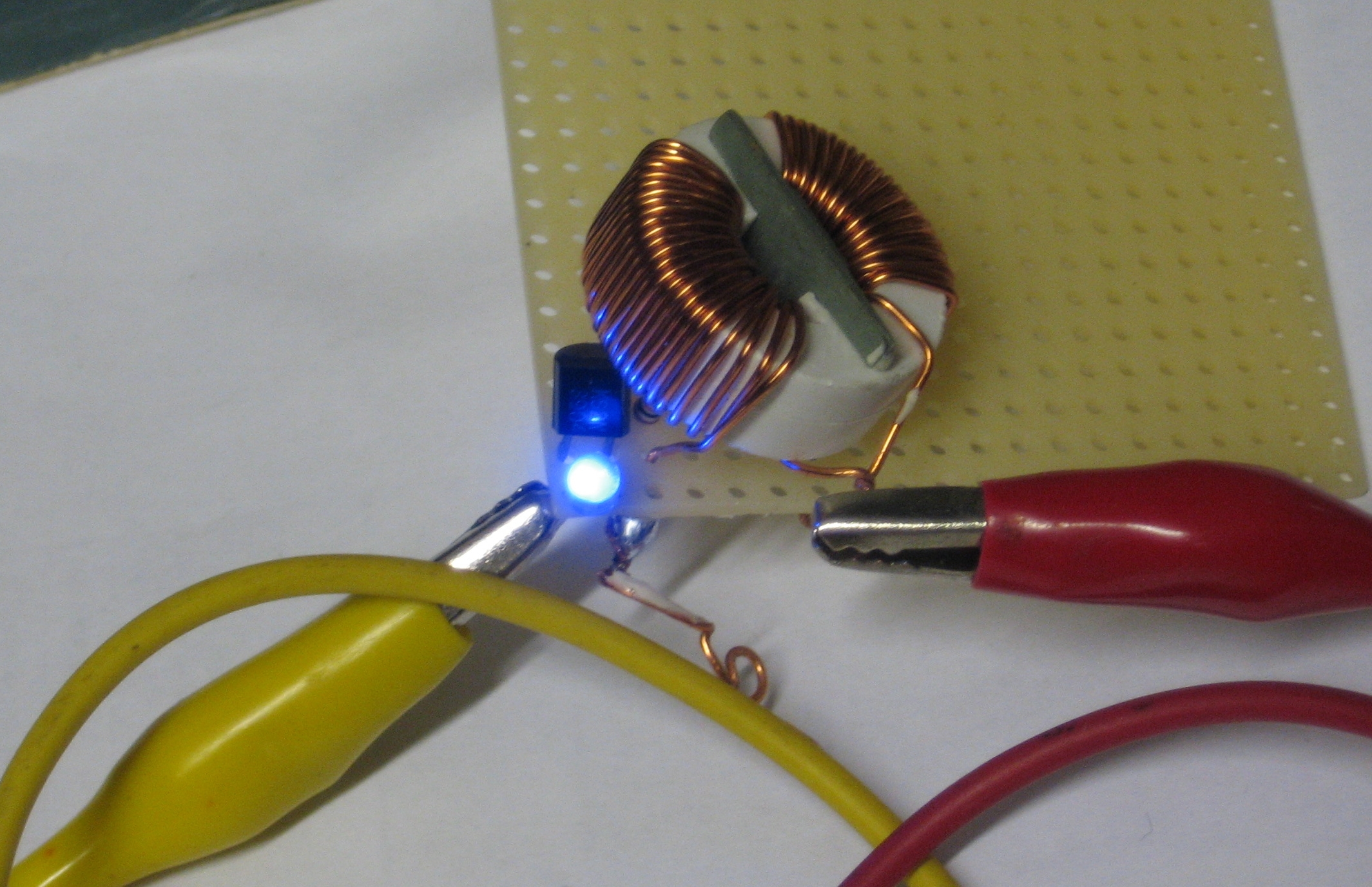
A joule thief circuit lit from a 0.5V AAA battery. Click to enlarge.
A Joule thief is a simple circuit that acts as a DC to DC booster, raising a supply voltage by several volts. In this iteration it uses the exhausted voltage of a alkaline battery and boosts it enough to light a blue LED that requires 2.8V to light. With an otherwise dead 0.5V AAA battery, it will light a blue LED and run for days, using (at the moment) just under 2mA of current. It's much much dimmer than using a fresh battery or running the LED with a proper current through it. Giving the Joule thief circuit 3V from two fresh batteries pulls 75mA through the LED, making it very, very bright and probably short-lived.
A schematic is below. The circuit works like this: When first turned on, current flows into the inductor and produces a magnetic field in the toroid. While this is happening, no voltage appears at the base of the transistor, so the transistor remains off. The LED sees at first no voltage and while the inductor fills up, it only sees a maximum voltage of the battery, which is not enough to pass the diode. Once the inductor is charged, the battery voltage appears at the base of the transistor, turning it on. This allows the right side of the inductor to want to dump the energy it has stored in its magnetic field as quickly as possible, and this gives us a high-voltage that appears across the inductor. When that voltage exceeds 2.8V the LED turns on and lights up until the voltage drops below, triggering the sequence to begin again. I measured the frequency of the on/off oscillation and it seems to run at about 34kHz; the multimeter said between 68 and 72kHz but a radio showed there was 34kHz signal as well, which I assume was the fundamental (and the 68kHz one a harmonic). It did change in frequency a bit while on.
 Bre Pettis/Windell Oskay
Friday, January 22, 2010
Las Vegas precipitation
Las Vegas received more rain last week, 1.69 inches, than it did in all of 2009, when it received 1.59 inches. The "average" is about 4 inches annually. If the rains continue into a full El Nino style winter, the area will bloom green in spring with the normally brown/gray mountains turned into green.
Source: http://www.lvrj.com/news/breaking_news/Rainfall-expected-to-taper-off-today-82379942.html
Source: http://www.lvrj.com/news/breaking_news/Rainfall-expected-to-taper-off-today-82379942.html
Wednesday, January 20, 2010
2010 AL30 animation
Patrick Wiggins makes a cool animation of an object passing by the Earth last week:
http://users.wirelessbeehive.com/~paw/temp/2010AL30.2.GIF
I liked it better than some of the other animations I've seen of the same object, since he didn't center the object on every frame but let it move to the right. This gives the effect of it speeding up.
http://users.wirelessbeehive.com/~paw/temp/2010AL30.2.GIF
I liked it better than some of the other animations I've seen of the same object, since he didn't center the object on every frame but let it move to the right. This gives the effect of it speeding up.
Thursday, December 24, 2009
Halogen resistance
If you are curious, the resistance of a 300W type J halogen bulb, the ones you would find in those halogen torchiere lamps, is 3.3 ohms when cold. When it's hot it is 48 ohms, but that's a calculation only based on the wattage.

A warm halogen bulb in the near infrared
Since converting such a torchiere to CFL (but not in this project), I had an extra halogen bulb and debated throwing it out, but I figured they might make a decent power resistor. I used it in a project converting a PC ATX power supply to a benchtop 12V source. It works--but the hassle of cleaning the contacts for soldering, soldering, and placing such a large object in the case was enough to decide buying a power resistor in the first place is probably easier.
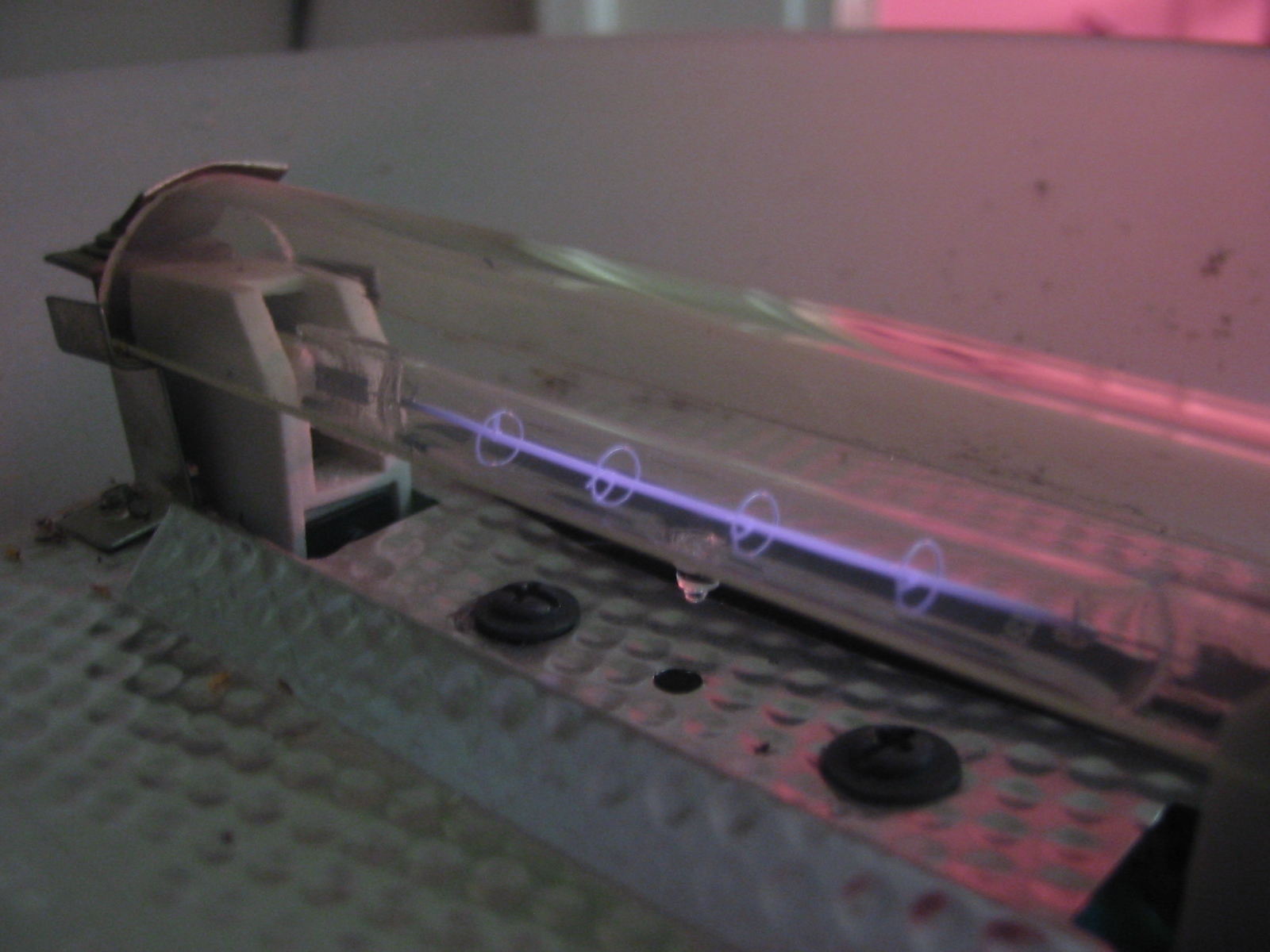
A warm halogen bulb in the near infrared
Since converting such a torchiere to CFL (but not in this project), I had an extra halogen bulb and debated throwing it out, but I figured they might make a decent power resistor. I used it in a project converting a PC ATX power supply to a benchtop 12V source. It works--but the hassle of cleaning the contacts for soldering, soldering, and placing such a large object in the case was enough to decide buying a power resistor in the first place is probably easier.
Monday, December 21, 2009
Winter Solstice 2009
Happy Winter Solstice.

From http://buscam.uchicago.edu/ taken on 11:54AM (a few minutes past the solstice time) (on campus only)
Chicago is looking as good as 2006!
Enjoy this graph of the date and time of the solstice over the years.
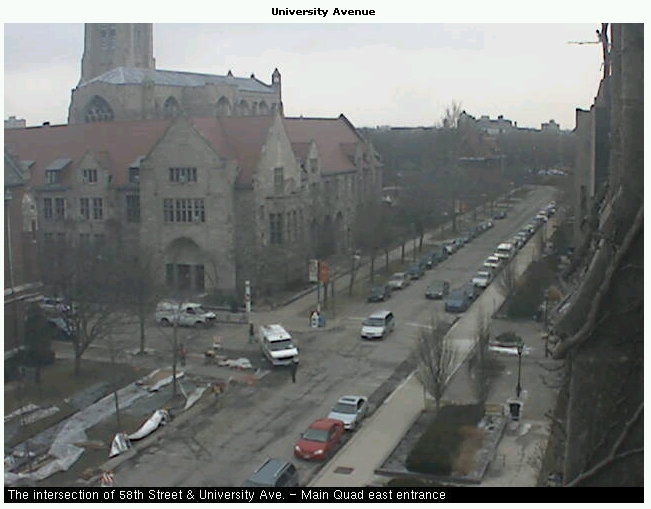
From http://buscam.uchicago.edu/ taken on 11:54AM (a few minutes past the solstice time) (on campus only)
Chicago is looking as good as 2006!
Enjoy this graph of the date and time of the solstice over the years.
Friday, December 18, 2009
Image of the day: Tethys
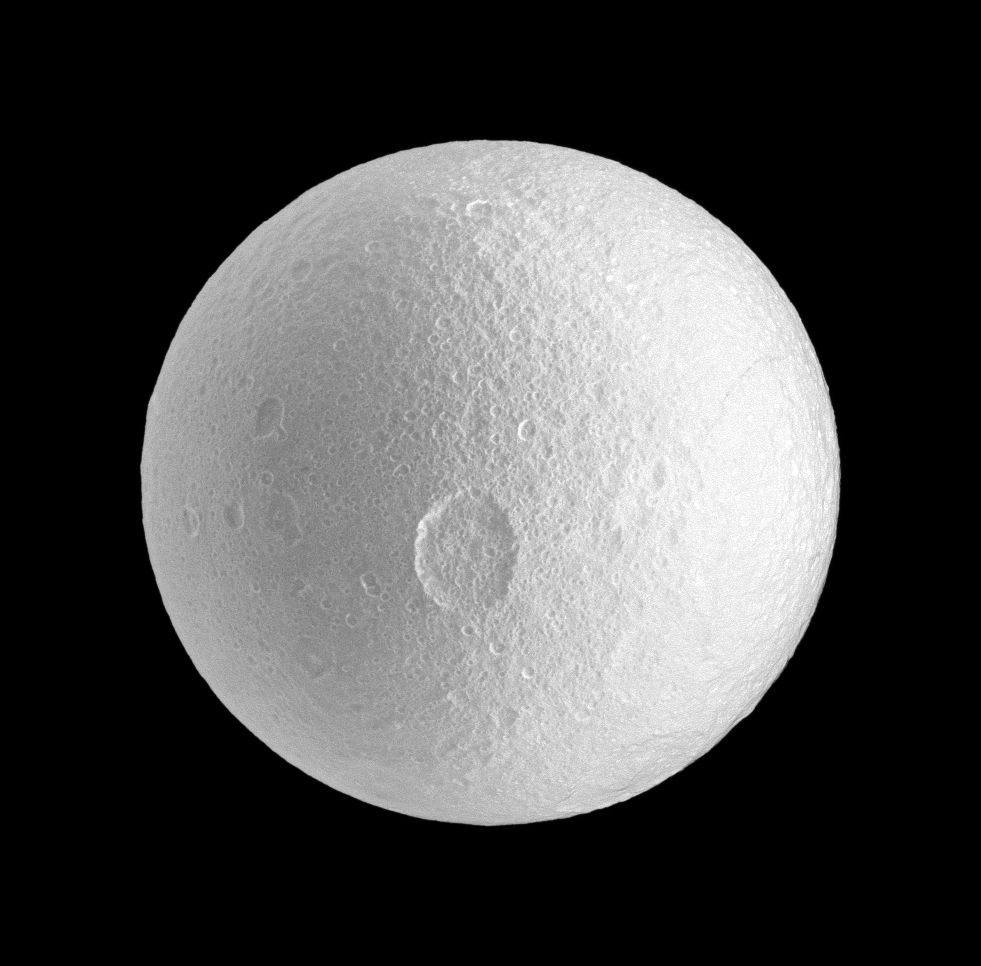
The saturnian satellite Tethys, imaged on October 14th, 2009. From the viewpoint of Cassini, the Sun was nearly directly behind the spacecraft when this image was taken.

Click to enlarge
Source: NASA/JPL/Space Science Institute
Click to enlarge
Source: NASA/JPL/Space Science Institute
Wednesday, December 16, 2009
Monday, December 14, 2009
Martian swirly art
I am sure you've already seen this image from Mars of the swirly traces of dust devils removing the light dust from the darker surface. But here it is.

Click to enlarge to a 2560x1920 version
This is a dune field in a crater just off of Syrtis Major.
Links to other sizes.

Click to enlarge to a 2560x1920 version
This is a dune field in a crater just off of Syrtis Major.
Links to other sizes.
Friday, December 11, 2009


Thursday, December 10, 2009
Crescent Earth
The Earth captured from the Rosetta spacecraft as it passed by Earth.
 .
.
ESA. Taken on 11/12/2009. Click to enlarge.
As seen on the Planetary Society blog.
 .
. ESA. Taken on 11/12/2009. Click to enlarge.
As seen on the Planetary Society blog.
Wednesday, November 11, 2009
November ISS sightings in Chicago
You can see the International Space Station in Chicago in the evening for the rest of the month. If schedules hold, you will also be able to see the Space Shuttle as it docks with the ISS, as the Shuttle should launch on the 16th.
Here's the next 10 days.
Here's the next 10 days.
Wednesday, October 28, 2009
Looking at the radio spectrum with an oscilloscope
One of the things I've always been interested in was radio; and part of that was scanning as much of the radio spectrum as possible to hear what was out there. As a kid, this was my father's shortwave receiver; I spent hours twirling the giant frequency handwheel on that radio absorbing every foreign radio broadcast I heard and wondering what the various weird noises I heard were.
For instance, at times there would be a overwhelmingly loud, rapid "thump-thump-thump" noise that was fairly broadband across a few megahertz. I asked my father about that and he called it the "Russian Woodpecker", an over-the-horizon radar system that used frequencies that were normally used by shortwave broadcasters. If I stayed up long enough at night, I would begin to pick up the European broadcasters waking up at dawn with their early morning news broadcasts.
One thing about most radios is you are only tuned to one frequency at a time. You get a limited amount of bandwidth around that frequency depending on how the radio works. It's hard hence to compare the strengths of two stations simultaneously without resorting to memory tricks or rapid tuning.
With a fancy piece of equipment called a spectrum analyzer, you can see a wide range of frequencies at once and see various radio stations, peaks, etc. To some extent you can do this with a PC sound card hooked up to the audio output of the radio, but again you are limited in bandwidth. See the laptop display below, for instance.

The generalized setup. An antenna, a diode detector, and an oscilloscope. The PC is not being used in this particular example.
What amazes me is a sub-$1000 digital oscilloscope that is advertised as a 40MHz scope, that is, it can display signals up to 40MHz in frequency, can in a FFT mode display the signals up to 500MHz and essentially function as a spectrum analyzer.

An overview of the Chicago radio spectrum
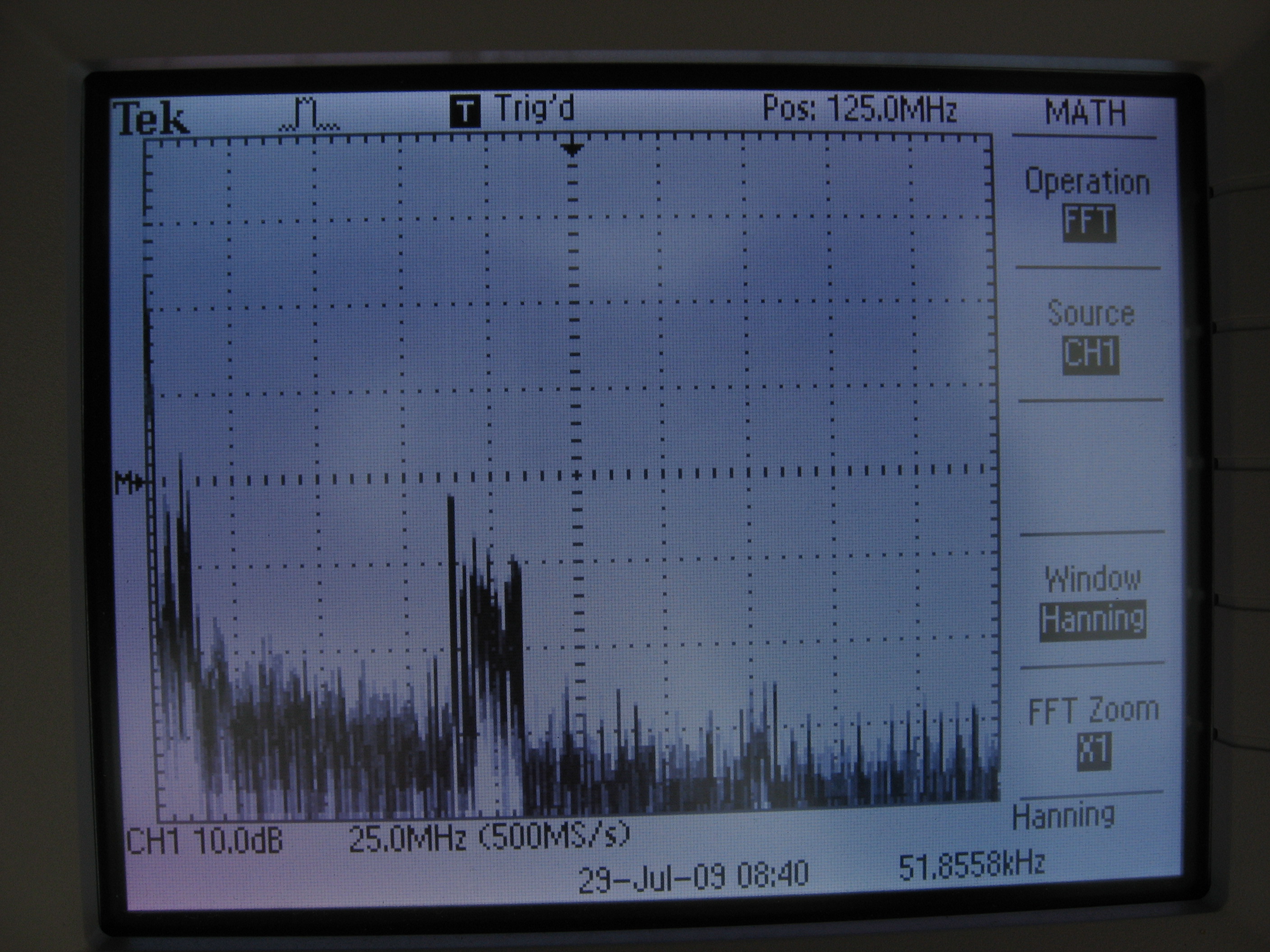
The key things to note here are intensity is the vertical, frequency is the horizontal. Near the upper right corner is "POS:", which notes the frequency at the center of the display. At the center bottom is the horizontal scale, in this case 25MHz per big division. So the bump of stuff to the left of center in this image is at about 125MHz-25MHz= 100MHz, which is in the FM Radio band.

FM Radio band.
In the FM band, you can see that there are plenty of stations filling the available channels. The isolated peak on the left is WHPK-FM, the campus radio station running at 100W, and is about two blocks from my location. It sits in the non-commercial section of the FM band.

AM Radio band
The AM radio band at my location is dominated by WRTO-AM at 1200kHz. This station gets into any cable, any wire, and if you have any rectification from a piece of corrosion, or just input an antenna directly into a PC, you will get La Tremenda.

Looking closer at 1200kHz
If you look closer at WRTO's signal, you see it has a strong carrier and two sidebands further out at about 12.5kHz out. Now, when I originally saved this image, I thought I was seeing the audio sidebands of the AM signal. If the AM radio station broadcasts a single note at 440Hz, for instance, you'd see the strong carrier, and two line peaks on either side at 440Hz away. But here they are all the way out at 12.5kHz, a frequency that is present in "ssss" or a cymbal but little else. And especially not normal AM radio broadcasting, which is limited by the FCC to just a tad over 20kHz bandwidth, so the stations have to drop all their treble sounds.
It appears these outliers are the dreaded "HD radio", a hybrid technique that transmits the audio in two sidebands that exceed the normal width of an AM broadcast. Unfortunately this process violates old technical standards that allowed stations to coexist with each other. It was dropped in favor of a proprietary digital standard that allows big stations to use more bandwidth and clog up the airwaves with digital hash noise.

Below the AM radio band
Just below the AM band is the rest of what is known as Mediumwave or Medium Frequency, which then transitions into LW or longwave; this band is notable for non-directional beacons for aeronavigation, DGPS (or differential GPS), and lots of noise. I will have to take another spin around this band to listen to some of those peaks and see if they are real signals.

VLF Radio spectrum
Once you get down here, you start running into lots and lots of switching mode power supply noise. Various Navies around the world still broadcast on this frequency for radionavigation and uninterruptible worldwide coverage. Two of the stronger signals to the left are probably the Russian radionavigation system at 11.9kHz and 12.6kHz.
I have some other snapshots showing excellent response to the shortwave radio broadcasters of the world. It's amazing to see the whole shortwave spectrum at once instead of moving around frequencies one kilohertz at a time.
For instance, at times there would be a overwhelmingly loud, rapid "thump-thump-thump" noise that was fairly broadband across a few megahertz. I asked my father about that and he called it the "Russian Woodpecker", an over-the-horizon radar system that used frequencies that were normally used by shortwave broadcasters. If I stayed up long enough at night, I would begin to pick up the European broadcasters waking up at dawn with their early morning news broadcasts.
One thing about most radios is you are only tuned to one frequency at a time. You get a limited amount of bandwidth around that frequency depending on how the radio works. It's hard hence to compare the strengths of two stations simultaneously without resorting to memory tricks or rapid tuning.
With a fancy piece of equipment called a spectrum analyzer, you can see a wide range of frequencies at once and see various radio stations, peaks, etc. To some extent you can do this with a PC sound card hooked up to the audio output of the radio, but again you are limited in bandwidth. See the laptop display below, for instance.

The generalized setup. An antenna, a diode detector, and an oscilloscope. The PC is not being used in this particular example.
What amazes me is a sub-$1000 digital oscilloscope that is advertised as a 40MHz scope, that is, it can display signals up to 40MHz in frequency, can in a FFT mode display the signals up to 500MHz and essentially function as a spectrum analyzer.
An overview of the Chicago radio spectrum
The key things to note here are intensity is the vertical, frequency is the horizontal. Near the upper right corner is "POS:", which notes the frequency at the center of the display. At the center bottom is the horizontal scale, in this case 25MHz per big division. So the bump of stuff to the left of center in this image is at about 125MHz-25MHz= 100MHz, which is in the FM Radio band.
FM Radio band.
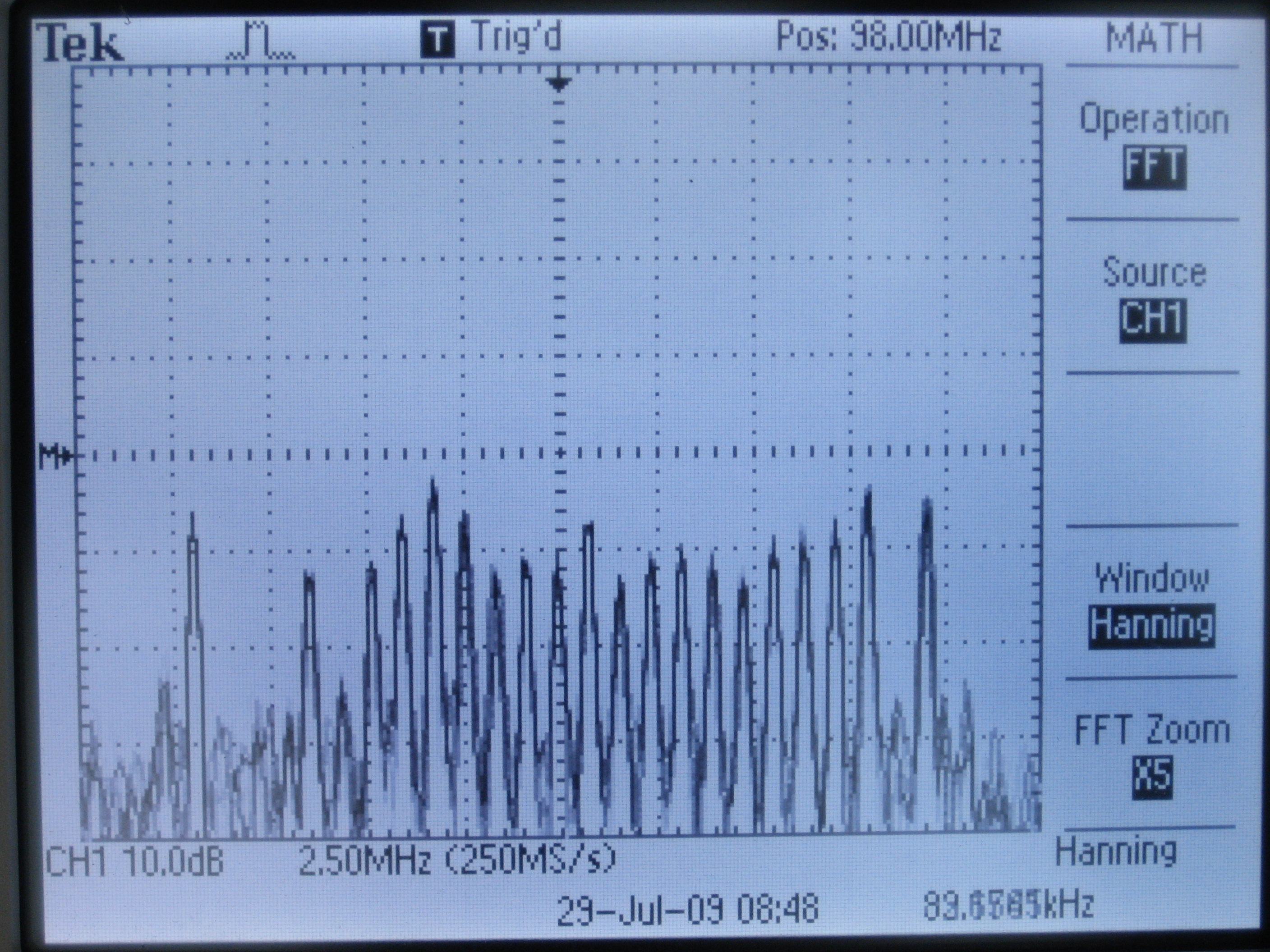
In the FM band, you can see that there are plenty of stations filling the available channels. The isolated peak on the left is WHPK-FM, the campus radio station running at 100W, and is about two blocks from my location. It sits in the non-commercial section of the FM band.
AM Radio band
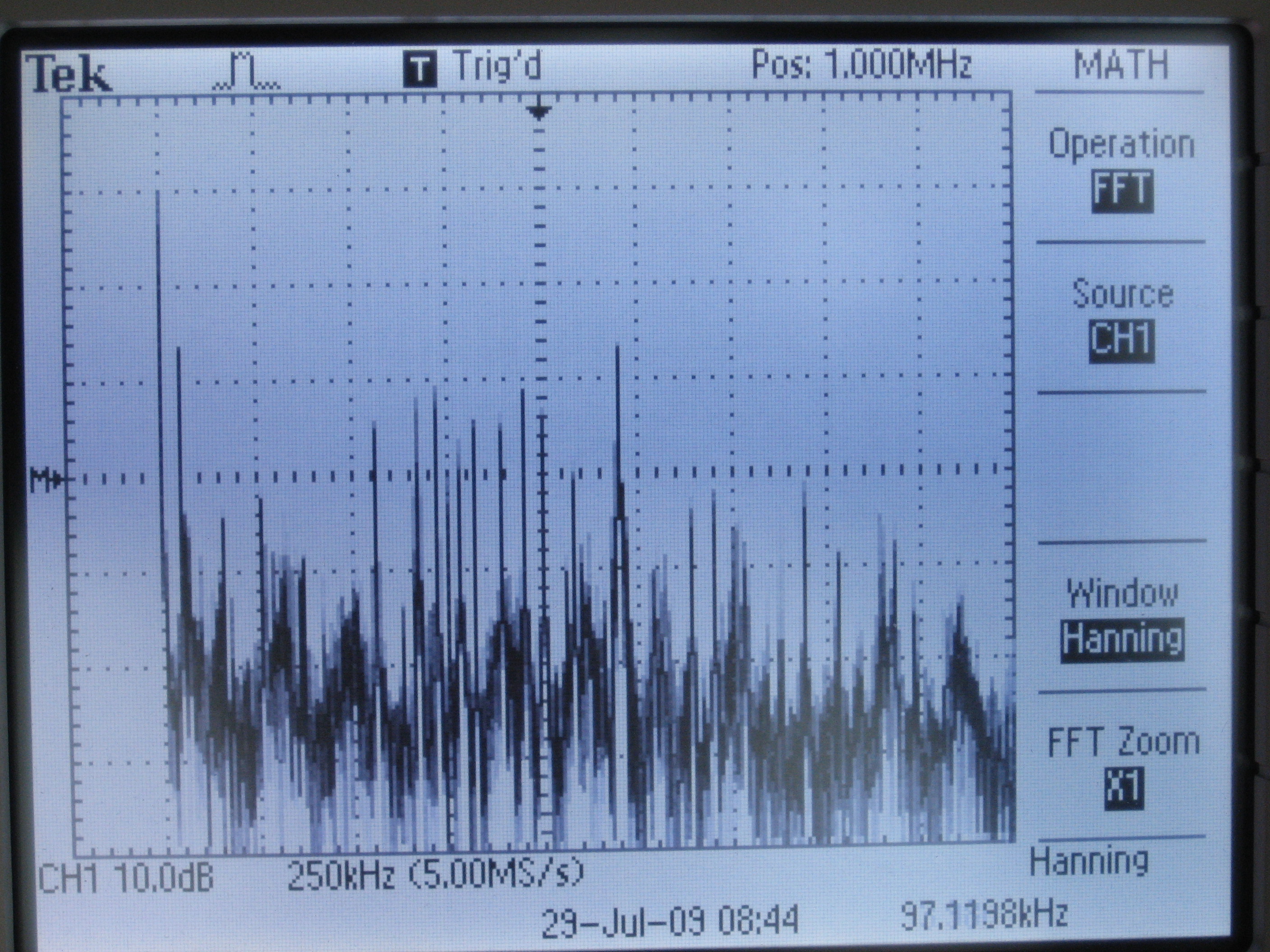
The AM radio band at my location is dominated by WRTO-AM at 1200kHz. This station gets into any cable, any wire, and if you have any rectification from a piece of corrosion, or just input an antenna directly into a PC, you will get La Tremenda.
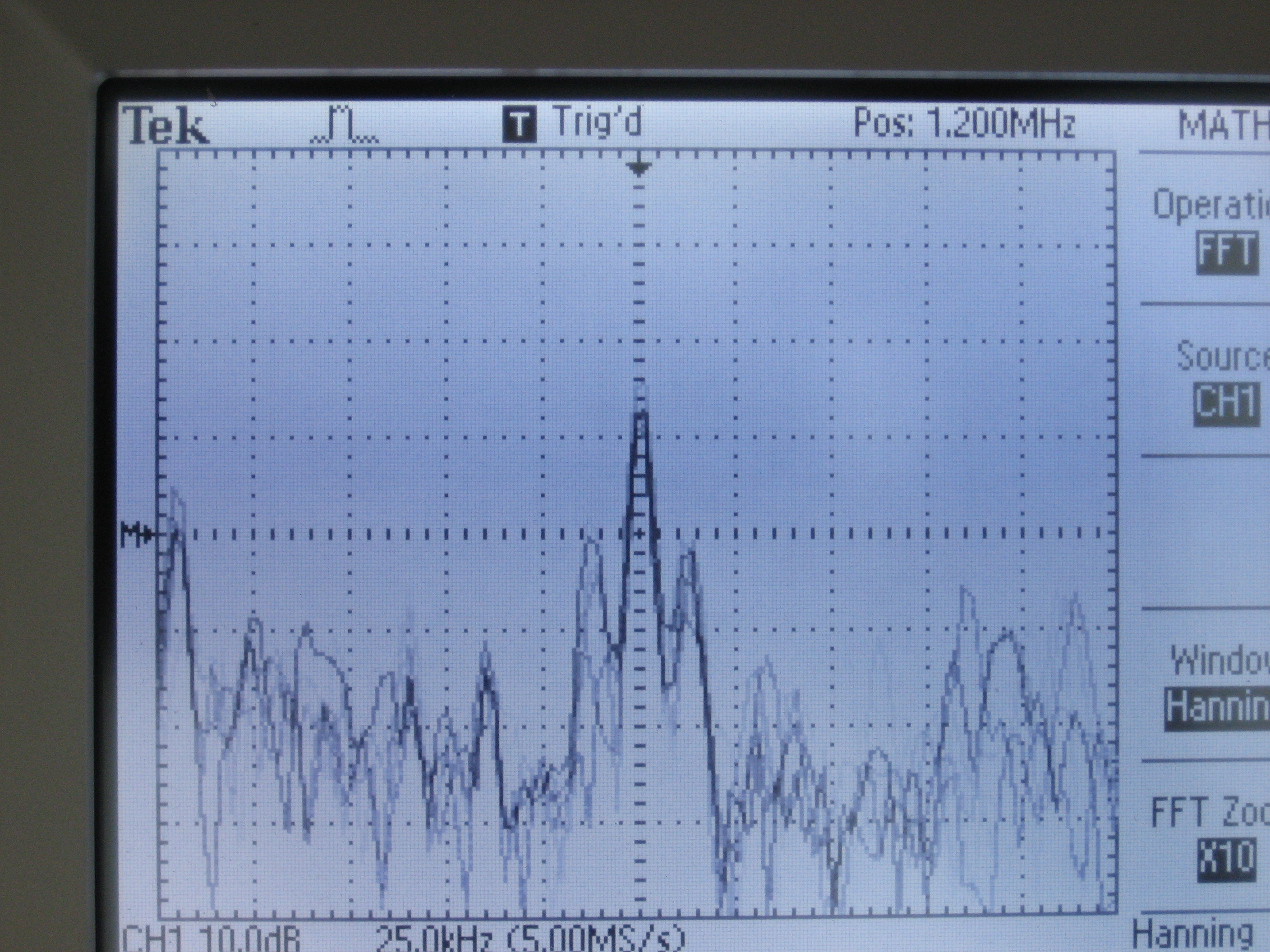
Looking closer at 1200kHz
If you look closer at WRTO's signal, you see it has a strong carrier and two sidebands further out at about 12.5kHz out. Now, when I originally saved this image, I thought I was seeing the audio sidebands of the AM signal. If the AM radio station broadcasts a single note at 440Hz, for instance, you'd see the strong carrier, and two line peaks on either side at 440Hz away. But here they are all the way out at 12.5kHz, a frequency that is present in "ssss" or a cymbal but little else. And especially not normal AM radio broadcasting, which is limited by the FCC to just a tad over 20kHz bandwidth, so the stations have to drop all their treble sounds.
It appears these outliers are the dreaded "HD radio", a hybrid technique that transmits the audio in two sidebands that exceed the normal width of an AM broadcast. Unfortunately this process violates old technical standards that allowed stations to coexist with each other. It was dropped in favor of a proprietary digital standard that allows big stations to use more bandwidth and clog up the airwaves with digital hash noise.
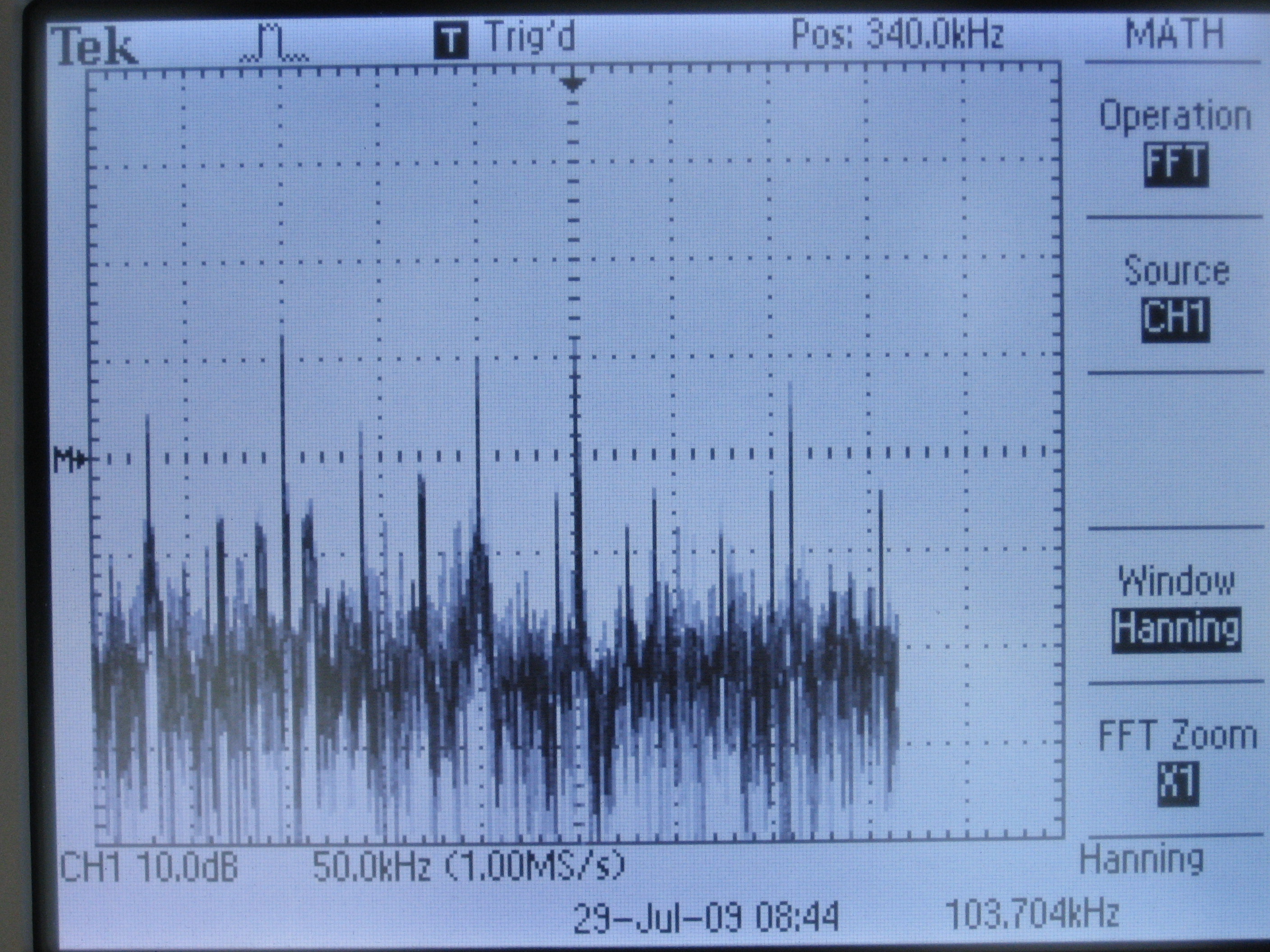
Below the AM radio band
Just below the AM band is the rest of what is known as Mediumwave or Medium Frequency, which then transitions into LW or longwave; this band is notable for non-directional beacons for aeronavigation, DGPS (or differential GPS), and lots of noise. I will have to take another spin around this band to listen to some of those peaks and see if they are real signals.
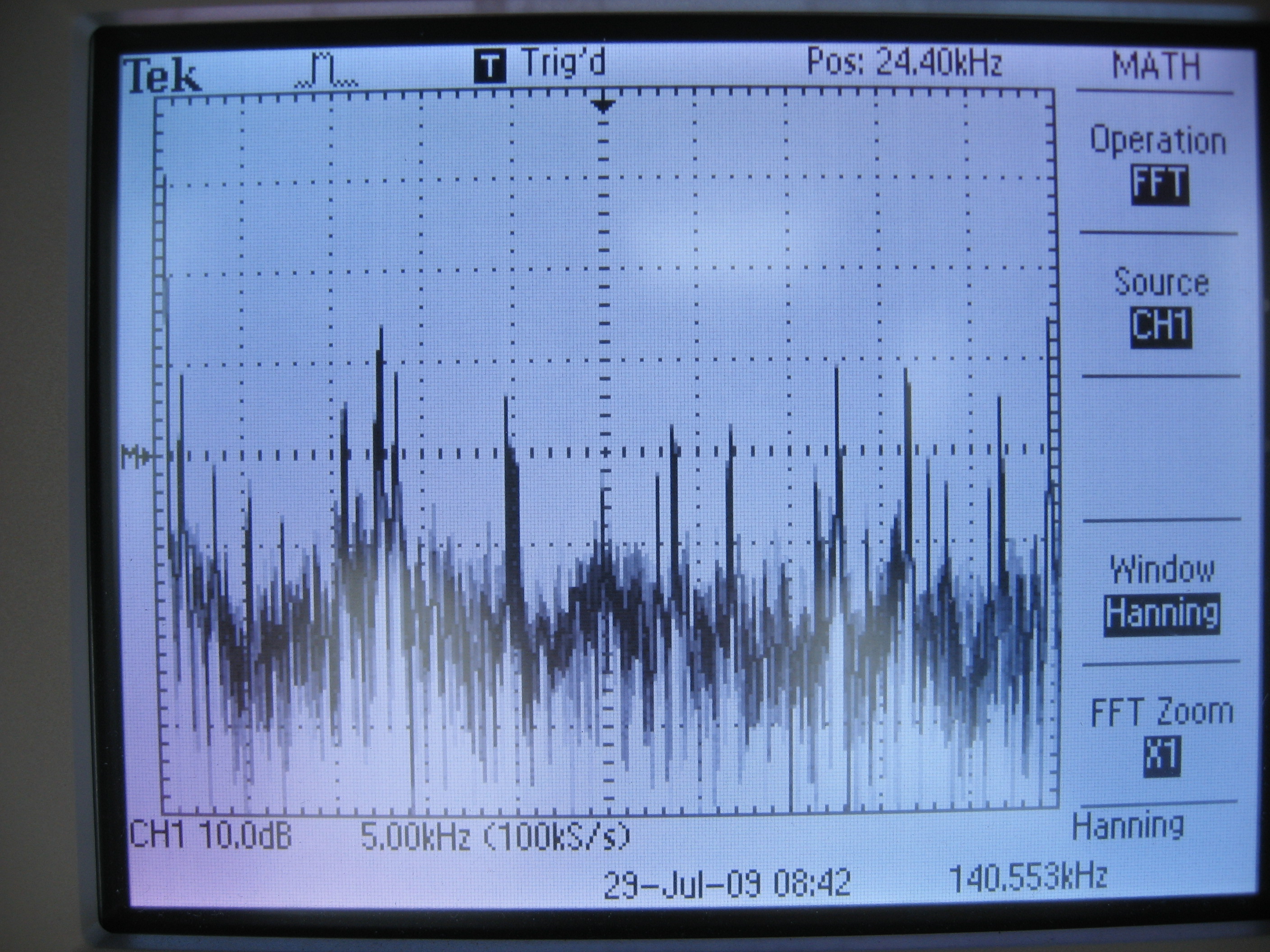
VLF Radio spectrum
Once you get down here, you start running into lots and lots of switching mode power supply noise. Various Navies around the world still broadcast on this frequency for radionavigation and uninterruptible worldwide coverage. Two of the stronger signals to the left are probably the Russian radionavigation system at 11.9kHz and 12.6kHz.
I have some other snapshots showing excellent response to the shortwave radio broadcasters of the world. It's amazing to see the whole shortwave spectrum at once instead of moving around frequencies one kilohertz at a time.
Monday, October 05, 2009
ISS at twilight
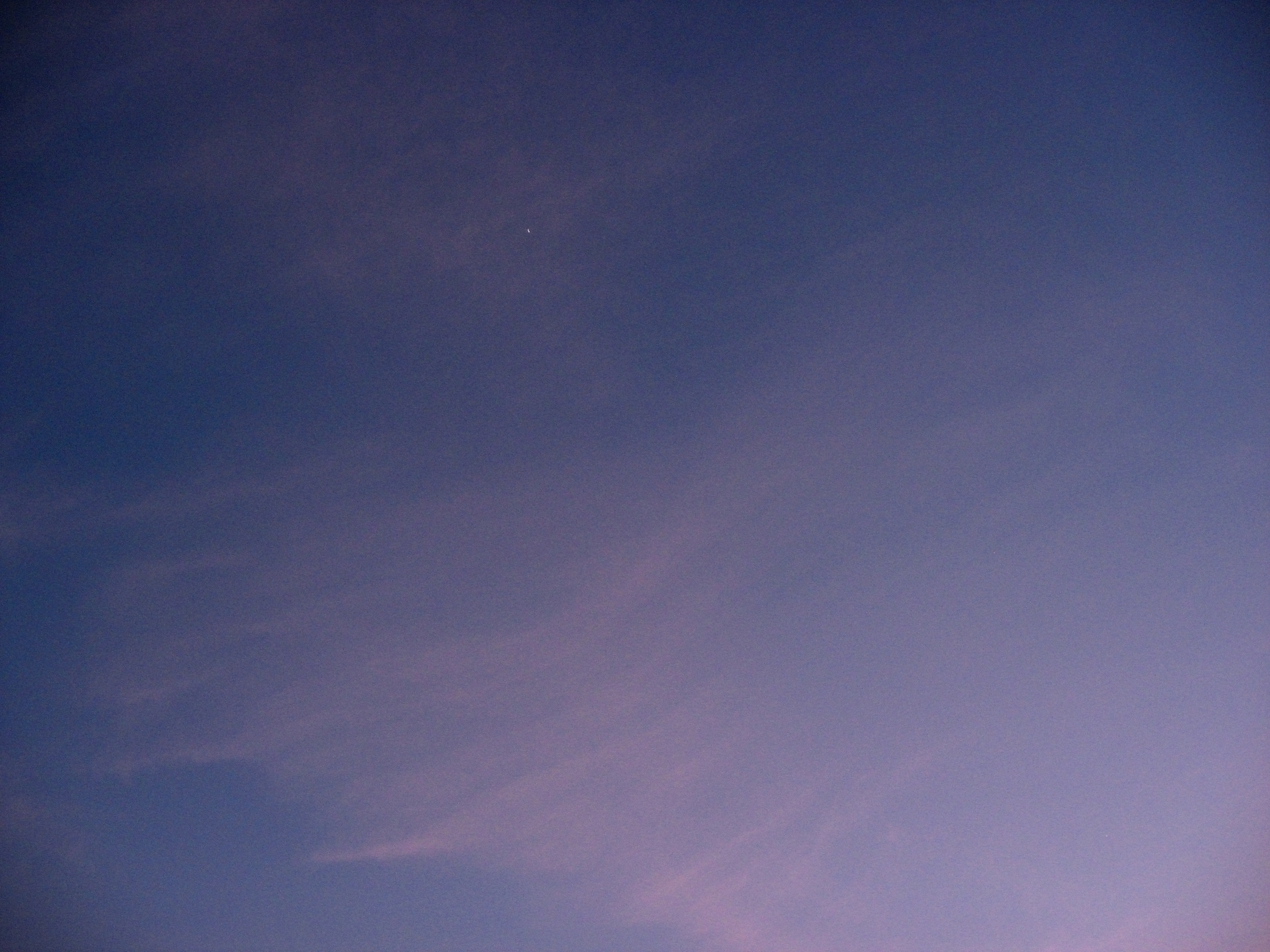
The International Space Station on September 11th, 2009, as viewed from Chicago. Click to enlarge.
Friday, October 02, 2009
near-IR Yerkes Observatory
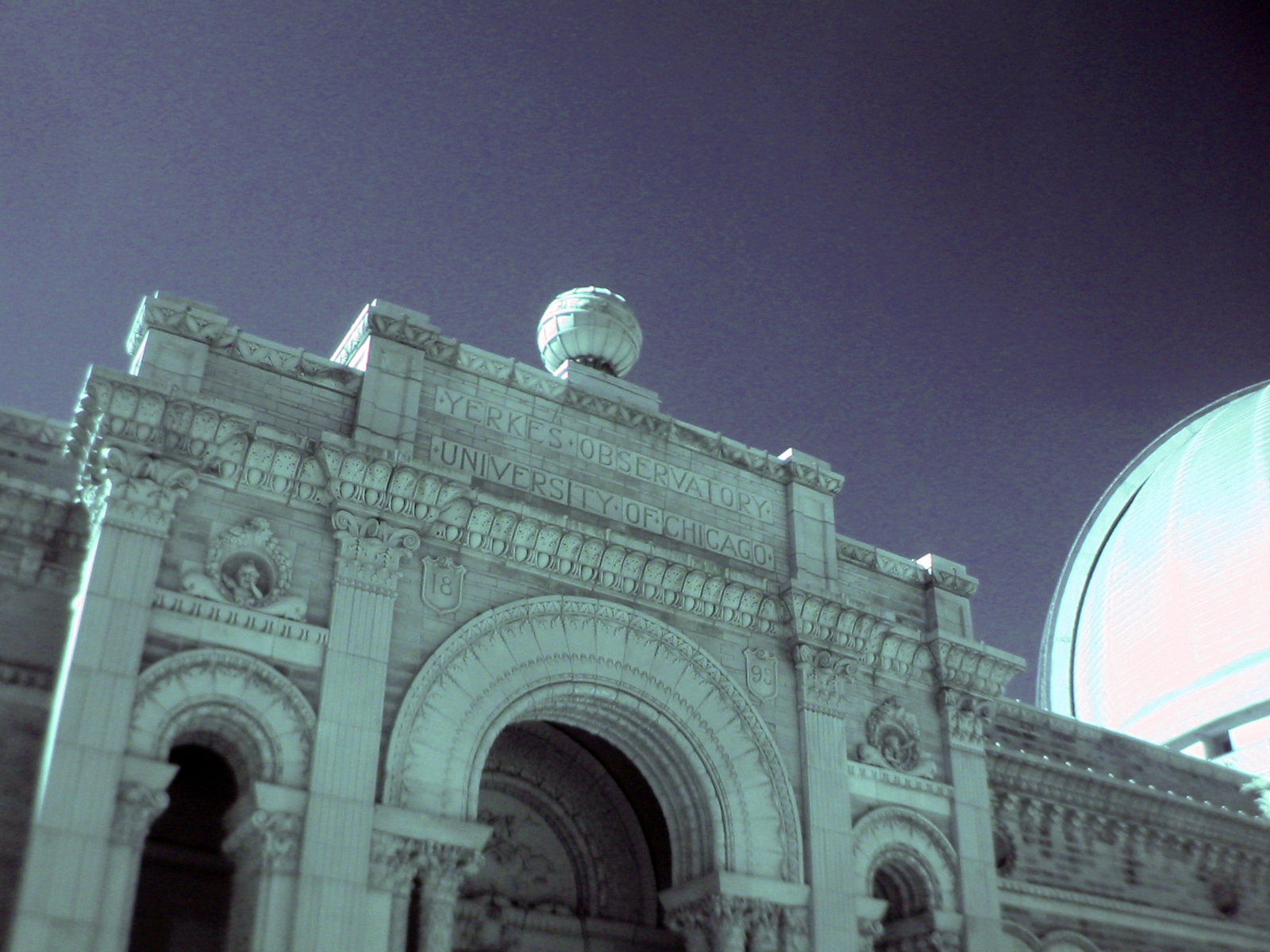
Click to enlarge. Image taken on April 22th, 2007 with Canon S300. Hue/Autolevels modified.
Subscribe to:
Posts (Atom)