"The magic numbers, as we know them now are :
2, 8, 20, 28, 50, 82, 126
and most importantly, they are the same for neutrons and protons."
Maria Goeppert-Mayer, The Nobel Lecture
The last female Nobel Laureate in Physics, 1963.
Showing posts with label physics. Show all posts
Showing posts with label physics. Show all posts
Thursday, September 30, 2010

Wednesday, June 23, 2010
nose grease
In my high school days I had a part-time job at a professional photo lab / studio called "Phillips' Photo Lab". I was hired as the black and white darkroom guy--I manually processed film, printed custom prints, shot copy negatives, and cleaned the color film and print processors. Later I branched into running the shop on Saturdays and once, just once, did a color print job.
I learned a lot from the pros whose lifeblood was photography: the tips and techniques that make life easier.
One of the things that I would not had believed unless I had personally experienced it was the magic of nose grease. The skin on the nose and to a lesser extent the neck near the back of the ears produces a hydrocarbon of about C30H50 called squalene. The only reason this is important was squalene had the same index of refraction as the gelatin used in photographic processes and hence could be used to fill in scratches on negatives and slides. You would acquire some nose grease, rub it gently into the scratch, and rewash the negative. Nearly as good as new, and it allowed prints and reproductions from otherwise damaged negatives.
This particular example is this blog's first mention of a principle I like to call "matching impedances". In the world there are a lot of interesting issues that in the end are solved or mitigated by taking two different systems and making them the same at the point they meet. In electronics, to maximize power transfer between two parts of a circuit, you match their electrical impedances (which is a function of their resistance at all frequencies).
You have encountered this when setting up a TV or stereo system; the speakers have an impedance rating on them, usually 8ohms for a home stereo and 4 for car audio. Your amplifier speaker outputs need to be designed to deal with a particular impedance; stick a 4ohm speaker on an amp designed for 8 and you might mess things up. On your TVs there used to be two terminals for antennas--one was coaxial and had an impedance of 75ohms and is now the de facto standard, and the other was two screws that had an impedance of 300ohms. To get the most signal you'd want all the impedances to match up: the TV, the cable, and the antenna. If they didn't, part of the precious signal would be reflected back towards the antenna and lost. For converting the impedances to match a little transformer was used, of which there may be a hundred million hiding behind the TVs of the world. Again, here the principle of matching the impedances came into play.
In the optical world reflections occur at surfaces that have differing indexes of refraction. The bigger the difference the higher the reflection ( I think it's a square of (n-n2/n+n2). For solar panels, for instance, the high index of refraction of silicon (4) compared to air (1) makes something like 50% of the incident light reflect off unless you use anti-reflective coatings to improve it. So even for something like a renewable energy resource you have to consider such details.
I use nose grease (n=1.45) to also try to fill in scratches in CDs/DVDs (made of polycarbonate, n=1.58). It's not perfect, but sometimes it makes it playable.
So, in the end: Match your impedances!
I learned a lot from the pros whose lifeblood was photography: the tips and techniques that make life easier.
One of the things that I would not had believed unless I had personally experienced it was the magic of nose grease. The skin on the nose and to a lesser extent the neck near the back of the ears produces a hydrocarbon of about C30H50 called squalene. The only reason this is important was squalene had the same index of refraction as the gelatin used in photographic processes and hence could be used to fill in scratches on negatives and slides. You would acquire some nose grease, rub it gently into the scratch, and rewash the negative. Nearly as good as new, and it allowed prints and reproductions from otherwise damaged negatives.
This particular example is this blog's first mention of a principle I like to call "matching impedances". In the world there are a lot of interesting issues that in the end are solved or mitigated by taking two different systems and making them the same at the point they meet. In electronics, to maximize power transfer between two parts of a circuit, you match their electrical impedances (which is a function of their resistance at all frequencies).
You have encountered this when setting up a TV or stereo system; the speakers have an impedance rating on them, usually 8ohms for a home stereo and 4 for car audio. Your amplifier speaker outputs need to be designed to deal with a particular impedance; stick a 4ohm speaker on an amp designed for 8 and you might mess things up. On your TVs there used to be two terminals for antennas--one was coaxial and had an impedance of 75ohms and is now the de facto standard, and the other was two screws that had an impedance of 300ohms. To get the most signal you'd want all the impedances to match up: the TV, the cable, and the antenna. If they didn't, part of the precious signal would be reflected back towards the antenna and lost. For converting the impedances to match a little transformer was used, of which there may be a hundred million hiding behind the TVs of the world. Again, here the principle of matching the impedances came into play.
In the optical world reflections occur at surfaces that have differing indexes of refraction. The bigger the difference the higher the reflection ( I think it's a square of (n-n2/n+n2). For solar panels, for instance, the high index of refraction of silicon (4) compared to air (1) makes something like 50% of the incident light reflect off unless you use anti-reflective coatings to improve it. So even for something like a renewable energy resource you have to consider such details.
I use nose grease (n=1.45) to also try to fill in scratches in CDs/DVDs (made of polycarbonate, n=1.58). It's not perfect, but sometimes it makes it playable.
So, in the end: Match your impedances!
Wednesday, December 16, 2009
Thursday, March 05, 2009
3 Nano -- a video project
I created this project originally for the Sights and Sounds of Science contest which was sponsored by the Chicago Materials Research Center of the University of Chicago. This particular version was made for the Five-Minute Film Festival sponsored by NSIT.
Nanocrystals are small collections of several hundred to hundred thousand atoms arranged in a crystal matrix. Quantum dots are nanocrystals made of semiconductors, and the several hundred atoms act like one giant molecule with regards to their electrons with variations in energy levels due to the size of the dot. The smaller the dot, the higher photon energy released during fluorescence.
This video was compiled from fluorescing colloidal quantum dots of different sizes excited by an argon laser. The dots are invisible (with one exception in a microscope at 2:14) but they produce the bright colors in the beam. The bits of bright blue flashes are dust particles in the solutions.
The music is from Ms. John Soda, the song is "Technicolor" from the album No P. or D.
Nanocrystals are small collections of several hundred to hundred thousand atoms arranged in a crystal matrix. Quantum dots are nanocrystals made of semiconductors, and the several hundred atoms act like one giant molecule with regards to their electrons with variations in energy levels due to the size of the dot. The smaller the dot, the higher photon energy released during fluorescence.
This video was compiled from fluorescing colloidal quantum dots of different sizes excited by an argon laser. The dots are invisible (with one exception in a microscope at 2:14) but they produce the bright colors in the beam. The bits of bright blue flashes are dust particles in the solutions.
The music is from Ms. John Soda, the song is "Technicolor" from the album No P. or D.
Monday, July 30, 2007
A simple ion chamber to measure radioactivity
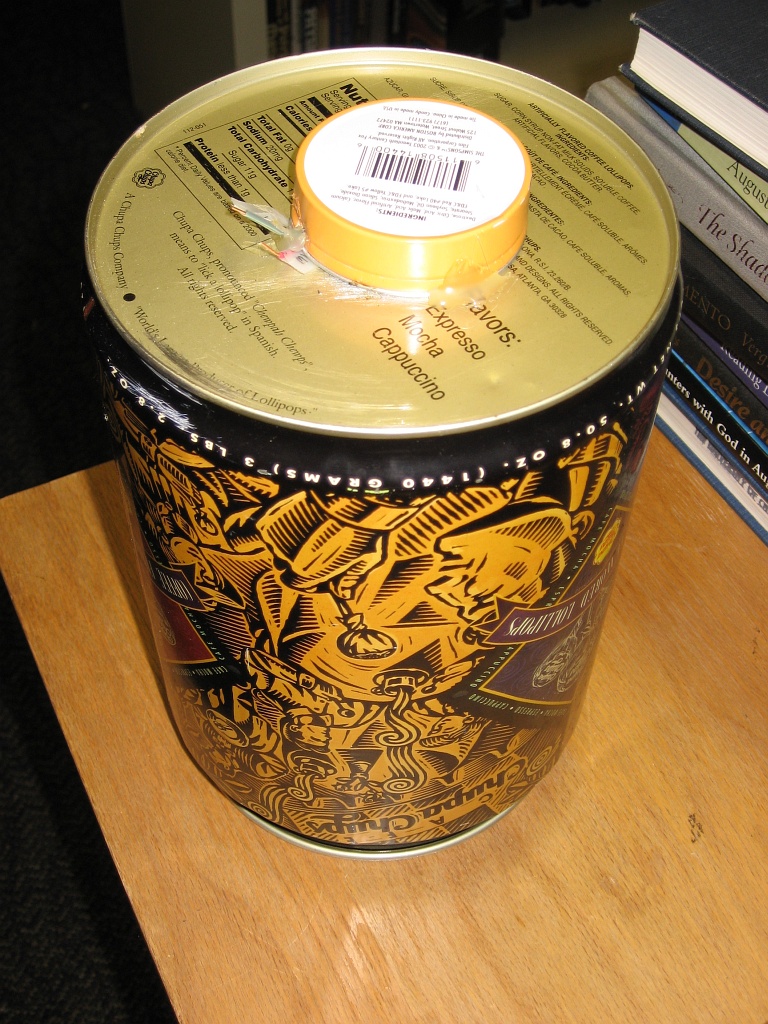
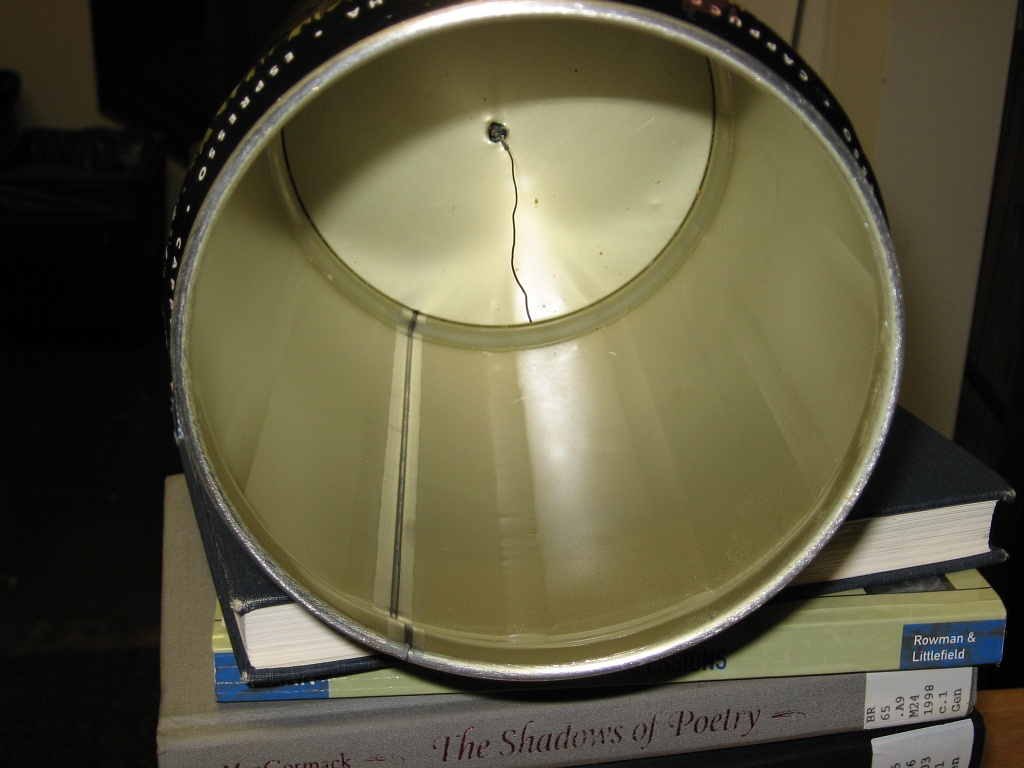
I built Charles Wenzel's simple ion chamber. It creates an electric field inside the can via a battery. A wire in the center of the can, isolated from the can, is connected to a transistor pair called a Darlington, essentially a pair of amplifiers. When ionizing radiation creates an ion in the can, the electric field drives the ion towards either the can or the wire, depending on the charge of the ion. This creates a very small current which barely turns on the darlington to allow the voltmeter to measure a small change in voltage.

I could easily up the voltage on the chamber by snapping in more 9V batteries.
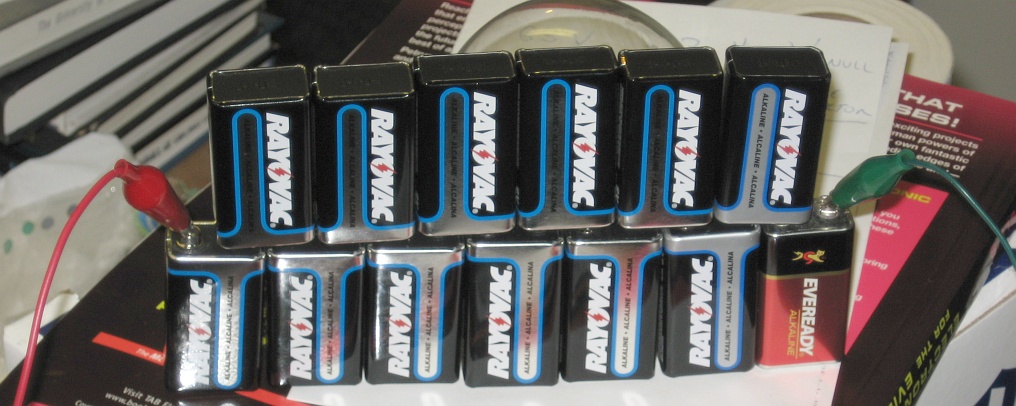
You can also light things up nicely: I had 122V DC at my disposal, although I wouldn't recommend running it for very long. Based on a rough calculation, the 40W lamp would run for an hour on this battery set, but the batteries aren't meant to source this much current (about 1/3 Amp).

I had an easy way of changing the chamber voltage, 9 volts at a time, so I measured the quiescent voltage and the voltage with a smoke detector alpha particle source in the chamber. I sealed the chamber by placing it on a sheet of aluminum foil.
| Voltage | Null voltage | alpha source |
| 36V | 4.8mV | 9.1mV |
| 45V | 7.1mV | 14.9mV |
| 54V | 11.3mV | 20.6mV |
| 63V | 23.4mV | 41.5mV |
| 72V | 1230mV | 1915mV |
| 81V | 12000mV | 12000mV |
Dear Blogger, why do you mess my table so?
Friday, July 20, 2007
The Japan nuclear plant earthquake leak
Robert Merkel does the calculations on the leaks from the nuclear power plant in Japan and makes the point most media missed: the leak of water into the ocean wasn't anything. The media missed the much larger release into the atmosphere--nearly 300 million becquerels, or about 3000x times the amount of radioactive material. (A becquerel is one atom disintegrating per second). But looking only at the total amount of radioactivity doesn't tell the whole story. A release of the noble gas krypton-85, for instance, does not really accumulate in organisms in any way; while a release of iodine-131 would concentrate and damage your thyroid. Half-lifes and the particular radiation emitted is also important in consideration: the weak beta electrons (~18keV) from tritium decay is considered not as hazardous as a multi-MeV alpha particle from polonium-210.
The reprocessing of nuclear fuel rods in France releases huge amounts of krypton-85 into the air: 1.8 × 10^17 Bq in 1994 alone.
The 90,000 becquerels of whatever went into the ocean (I am guessing it was tritium) is actually not that much: your own body has about 4000Bq of potassium-40 and 3000Bq of carbon-14 in it; in addition, at least here, tritium is allowed to be diluted by large amounts of river water in Illinois.
The end result is the release wasn't a lot; it sounded like a lot from the numbers, but that's due to the definition of a Becquerel more than anything else. The reality is most people don't have much of an education on radioactivity, and this affects how they irrationally perceive a risk.
All of this is really just a minor detail though, when the real issue is any delay or hiding of release information, which according to the press is endemic in the Japanese nuclear industry.
UPDATE: I've found descriptions of the leaks here. The spent fuel pool water sloshed onto the floor and leaked out via cabling. The second leak, to the atmosphere, was iodine and radioactive dust from a main exhaust line.
The reprocessing of nuclear fuel rods in France releases huge amounts of krypton-85 into the air: 1.8 × 10^17 Bq in 1994 alone.
The 90,000 becquerels of whatever went into the ocean (I am guessing it was tritium) is actually not that much: your own body has about 4000Bq of potassium-40 and 3000Bq of carbon-14 in it; in addition, at least here, tritium is allowed to be diluted by large amounts of river water in Illinois.
The end result is the release wasn't a lot; it sounded like a lot from the numbers, but that's due to the definition of a Becquerel more than anything else. The reality is most people don't have much of an education on radioactivity, and this affects how they irrationally perceive a risk.
All of this is really just a minor detail though, when the real issue is any delay or hiding of release information, which according to the press is endemic in the Japanese nuclear industry.
UPDATE: I've found descriptions of the leaks here. The spent fuel pool water sloshed onto the floor and leaked out via cabling. The second leak, to the atmosphere, was iodine and radioactive dust from a main exhaust line.
Friday, July 13, 2007

Subscribe to:
Posts (Atom)