Monday, May 18, 2009
What is going on with the Herschel and Planck missions?
The European Space Agency launched an ambitious set of satellites a few days ago: Herschel is a 3.5m diameter infrared telescope, and Planck is a cosmic microwave background telescope. Both are planned to be placed in one of Earth's Lagrangian points called L2. Upon launch such large objects can be tracked with optical telescope for a while. Upon examining these images, astronomers found not two objects, but at first four, which turned out to be the booster rocket and the structure holding both satellite while launching (see here). But later, they found two more fainter objects. These objects have seemingly moved off of the Herschel/Planck trajectory. What were they? The other more disturbing news came today, when Jean-Claude Pelle of Southern Stars Observatories reported finding dozens of new objects in the same path. This implies a possible failure of one or more of the telescopes and would be a blow to science.

Tuesday, May 12, 2009
ISS passes for Chicago
UPDATE 7/06/2009: Here's the current set of passes.
There are another set of convenient evening passes of the International Space Station over Chicago until the end of the month. Last night we watched it streak across the sky in five minutes from Ryerson. Through the telescope at low power it was two blazing white ovoids with two small orange dots on one of the white blobs.
There are another set of convenient evening passes of the International Space Station over Chicago until the end of the month. Last night we watched it streak across the sky in five minutes from Ryerson. Through the telescope at low power it was two blazing white ovoids with two small orange dots on one of the white blobs.
Tuesday, April 21, 2009
Spy numbers station on shortwave
I've heard this strong station several times now over the past year, usually later at night. It always broadcasts at 5900 kHz (or now that I think about it, have I picked it up at 9800kHz?). I picked this up Monday night/Tuesday morning, April 21st, just after 00:34 CDT (5:34 UT).
The station is pretty strong here in Chicago, with only occasional fading, and it sends a modified CW signal that can be picked up with any shortwave receiver. It only uses three digit code letters in groups of five: those Morse Code letters that are described by three combinations of dots and dashes, minus S and O, which are dot-dot-dot and dash-dash-dash.
5900-spystation.mp3 audio file, 7.43MB
Decoded, the file yields this:
DAUWN WIWNW GDNWR UTWAT RGAID INWTA NUGIW UIWWA GINRT NRDWI DNRUT RDAUG NNAII TWIIR UDDNA ATDGT NUART DTIWU IUWWI TINUW ADNIT RRRWT DATRA DUWGW NGINI UTDTR IDIRA DRUDD NIDTU IIDRG URWUU GTTNI UIWIR UITND ATTDI WARGR DGTGD DWIRD AIIAI ARDTI TIGDU GRUWI AUTRT NTWNU GRUUU TUGUG AAARI TRRNG TTDAA WUWGU NNATW WNGRN TNRAN DRUTN DWUGU RDAUN RGGNN TNWNN WDGDD WARGA DDGNN DUDTA RRNNN RWTNU RUWTI GRTIA UDAAN ITIUG UIIAR WIUTU IATNT UDNGN ARGNT TAAWU WUADN DAARW INRGR GNNAG ADGRU GNWWR GWGUD WDNNA URRAR WITIN RRDAD AIDRR GUAUG INANU DIWUI WAGAN NRUUN AWRAD DWRNR UTRAU INIDR UITUN ATDUG RUUAA UIGWT DAIUI AIRRD ANAIN IDATI WDIUG WTNAD UNRAI GNDTR ADNNI DUNGR RDWDI UGTUD TDATG GIGUG IAANA DRDTD TGIGN GWUNN GWIII ADWDD
The actual contents of this message are presumbly only known by the intended spy and the agency that sent the one-time pad message to them.
The station is pretty strong here in Chicago, with only occasional fading, and it sends a modified CW signal that can be picked up with any shortwave receiver. It only uses three digit code letters in groups of five: those Morse Code letters that are described by three combinations of dots and dashes, minus S and O, which are dot-dot-dot and dash-dash-dash.
5900-spystation.mp3 audio file, 7.43MB
Decoded, the file yields this:
DAUWN WIWNW GDNWR UTWAT RGAID INWTA NUGIW UIWWA GINRT NRDWI DNRUT RDAUG NNAII TWIIR UDDNA ATDGT NUART DTIWU IUWWI TINUW ADNIT RRRWT DATRA DUWGW NGINI UTDTR IDIRA DRUDD NIDTU IIDRG URWUU GTTNI UIWIR UITND ATTDI WARGR DGTGD DWIRD AIIAI ARDTI TIGDU GRUWI AUTRT NTWNU GRUUU TUGUG AAARI TRRNG TTDAA WUWGU NNATW WNGRN TNRAN DRUTN DWUGU RDAUN RGGNN TNWNN WDGDD WARGA DDGNN DUDTA RRNNN RWTNU RUWTI GRTIA UDAAN ITIUG UIIAR WIUTU IATNT UDNGN ARGNT TAAWU WUADN DAARW INRGR GNNAG ADGRU GNWWR GWGUD WDNNA URRAR WITIN RRDAD AIDRR GUAUG INANU DIWUI WAGAN NRUUN AWRAD DWRNR UTRAU INIDR UITUN ATDUG RUUAA UIGWT DAIUI AIRRD ANAIN IDATI WDIUG WTNAD UNRAI GNDTR ADNNI DUNGR RDWDI UGTUD TDATG GIGUG IAANA DRDTD TGIGN GWUNN GWIII ADWDD
The actual contents of this message are presumbly only known by the intended spy and the agency that sent the one-time pad message to them.
Monday, April 13, 2009
SO2 plume from Galapagos volcanic eruption
You can see the sulfur dioxide (SO2) plume from the Galapagos volcanic eruption via the OMI on the Aura satellite (which I'm using to watch for hopefully great sunsets here):

NOAA/NESDIS/NASA-Goddard -- Click to enlarge to global view
NOAA/NESDIS/NASA-Goddard -- Click to enlarge to global view
Thursday, April 09, 2009
400 Years of the Telescope: Friday on PBS
This such an auspicious year. I watched an interview on Chicago Tonight with one of the creators of "400 Years of the Telescope", to be broadcast on PBS this Friday. Immediately a shot of the Yerkes 40-inch refractor passed by in glorious HD, a scope I am intimately familiar with, and now I am compelled to watch. Friday at 8PM on WTTW. Of course, I am very happy when E.E. Barnard pops up on the schedule page on the site--Barnard's experimentation with astrophotography has a tie to the RAS observatory: our 1895 Warner and Swasey mount was first lent to Yerkes Observatory so Barnard could test camera lenses.


Tuesday, April 07, 2009
Radio astronomy dish raising

Joe Cottral managed to get a spare 2.5m satellite dish from western Illinois to Chicago. The rest of the RAS had the responsibility of getting the dish from ground level up to our 6th floor aerie. We decided on raising the dish as reasonably quickly as possible, to reduce the annoyance factor for all non-involved. We also picked after much observation and discussion to raise the dish via the southeast corner of Ryerson which is an elevated turret. The reason being the turret allowed easy transfer over the parapets of Ryerson. The loading dock offered easy vertical lift, and the fire escape offered quick one-story lifts, but in the end, Lui's suggestion of the turret was the superior option.
Now, we have to 1. acquire a receiver capable of 1420MHz and 1.6GHz-ish, 2. Clean up the dish mounting steel, 3. Mount the dish on Ryerson with lots of Quikcrete, 4. Get microwave-capable cable, 5. get a low-noise-amplifier, and 6. put it all together. Minor bit there. Oh yes, and decide where to place it on the roof.
Tuesday, March 31, 2009
Photo from the last Shuttle mission to the ISS
This has been sitting in one my browser tabs for a little while and too good not to share.

Click to enlarge. Original is 4288x2929.

Click to enlarge. Original is 4288x2929.
Friday, March 27, 2009
Redoubt volcano: image of the week
This is definitely the image of the week for the Redoubt eruption.

This is from a Japanese weather satellite staring at the Western Pacific, and the volcano is near the limb of the Earth from its perspective.
Picture Date: March 26, 2009 17:30:00
Image Creator: Dehn, Jonathan / NWS
This is from a Japanese weather satellite staring at the Western Pacific, and the volcano is near the limb of the Earth from its perspective.
Picture Date: March 26, 2009 17:30:00
Image Creator: Dehn, Jonathan / NWS
Thursday, March 26, 2009
Redoubt volcano ash plume and sunsets
You may recall some fantastic sunsets in Chicago this summer from some eruption in the Aleutians. Now, since Redoubt has erupted, I was curious if the plumes were heading this way. In July I was unable to find readable (i.e. a common image format) data from the ozone monitor on the Aura satellite (which can track SO2 emissions as well). But now I've found this stuff, and it looks like at least one plume is over the contiguous 48 states, and Chicago in particular:

So if it's clear for you, and there is a plume somewhere within a few hundred miles of you, hope for a great sunset or sunrise!
It appears based on the weather there will be no clear sunsets for a while in Chicago though.

So if it's clear for you, and there is a plume somewhere within a few hundred miles of you, hope for a great sunset or sunrise!
It appears based on the weather there will be no clear sunsets for a while in Chicago though.
Wednesday, March 25, 2009
Messier 77 - a galaxy in Cetus
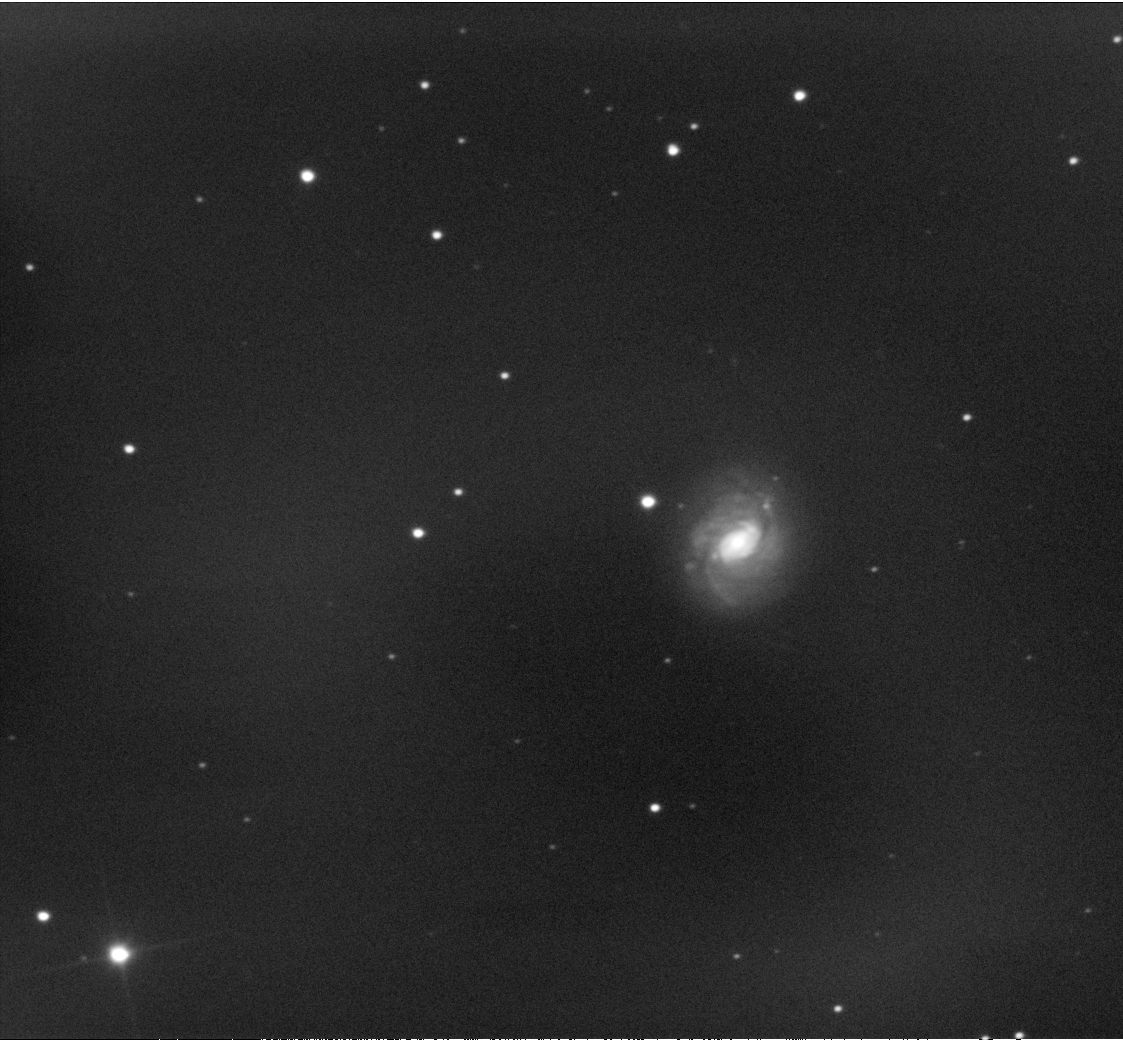
Messier 77, a spiral galaxy in Cetus. Click to enlarge. About 30 minutes exposure.
This galaxy is about 50 million light-years away. At the core of M77 is a well-studied massive and active black hole of at least 100 million solar masses.
Tuesday, March 24, 2009
Realuminizing a reflection grating
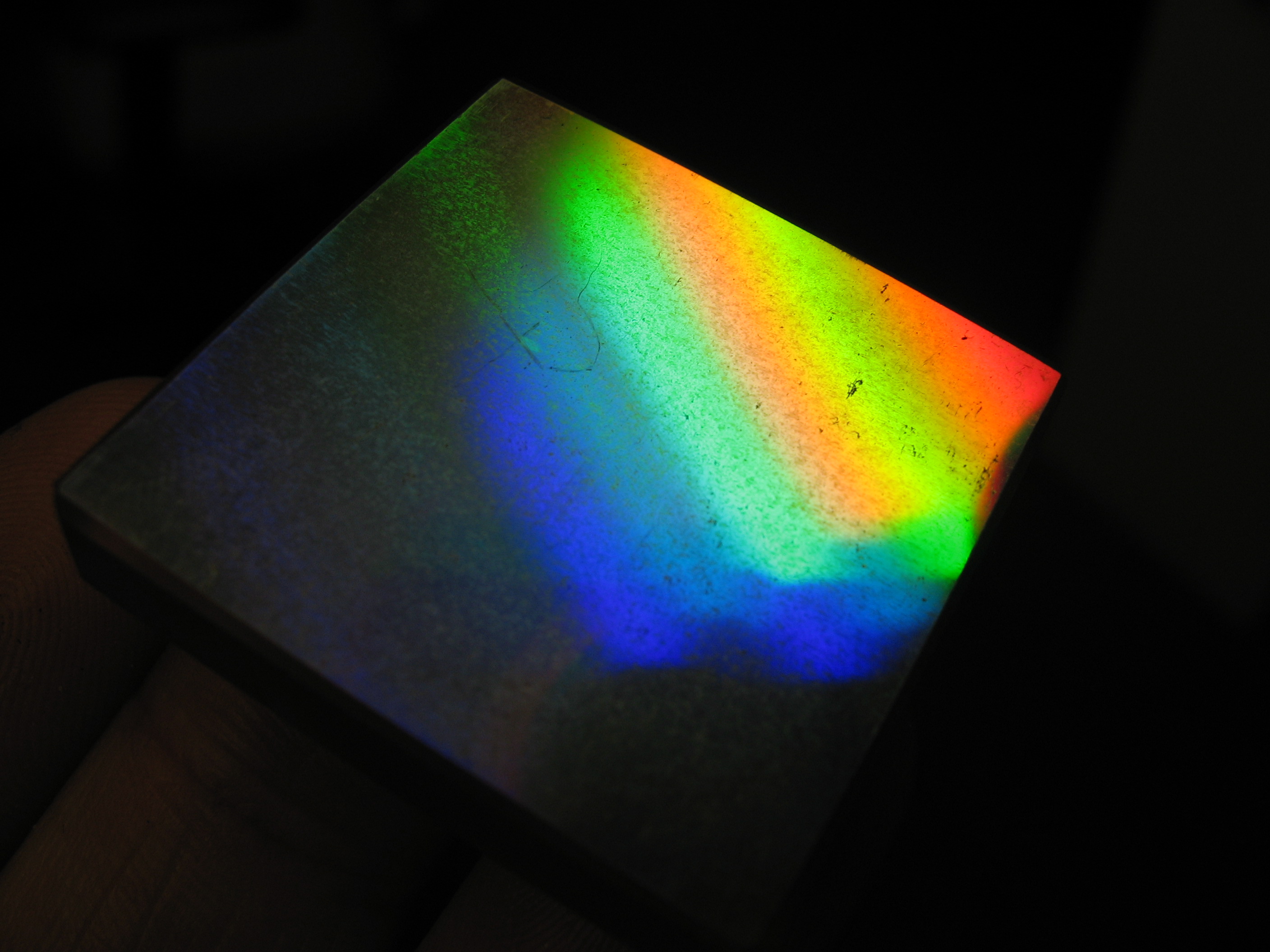
An old reflection grating
When John Crocker and I built the RAS solar spectroscope (see some of the spectra here), we had no budget for the project. We used what was available and free for us to use; so we used blue acrylic as the structural material of the spectroscope; razor blades for the slit; spare singlet convex lens for the collimator, a surplus finderscope as the viewing scope; and finally, we bought 3 "defective" surplus reflection gratings from Edmund Scientific. This was the special--they were defective in some manner, enough to fail some sort of specification, but not enough to be truly defective. You couldn't specify resolution or anything; so we bought three on the correct thought that one of them would likely match our specs.
Over the years the aluminum corroded and was giving a lot of scatter in the spectroscope; what this did was create a gray mush on top of the spectrum. So I endeavored to get the grating recoated.

Fluorescent light spectrum
Eventually, I discovered someone willing to use a coating machine on campus to recoat the grating. This meant I should prepare the grating for recoating, and I removed it from the spectroscope for a bath. Standard techniques for removing aluminum off of glass require something that will dissolve the metal but not hurt the glass surface. NaOH is out as it like many bases will etch glass. Instead a good acid is needed. Nitric is popular, but I did not have any. I thought about glacial acetic acid, since we have some as stop bath. But I realized I had hydrochloric acid, another excellent acid for this process. That source was toilet bowl cleaner. I had some already, instead of going to the hardware store for muriatic acid (an obsolete name for hydrochloric). A note: depending on your retailers, the muriatic acid at the hardware or pool store may be cheaper than toilet bowl cleaner. It is certainly a purer source.
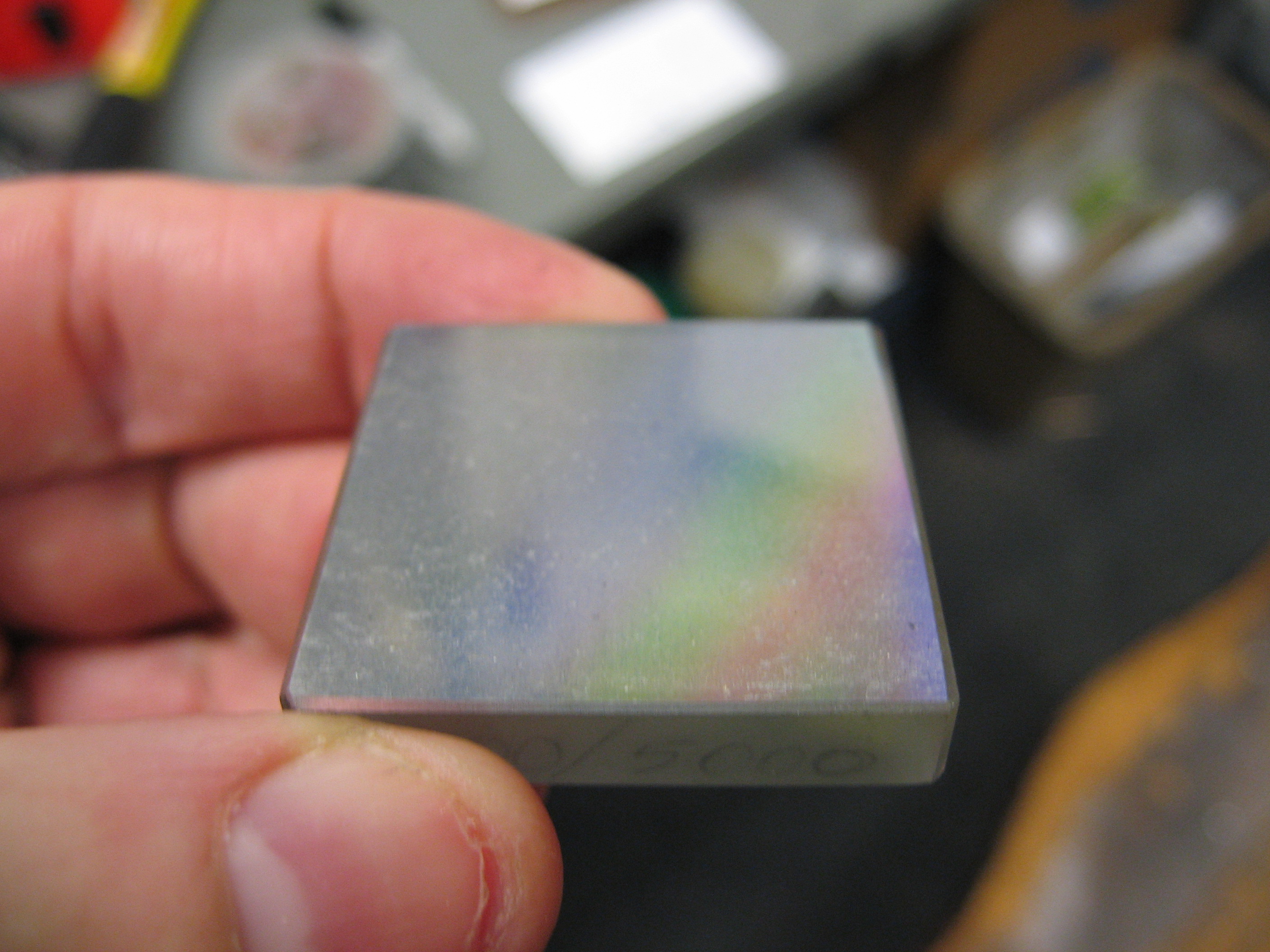
A view of the oxidized old coating.
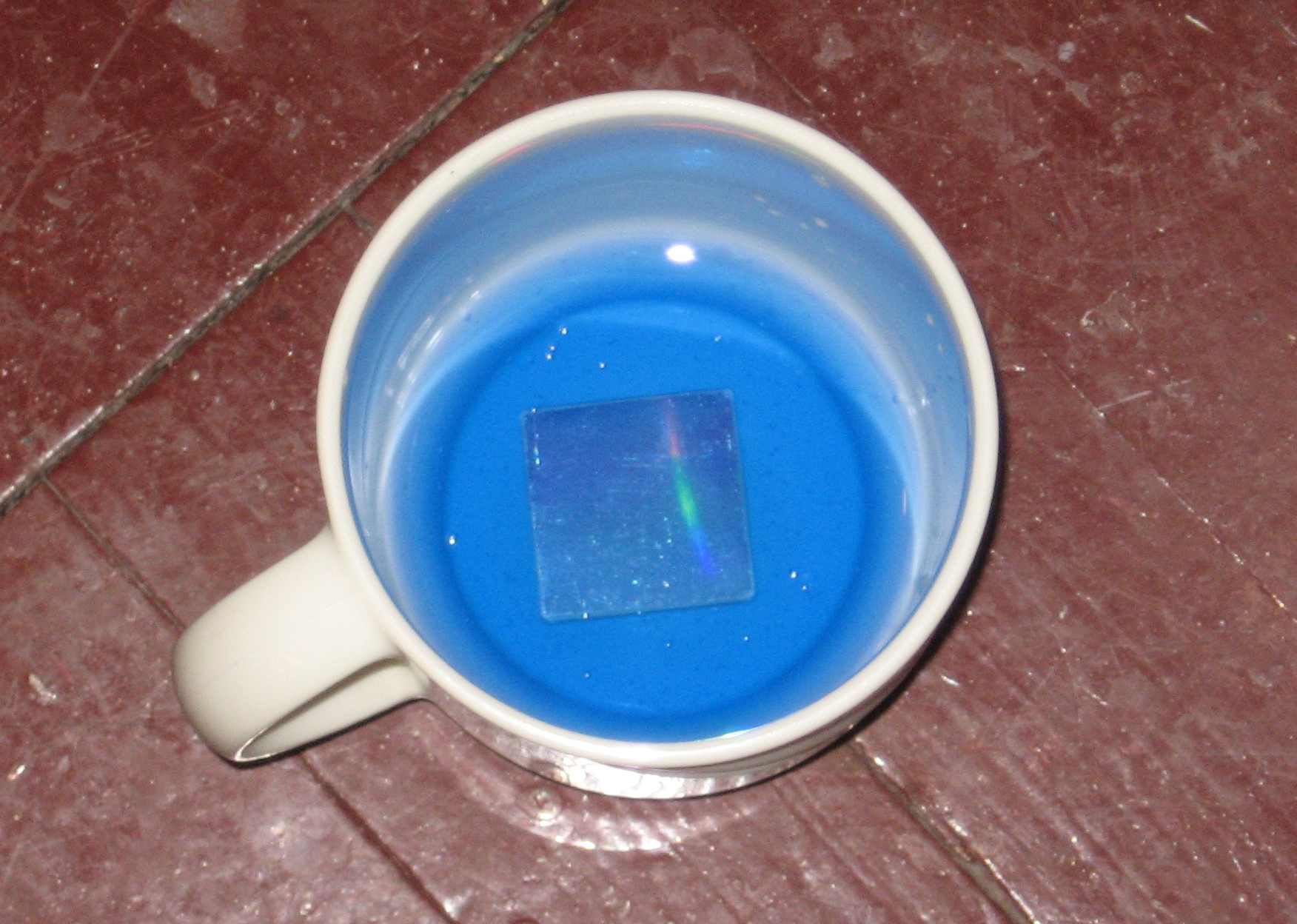
Smells fantastic, but don't breathe deeply. Acid fumes.
After a while I was concerned the metal was not coming off. A test piece of aluminum foil started dissolving in minutes, so I knew the problem was with the grating. Some old coatings can have such a thick aluminum oxide coating that the underlying metal is protected from the acid, and one trick is to damage the coating via a pinprick or scratch near the edge. I decided to try scotch tape--it can remove surfaces nicely.
A first pass pulled off half the aluminum coating, oxide and all. Success! I could see the grating underneath. But disaster struck on the second pass.
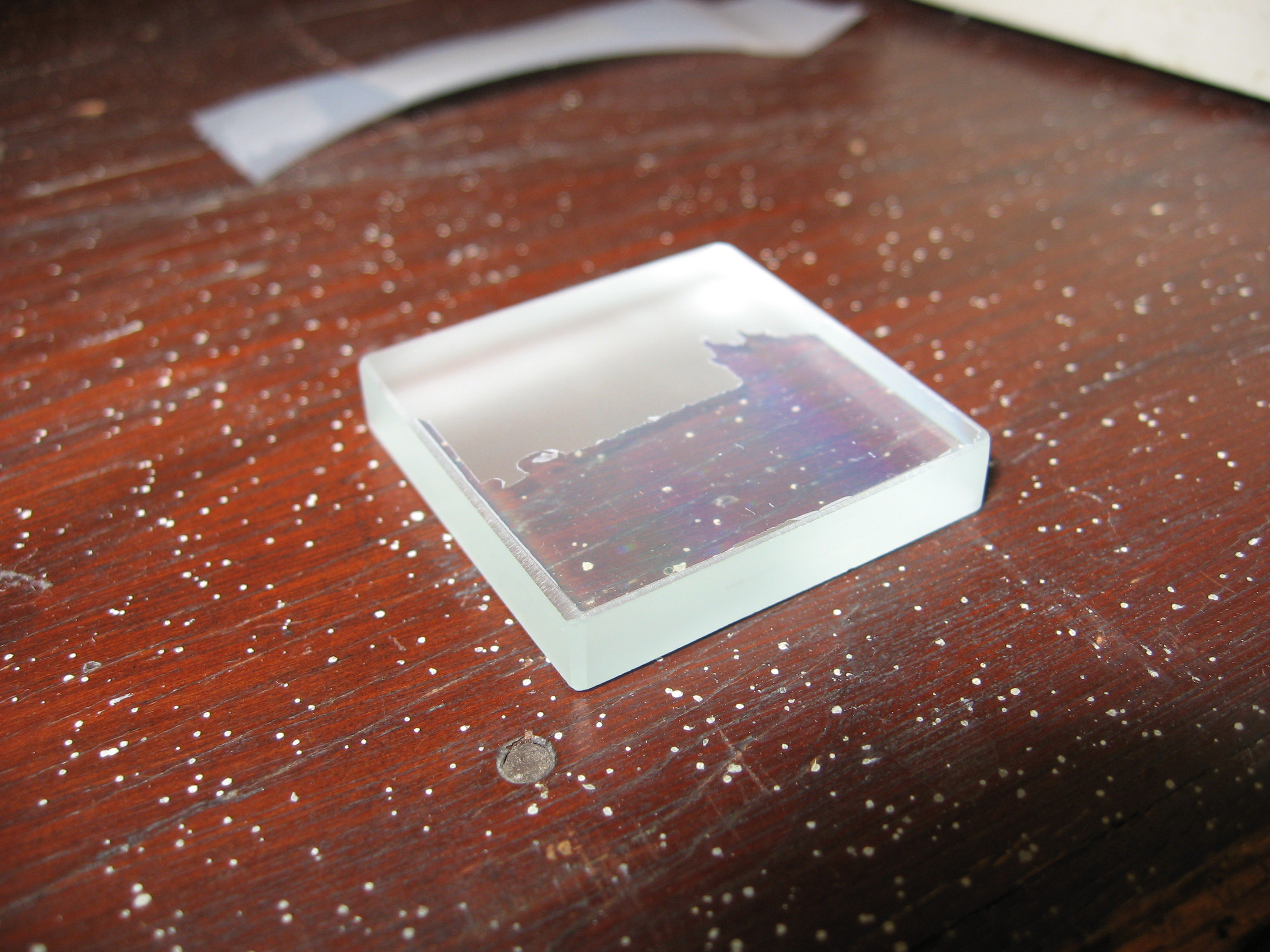
You see, I had assumed the grating was actually on the glass: a long repetition of grooved lines in the glass. Instead, it was a thin layer of plastic replica glued on top. The second pass with tape removed the grating, leaving me with a worthless piece of frosted glass. So much for a simple near-zero cost for repairing the spectroscope. But now I have wintergreen-smelling fresh glass squares.
Friday, March 20, 2009
Solar cells from donuts and tea
It's been posted everywhere, and it doesn't acknowledge the source of the idea as far as I can tell, but here's a fantastic little video about making solar cells out of materials derived from powdered donuts and tea. He isolates titanium dioxide from the powder and sensitizes it with anthocyanins from a Tazo passion hibiscus tea. Here is a high school teacher doing the same project, with numerical data & extra science that you can't really fit in a video.
Still, I love these sort of suprising projects.
Still, I love these sort of suprising projects.
Crescent Venus movie
I took this Wednesday evening. Venus is close to the Earth, big in angular size, close to the Sun and getting lower every day. Turbulence, turbulence, turbulence. And an orange filter.
Thursday, March 19, 2009
Shuttle ISS pass in Chicago on Tuesday
I caught one of the ISS/Shuttle passes on Tuesday evening. All the shakiness of the Shuttle is me and not the Space Shuttle, obviously.

You still have some chances to see them pass, even if they aren't perfect passes.
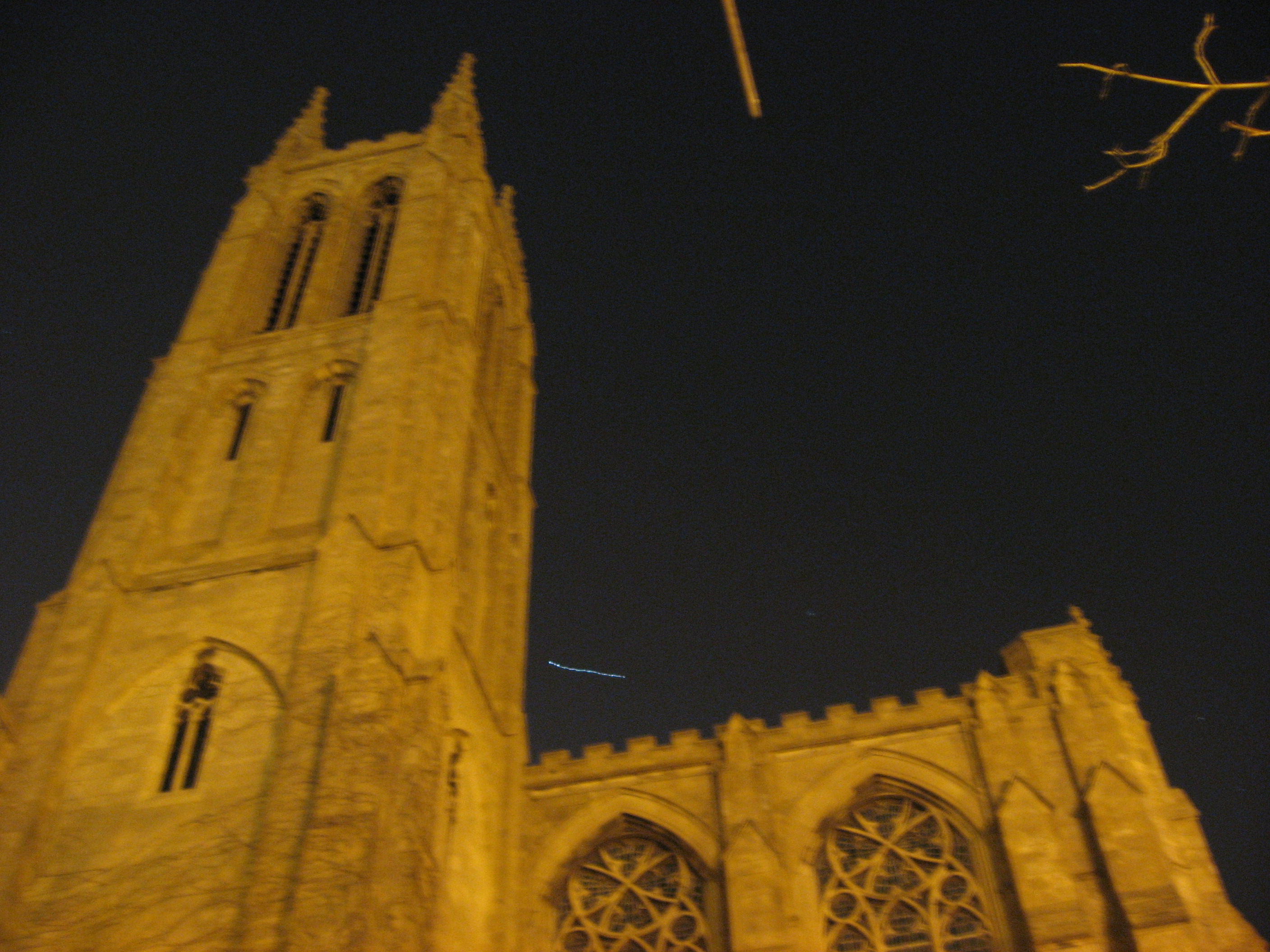
You still have some chances to see them pass, even if they aren't perfect passes.
Wednesday, March 18, 2009
Leo 1: a local group galaxy
Leo 1 is a dwarf galaxy located about 800,000 light years away in the constellation Leo. In fact, you can nearly pinpoint the location of the galaxy with your naked eye by looking at the bright blueish star Regulus. (You can find Regulus, if you don't know many constellations, by looking at the Big Dipper. Know the pointer stars on the bowl that point to Polaris? If you go backwards from them, they point to Regulus). Regulus is only a 1/3 a degree away from this galaxy, and its glare is always in the way. Take a look at this fantastic image from Russell Croman
Occasionally slightly crazy, I decided to attempt to image this galaxy last Friday. The moon had just risen and it was slightly hazy. In other words, I was completely crazy.

About 45 minutes exposure. Click to enlarge
It's tough to see, but look at the slightly knobbier noise just to the bottom right of center. Compared that to the noise in the rest of the image. You can use the two stars in the upper left to compare the frame with this image from Wikipedia/Digital Sky Survey/STScI:

I definitely need to get some better flats made.
Occasionally slightly crazy, I decided to attempt to image this galaxy last Friday. The moon had just risen and it was slightly hazy. In other words, I was completely crazy.

About 45 minutes exposure. Click to enlarge
It's tough to see, but look at the slightly knobbier noise just to the bottom right of center. Compared that to the noise in the rest of the image. You can use the two stars in the upper left to compare the frame with this image from Wikipedia/Digital Sky Survey/STScI:

I definitely need to get some better flats made.
Subscribe to:
Posts (Atom)