NASA/JHUAPL/Carnegie
Mercury from Messenger's closest approach, edited to highlight the terminator from the stock release image.

In the living room, for example, where there are four recessed lights along one wall, Mr. Chipman tested six dimmable bulbs and determined that one made by Greenlite with the same hue as incandescents worked best in certain spots, attractively lighting an exposed brick wall and maple bookshelves. A Satco brand bulb with a slightly whiter hue made a limestone-tiled fireplace in the middle of the wall look best, so he installed one above it. Mr. Chipman’s wife, Liz Diamond, 53, a theater director who considers herself even more particular about aesthetics than her husband, said investing time in trying multiple bulbs made a big difference. “There was one bulb that made the limestone look really freaky, ugly and moldy,” she said, but the Satco bulb now in place makes the space look “fabulous.” “I was amazed at how much variation there was, but you can really get a color that you like,” she said. Mr. Chipman agreed. “You really have to experiment with different bulbs to find the ones that work for you,” he said. “But they exist.”
This unfolding story and the present results have been made possible by the tracking efforts of many astronomers at several observatories around the world:
* 2007 WD5 was discovered using the Mt. Lemmon 1.5-meter telescope by Andrea Boattini of the University of Arizona's Catalina Sky Survey, which is led by Steve Larson.
* Follow-up from archival images taken by the 1.8-meter telescope on Kitt Peak in Arizona were provided by Terrence H. Brezzi of the University of Arizona's Spacewatch Project, which is led by Robert McMillan.
* Andy Puckett of the Univ. of Alaska obtained pre-discovery measurements from archival images of the Sloan Digital Sky Survey’s 2.5-meter telescope on Apache Point, NM.
* Bill Ryan of New Mexico Tech's Magdalena Ridge Observatory observed 2007 WD5 on several crucial nights, with critical support from university and observatory staff.
* Observations from the 6.5-meter Multi-Mirror Telescope (MMT) Observatory in Arizona were provided by a team consisting of Holger Israel (Univ. Bonn), Matt Holman (Harvard/CfA), Steve Larson (Univ. Ariz.), Faith Vilas (MMTO), Cesar Fuentes (Harvard/CfA), David Trilling (Univ. Ariz.) and Maureen Conroy (Harvard/CfA).
* The 3.5-meter telescope at the Calar Alto Observatory in Spain provided follow-up through a team consisting of Adriano Campo Bagatin (Univ. Alicante), Gilles Bergond (Calar Alto Obs.), Rene Duffard (Inst. de Astrofisica de Andalucia), Jose Luis Ortiz (Inst. de Astrofisica de Andalucia), Reiner Stoss (Obs. Astronomico de Mallorca and Astronomisches Rechen-Institut) and Javier Licandro (Inst. de Astrofisica de Canarias).
* Fabrizio Bernardi, Marco Micheli and Dave Tholen of the Univ. of Hawaii Institute for Astronomy observed the asteroid at its faintest using the 2.2-meter UH telescope on Mauna Kea in Hawaii.

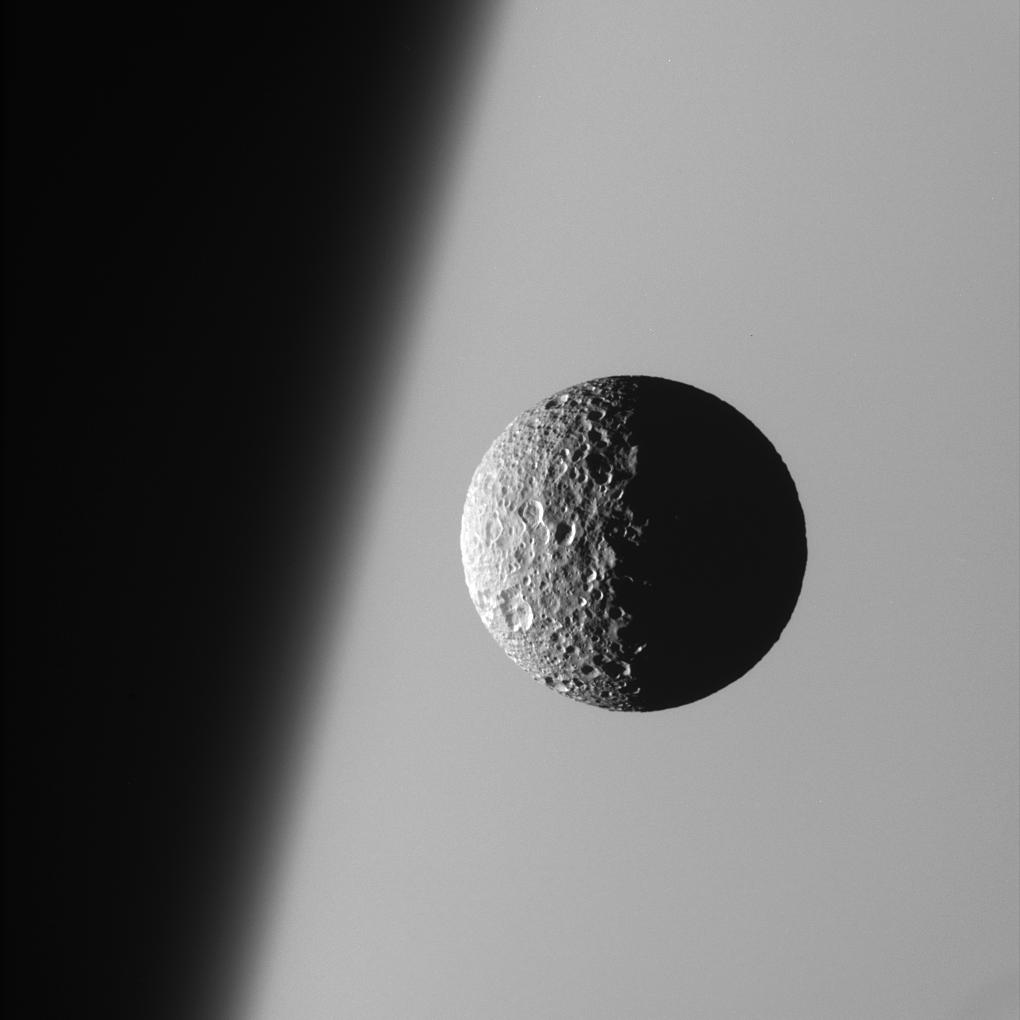
The Cassini spacecraft peers through the fine, smoke-sized ice particles of Saturn's F ring toward the cratered face of Mimas. The F ring's core, which contains significantly larger particles, is dense enough to completely block the light from Mimas.
The image was taken in visible light with the Cassini spacecraft narrow-angle camera on Nov. 18, 2007. The view was acquired at a distance of approximately 772,000 kilometers from Mimas
My own philosophy comes from the old days of radio, where any radio wave entering your home or your personal space was fair game to receive and listen to. Telecom interests lobbied and paid campaigns well to get the Electronic Communications Privacy Act of 1986, which suddenly made certain wavelengths illegal to listen to, all because their cordless and cellular phones were poorly designed and completely open to listening.
Australian DRM from 1923 - dumb radio idea that refuses to die
The Schneier section.
Bruce Schneier usually gets it right about security and insecurity in the world.
Protesters might even nab one with a net -- one of many reasons why Ehrhard, the former Air Force colonel, and other experts said they doubted that the hovering bugs spotted in Washington were spies.
So what was seen by Crane, Alarcon and a handful of others at the D.C. march -- and as far back as 2004, during the Republican National Convention in New York, when one observant but perhaps paranoid peace-march participant described on the Web "a jet-black dragonfly hovering about 10 feet off the ground, precisely in the middle of 7th avenue . . . watching us"?
They probably saw dragonflies, said Jerry Louton, an entomologist at the National Museum of Natural History. Washington is home to some large, spectacularly adorned dragonflies that "can knock your socks off," he said.
At the same time, he added, some details do not make sense. Three people at the D.C. event independently described a row of spheres, the size of small berries, attached along the tails of the big dragonflies -- an accoutrement that Louton could not explain. And all reported seeing at least three maneuvering in unison.
"Dragonflies never fly in a pack," he said.