There is a plume of something in the air above Chicago today. I noticed it on the way in, as a whiteish (or less blue) western sky. I thought it might be the lake breeze, but reasoned it would have been to the east towards the lake. Checking the satellite shows a plume moving to the southeast. It's probably smoke particulates from a wildfire somewhere, but the only recent one I've heard about is a set of fires not far from the parents' place in the Desert National Wildlife Refuge. From the direction of the plume I am guessing it must be a summertime fire from Northern Canada or Alaska, although the Alaska Fire report is only reporting 12 fires, one only 140 acres in extent. I see the Las Vegas Review-Journal is reporting a fire on the Nevada Test Site today.
UPDATE: Probably this fire.
Thursday, July 06, 2006


Tuesday, July 04, 2006
Happy Fourth of July!
Happy 4th of July! I cooked hot dogs and melted aluminum, and watched continuous displays of clearly "illegal" fireworks across the city of Chicago. Huzzah to the fellow at about 3000ft southeast of Ryerson, at what I was guessing the east end of the Midway, who had a long and impressive display. Peggy called out a satellite above that was in fact the most impressive orbiter of them all, the Space Shuttle passing overhead. And visible, people watching the displays from Rockefeller.

Sunday, July 02, 2006
NSA and domestic phone spying before 9/11
Why is it that I heard a report about the NSA's supposed domestic phone spying before 9/11 not from any American news bureau, but from Radio Habana Cuba via static-y shortwave first? I am still waiting for this tidbit to arrive on the front pages of CNN, the New York Times, the Washington Post, etc. All of them are talking about USA Today removing the proof that BellSouth and Verizon had given access, but no one is talking about the NSA's prior relationship with AT&T. Slashdot also posted the story today.
Bloomberg has the story, and I'm guessing Radio Havana picked it up from there.
That said, I wouldn't trust Radio Havana Propaganda for ANY news, which is why I went looking for proof of the existence of the story as soon as it crossed the airwaves.
Bloomberg has the story, and I'm guessing Radio Havana picked it up from there.
That said, I wouldn't trust Radio Havana Propaganda for ANY news, which is why I went looking for proof of the existence of the story as soon as it crossed the airwaves.
Friday, June 30, 2006
The Moon on June 29th

Michael Milligan blogged his viewing of the Moon through the University of Minnesota's 10-inch refractor last evening. A great coincidence (aka clear skies for us both) had me at Ryerson viewing the Moon that evening too. It was a useful starting point to Saturn, Mars, and even the elusive Mercury. I also looked at Jupiter to add to the planet list.
I too photographed it, although I waited until the sun had set, taking the first image at 8:45PM with the intention of getting some of the twilight blue in the image.
This second image is a point-of-view image through the viewfinder.

Earlier I also branded a piece of wood with an "R" for Ryerson using the sun's setting rays.


Thursday, June 29, 2006
The Antennae galaxy from Chicago

I am guessing that the Astronomy Picture of the Day for tomorrow, with the title "cosmic antennae", is likely to be about the Antennae Galaxy, an interacting pair 63 million light-years away in Corvus the Crow, visible now as a compact quadrilateral to the far lower-right of Jupiter blazing in the south after sunset. So, I'm posting a poor image of them now, because otherwise the APOD gets me every time in posting something I should have posted earlier.

I imaged the Antennae (also known as NGC 4038/4039) on April 26th from Ryerson Observatory. The total exposure time was about 85 minutes. My light-polluted skies overwhelmed the faint antennae structure of stars thrown out of the galaxies during the collision. I can see the individual superclusters of bright blue supergiants formed during intense starbirths from the compression of gas clouds during the collison. The two brightest knots in the galaxy (oriented roughly vertical in my image) are actually the cores of the original pre-collision galaxies.
Any variations in the dark gray background are dust donuts from the telescope, and leftovers of a smoothing feature I used to help get rid of the vignetting. My flats were not good enough to use for this processing.
Friday, June 23, 2006
A color illusion
Instructions: Keep your mouse out of the image. Stare at the center black dot for thirty seconds. Move mouse into image.
Click here for the illusion:
http://www.lib.uchicago.edu/~dean/blog/illusion.html
The idea is from John Sadowski
I need to find a better horizontal image for this illusion.
Click here for the illusion:
http://www.lib.uchicago.edu/~dean/blog/illusion.html
The idea is from John Sadowski
I need to find a better horizontal image for this illusion.
Wednesday, June 21, 2006
Pluto's new moons named: Nix and Hydra
I just saw on a cable TV news crawl that the IAU has named the two new moons of Pluto: Nix and Hydra.
Forbes article
Blog post about discovery
Cute:
Info from the Southwest Research Institute
Forbes article
Blog post about discovery
Cute:
"The 'P' and the 'L' in Pluto are in honor of the Percival Lowell, who instigated the search that resulted in the discovery of Pluto," Stern told Space.com. "The 'N' and the 'H' are exactly parallel to honor New Horizons which instigated the search that led us to [the new satellites]."
Info from the Southwest Research Institute
Monday, June 19, 2006
A triple junction in the Sky
D'oh! I started this entry two weeks ago, since it's such a fabulous image, of Regulus and Leo I, but never finished the entry and of course APOD covers it today.

I called the entry "A Triple Junction in the Sky" because of three distance scales that converge at this place in the sky. Leo I, being a (barely) extragalactic source, is that of all things outside of our own galaxy. It's not the farthest thing in the image; there are many angularly small galaxies that are quite a distance aways. The second scale is stellar: Regulus shines at 75 light-years away. One of the four Royal Stars of Persia, it quarters the sky with Aldebaran, Antares, and Fomalhaut.
The third scale, not visible in the image, is the the planetary scale. Regulus lies nearly on the ecliptic, the plane of the solar system, and the moon frequently occults Regulus. In fact other planetary objects can occult Regulus: the asteroid Rhodope covered it for a few seconds in Europe in 2005. Astronomers can use these occultations to measure the sizes of asteroids.
Be sure to see the large-sized image.
Image copyright: © 2005 Russell Croman, www.rc-astro.com
I called the entry "A Triple Junction in the Sky" because of three distance scales that converge at this place in the sky. Leo I, being a (barely) extragalactic source, is that of all things outside of our own galaxy. It's not the farthest thing in the image; there are many angularly small galaxies that are quite a distance aways. The second scale is stellar: Regulus shines at 75 light-years away. One of the four Royal Stars of Persia, it quarters the sky with Aldebaran, Antares, and Fomalhaut.
The third scale, not visible in the image, is the the planetary scale. Regulus lies nearly on the ecliptic, the plane of the solar system, and the moon frequently occults Regulus. In fact other planetary objects can occult Regulus: the asteroid Rhodope covered it for a few seconds in Europe in 2005. Astronomers can use these occultations to measure the sizes of asteroids.
Be sure to see the large-sized image.
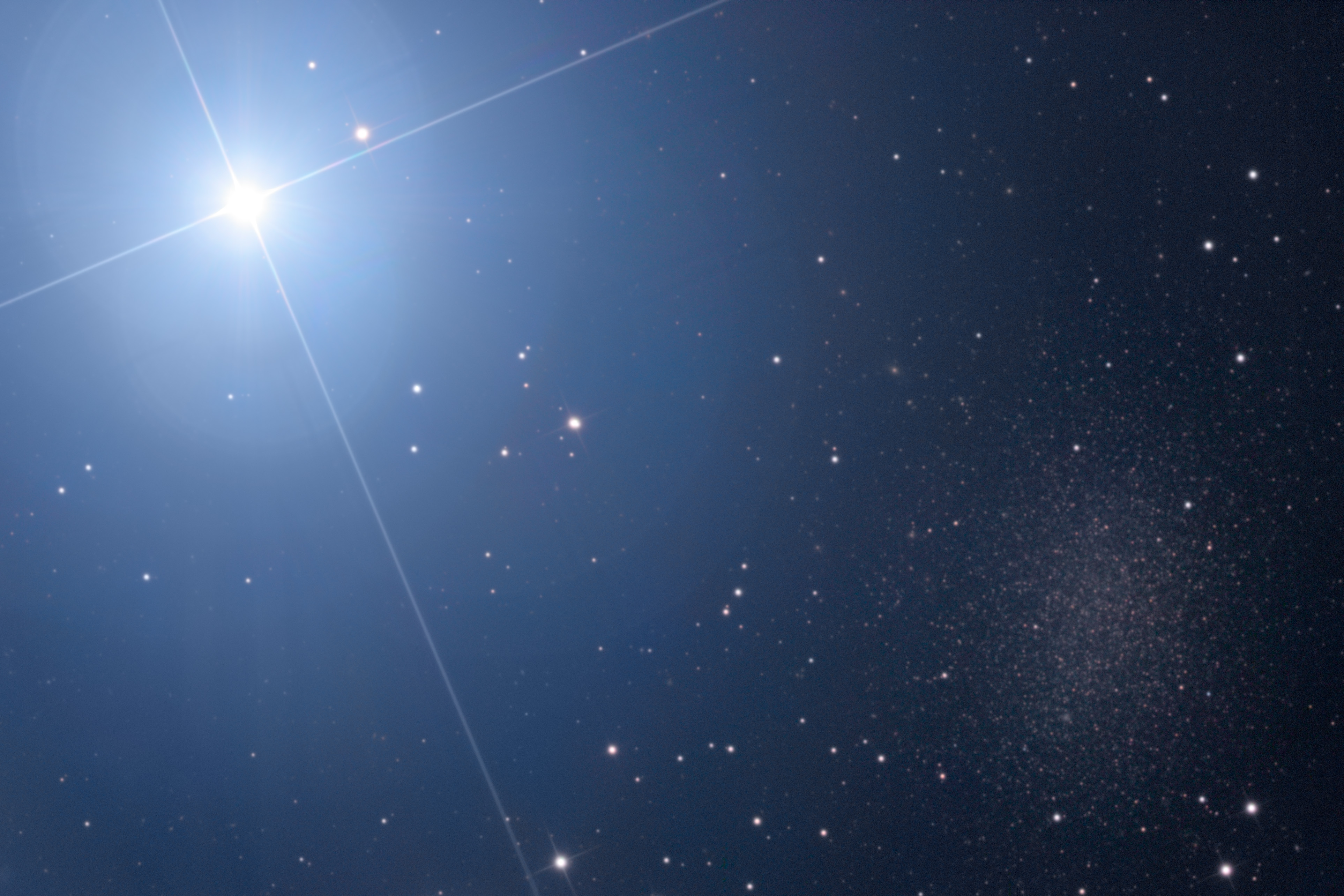
Image copyright: © 2005 Russell Croman, www.rc-astro.com
Wednesday, June 07, 2006
Yerkes Observatory sold

Sure enough, the University has sold Yerkes Observatory to Mirbeau Spa for $8 million. They get most of the land surrounding the observatory for their 72 house development and spa and donate the observatory building and nearby grounds to the city of Williams Bay, which has to agree to this. A non-profit will run the observatory, although the University is paying for the operation for 5 years and the claim is that special taxes of an unknown sort will fund the observatory's mission after that.
Chicago Tribune story archived via U of C News Office.
Official University Press Release
Tuesday, June 06, 2006
Yerkes Observatory News
I understand that a Yerkes Observatory decision has been made and one should expect an official announcement soon.
Friday, June 02, 2006
The Permian-Triassic Extinction: a source?

Ralph von Frese argues that a structure in the crust under Antarctica is a 500km wide impact crater and speculates that is was the source of the Permian-Triassic Extinction event which killed off 90% of all marine species.
Confirmation of this theory would require at least two things: the presence of shocked minerals near the impact crater, and dating of the crater to near the boundary (245 million years ago). It has been assumed by many that if there was an extraterrestial impact that caused the extinction it had hit in an ocean basin, and the evidence on the sea floor had long been subducted (the maximum age of oceanic crust in the Pacific is Jurassic in age).

Some images are here.
EDIT: There is some counter-arguments at Nature. Link via The Esoteric Science Resource Center.
Monday, May 29, 2006
Noctilucent clouds: A volcanic ash cloud from Mt. Pinatubo

I have never seen a noctilucent cloud.
I've been far enough north before, roughly the arctic circle, but I
was up there in September and the clouds are entirely summer events, lit up by sunlight streaming over the pole.
I believe though, that I've seen what they would look like. In late
June of 1991 I was living in Las Vegas with my parents (that's what being in high school will do for you) and was in complete harmony with celestial cycles. Sunrise, sunset, moon phases, etc. There is room for another post in that, but the point I am trying to make was that I was very sensitive to the timing of the sunset and the fading of the daylight.
Mount Pinatubo in the Phillipines blew itself apart in one of the largest eruptions of the 20th century on June 15th. The explosion sent cubic kilometers of material high into the atmosphere, breaking into the stratosphere. Once material is in the stratosphere, the only way of removing it is by gravity or ultraviolet light destruction. Small particles fall really slowly, yah? I didn't think an explosion located literally on the other side of the globe would be so evident.
The sun had just set and I was in my bedroom reading with the fading twilight that was still coming through the windows. After about fifteen minutes, I noticed that instead of getting darker, it had suddenly brightened outside. I went out and was shocked to see a broad glowing cirrus cloud covering the western horizon up to about thirty degrees above the Spring Mountains. The cloud was glowing eerie white-yellow against the deepening blue. I was shocked enough to get my father and showed him
the cloud. It was like a spiderweb of cirrus. The color deepened into fluorescent pink and then faded away nearly an hour after sunset. For a few weeks details in the cloud could still be seen--although it spread and faded away. The nights were not as clear for a year afterward, as the ash slowly fell out of the stratosphere.
The Cocteau Twins "Heaven or Las Vegas" album art reminds me of this period and of the glowing cloud in the west that night.
P.S. This entry was originally written two years ago. I finally found an image I took of it and Venus.
Tuesday, May 23, 2006
Geiger counter for Regenstein back up
The live radiation readings from the Reg is back up and running. I took it down to use it for the Scavenger Hunt this year. The item was:
89. Find the most radioactive place you can get on campus without breaking any rules, laws, or safety regulations. Record the radioactivity level in μrad/h. [5 points. -100 points if we have to call radiation safety].
Saturday, May 20, 2006
Monday, May 08, 2006
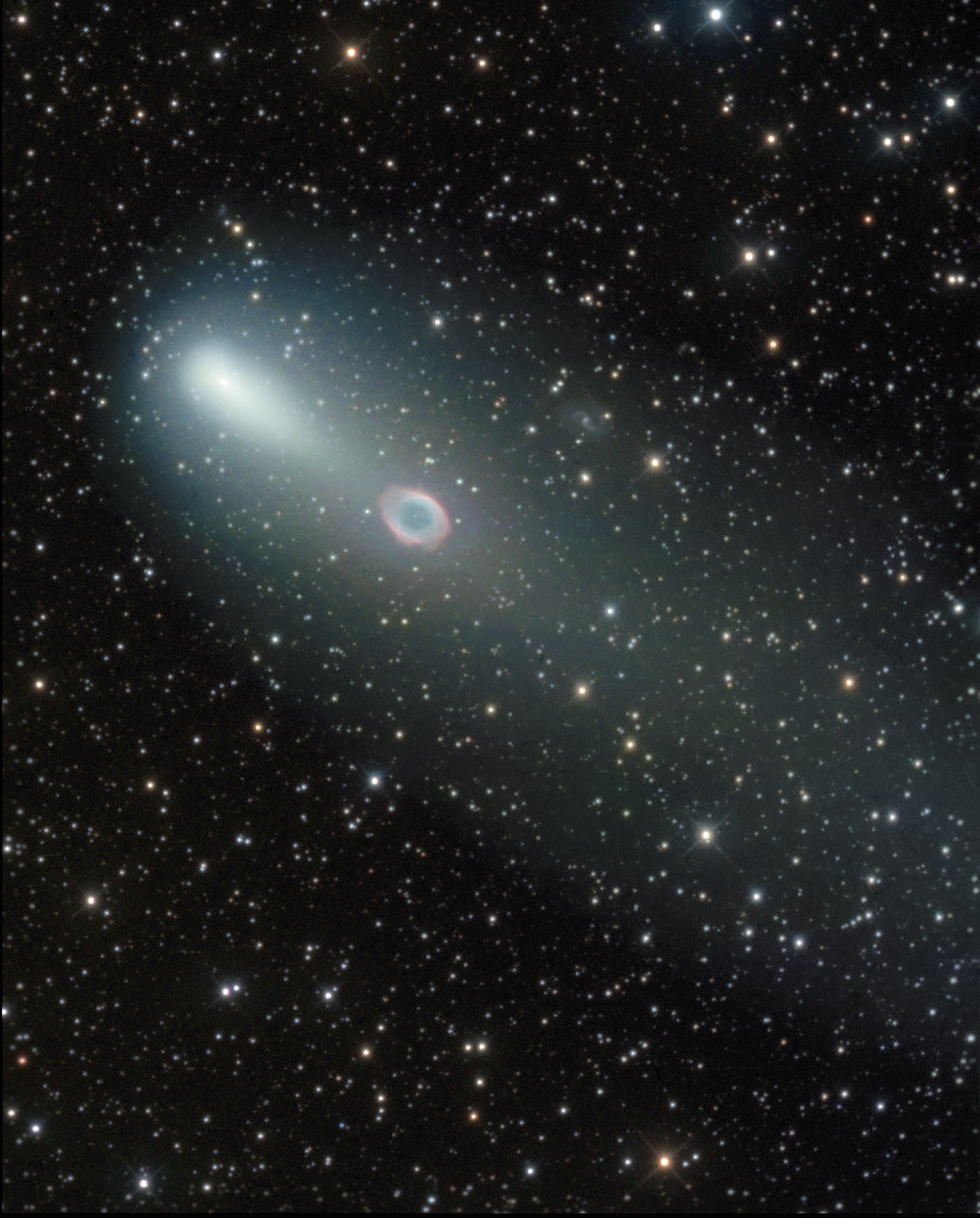
Comet Schwassmann Wachmann 3 passes the Ring Nebula

A fragmenting comet passed the Ring Nebula yesterday:
Animation from Horace Smith

Color image from Stefan Seip / Steffen Brückner.
Spaceweather has many images of the conjunction.
EDIT: This one by Johannes Schedler is great.
SECOND UPDATE: Even Better.
Subscribe to:
Posts (Atom)