I won't get into the long-recognized shifting of the Sun's position and the calendar with regards to the zodiacal signs--as someone who has done a lot of astronomy astrology is one of those things that is like asking a chemist about alchemy--the rolling-eyes chemist can't believe the general public believes you can turn things into gold.
But Allstate, a statistical insurance companies with many many actuaries and other employees incredibly well-versed in mathematics, put out a press release (no longer available) claiming new Virgos were the worst drivers. The Chicago Tribune then put out a story on the press release. The new Ophiuchus was the best driver.
Now, for the shockingly bad details--whomever at Allstate failed to normalize the fact that the new signs have really different lengths--the Sun being in Virgo for a long time as it's a longer constellation (45 days) versus the short 6 day dip in Scorpio. Neither did the Tribune do its diligence in fact-checking this story, leaving it to an anonymous commenter to point out the utter stupidity of it.
I expected better from Allstate. You should have a few of the statisticians on your payroll take the PR people and their management for a little talk. You've lost the confidence of many customers who might know a little science or math, and it's embarrassing to have a company 1. Give a statement in a press release about astrology and 2. Completely get the numbers wrong. I also expected more from the Tribune press--unfortunately it appears companies can just put advertising up for free, caged as PR, and the newspaper will call it a story straight.
Saturday, January 29, 2011

Tuesday, January 25, 2011
Making Things Talk & Processing projects
I got Making Things Talk as a gift from a great friend of mine and I just ran two of the projects in the "Identification" chapter.
To start off, you install Processing, a free language for visualization. For me the download for Windows was here. It's a slightly different install process than usual; just make a directory like "C:\Program Files\processing-1.2.1" and dump the contents there, and make a shortcut to processing.exe somewhere convenient for you (or you will forget it's installed).
Then in order to do video things you first need to have quicktime installed; if you have iTunes then you've got quicktime. And, finally, you need a VDIG implementation; for Windows it is WinVDIG. Install version 1.01 from here.
The first project was finding a particular color in a webcam image, reading the color, then putting a pointer on that spot.

Hey it works! See the dot on my nose?
The screenshot misses the dynamic aspect of the little dot following you around.
The second project was using your imager to decode QR Codes--and ha ha, check out the sample from the book. Nice one, Tom Igoe.

Great stuff.
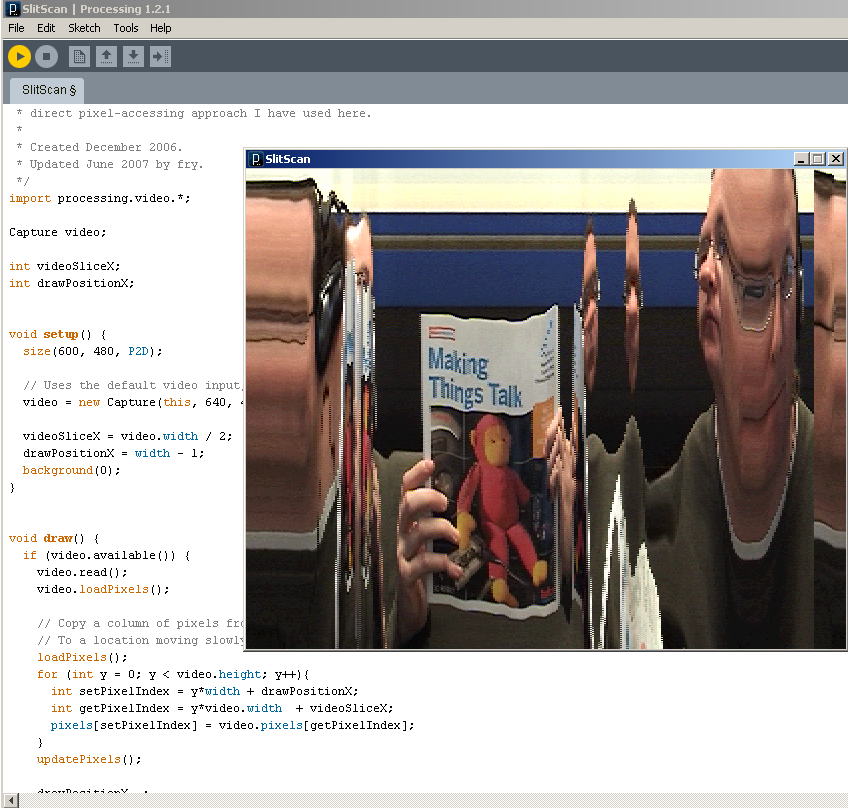
P.S. I just loaded the 'slitscan' example from the Processing examples. Ha!

To start off, you install Processing, a free language for visualization. For me the download for Windows was here. It's a slightly different install process than usual; just make a directory like "C:\Program Files\processing-1.2.1" and dump the contents there, and make a shortcut to processing.exe somewhere convenient for you (or you will forget it's installed).
Then in order to do video things you first need to have quicktime installed; if you have iTunes then you've got quicktime. And, finally, you need a VDIG implementation; for Windows it is WinVDIG. Install version 1.01 from here.
The first project was finding a particular color in a webcam image, reading the color, then putting a pointer on that spot.
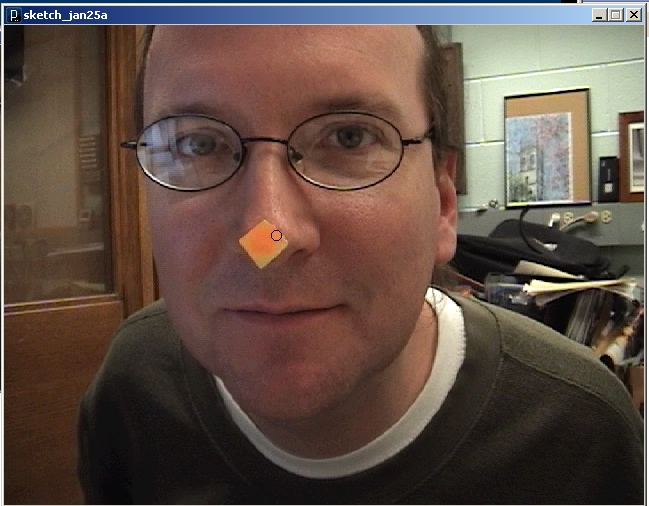
Hey it works! See the dot on my nose?
The screenshot misses the dynamic aspect of the little dot following you around.
The second project was using your imager to decode QR Codes--and ha ha, check out the sample from the book. Nice one, Tom Igoe.
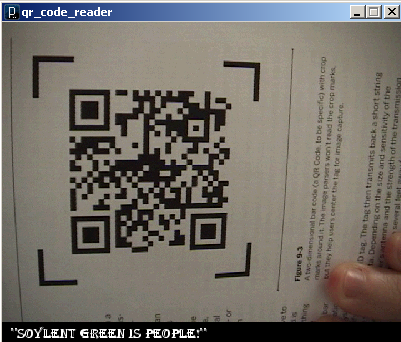
Great stuff.
P.S. I just loaded the 'slitscan' example from the Processing examples. Ha!
Thursday, January 13, 2011
Monday, January 10, 2011
Two new trends to keep an eye on in 2011 and beyond: 3D printing and Mobile Security
3D printing and mobile security are two big trends to watch.
The next big thing will be 3D printing. It's a hobbyist field right now, with rudimentary designs and machines, but it's going to get better. What happens when you can replicate any physical thing? That part that broke on your dishwasher, your bike, or that toy--you will just make (or buy from some third-party) a replacement. You won't buy the part from the manufacturer (even if you could). Those cheap things that break and then you throw out? Why would you if it could be easily fixed for next to nothing from a machine you had under your desk?
The best approach to this emerging market is to keep it open, free from patents and IP, and let it flourish. Many organizations and business interests will attempt to get a stranglehold on the emerging field, and it's important not to let that happen, lest they stifle the innovation an open field offers. The Internet would absolutely not be what it was if large corporations controlled it.
Dan's Data has an interesting post about the future of 3D printing.
Mobile Security needs to be addressed. We sat with cellular phones in a controlled world with little to worry about, as the oligarchy of carriers strongly restricted what could be run on their phones and networks. That worked at the cost of innovation. The new world of open platforms on the smartphone now means maliciousness is around the corner if the native OS isn't correctly applying security features like sandboxing. We need phones; we use them all the time, all day, and we need to be able to summon people in emergencies. We can't let them break because of bad security. We need to be able to prevent mass Denial-Of-Service, worm outbreaks, malicious breaking of phone security, and surveillance on these devices. And it's not just having the carrier control the phone; mobile security is also about You having control and not letting Them (whether they are a cracker or a malicious app or the Carrier) reading your data.
(While mobile security needs to be addressed as an emerging issue, that in no way reduces the disaster of the current free-for-all in web plug-in security holes).
UPDATE: for instance this finding of SMS messages that can kill nearly any phone.
The next big thing will be 3D printing. It's a hobbyist field right now, with rudimentary designs and machines, but it's going to get better. What happens when you can replicate any physical thing? That part that broke on your dishwasher, your bike, or that toy--you will just make (or buy from some third-party) a replacement. You won't buy the part from the manufacturer (even if you could). Those cheap things that break and then you throw out? Why would you if it could be easily fixed for next to nothing from a machine you had under your desk?
The best approach to this emerging market is to keep it open, free from patents and IP, and let it flourish. Many organizations and business interests will attempt to get a stranglehold on the emerging field, and it's important not to let that happen, lest they stifle the innovation an open field offers. The Internet would absolutely not be what it was if large corporations controlled it.
Dan's Data has an interesting post about the future of 3D printing.
Mobile Security needs to be addressed. We sat with cellular phones in a controlled world with little to worry about, as the oligarchy of carriers strongly restricted what could be run on their phones and networks. That worked at the cost of innovation. The new world of open platforms on the smartphone now means maliciousness is around the corner if the native OS isn't correctly applying security features like sandboxing. We need phones; we use them all the time, all day, and we need to be able to summon people in emergencies. We can't let them break because of bad security. We need to be able to prevent mass Denial-Of-Service, worm outbreaks, malicious breaking of phone security, and surveillance on these devices. And it's not just having the carrier control the phone; mobile security is also about You having control and not letting Them (whether they are a cracker or a malicious app or the Carrier) reading your data.
(While mobile security needs to be addressed as an emerging issue, that in no way reduces the disaster of the current free-for-all in web plug-in security holes).
UPDATE: for instance this finding of SMS messages that can kill nearly any phone.
Sunday, December 26, 2010
Partial solar eclipse on January 4th
The eclipse season continues, as the Moon's nodes--the intersection line of the Moon's orbital plane and the Earth's orbital plane--continue to point in the direction of the Sun and anti-Sun. After the winter solstice lunar eclipse Europe, Northern Africa, and the Middle East will get a partial solar eclipse on January 4th. The maximum eclipse reaches nearly 86% in Scandinavia, although I wouldn't really trust a low-altitude solar eclipse at the Arctic Circle this time of year to be likely visible.
Since we know the Moon's orbital plane right now, we can extrapolate to the appearance of the Moon in upcoming months and phases. We know that the first and third quarter Moons will be either higher or lower away from the ecliptic, since at new the moon was obviously at the ecliptic (to produce the eclipse). So we need one other piece of information to give us the appearance of the Moon in the sky: is the node ascending or descending? Recall the Moon passing Jupiter about two weeks ago.
Was it above or below Jupiter in the sky?
Sadly, I had to check via a planetarium program because I couldn't remember. It passed above Jupiter. So the node is ascending, and the First Quarter Moon in January will be higher than usual in the sky and the Third Quarter Moon lower (but keep in mind only in deviation from the ecliptic, not in absolute elevation in the sky). In three months (aka March-April) the full Moon will be lower in the sky than usual and rise and set further south than normal.
http://eclipse.gsfc.nasa.gov/OH/OH2011.html
Since we know the Moon's orbital plane right now, we can extrapolate to the appearance of the Moon in upcoming months and phases. We know that the first and third quarter Moons will be either higher or lower away from the ecliptic, since at new the moon was obviously at the ecliptic (to produce the eclipse). So we need one other piece of information to give us the appearance of the Moon in the sky: is the node ascending or descending? Recall the Moon passing Jupiter about two weeks ago.
Was it above or below Jupiter in the sky?
Sadly, I had to check via a planetarium program because I couldn't remember. It passed above Jupiter. So the node is ascending, and the First Quarter Moon in January will be higher than usual in the sky and the Third Quarter Moon lower (but keep in mind only in deviation from the ecliptic, not in absolute elevation in the sky). In three months (aka March-April) the full Moon will be lower in the sky than usual and rise and set further south than normal.
http://eclipse.gsfc.nasa.gov/OH/OH2011.html
Wednesday, December 15, 2010
Light Pollution also boosts air pollution
In addition to causing breast cancer, light pollution has now been shown to affect the atmospheric chemistry at night in urban regions, increasing the next day air pollution by up to 5%. Ignoring any deleterious effect on astronomy, why are we being idiots on this? Why can't people aim lights correctly so they don't miss well over 50% of the thing they want to light? Why can't we understand if you want to light something on the ground, you can't do it by sending light up?
http://www.bbc.co.uk/news/science-environment-11990737
http://www.treehugger.com/files/2010/12/urban-light-pollution-boosts-air-pollution.php
http://www.bbc.co.uk/news/science-environment-11990737
http://www.treehugger.com/files/2010/12/urban-light-pollution-boosts-air-pollution.php
Monday, November 08, 2010
Pluto is bigger than Eris
A rare occultation of a star by the Kuiper Belt Object known as Eris was recorded in several stations in Chile and at first glance the data suggest Eris is in fact smaller than Pluto--the albedo of Eris must be higher than predicted.
Sky & Telescope has a good write-up.
Here's a report from one of the observers.
And here's Mike Brown's take on the observation (An observation of the observation).
Sky & Telescope has a good write-up.
Here's a report from one of the observers.
And here's Mike Brown's take on the observation (An observation of the observation).
Thursday, November 04, 2010
Comet Hartley 2 close-up by EPOXI
Oh man, this is great. The radar images from last week indicated the comet was dog-boned shaped but the close-ups from the former Deep Impact/now EPOXI mission are great and confirmed the nature of this heterogeneous object. In other words, this looks just like some of the asteroids out there.

Credit: NASA / JPL / UMD / Emily Lakdawalla
Click to enlarge

Credit: NASA / JPL / UMD / Emily Lakdawalla
Click to enlarge
Wednesday, October 20, 2010
The star next to the moon tonight
The bright "star" next to the nearly Full Moon tonight was Jupiter, in case you were wondering.
Saturday, October 16, 2010
stupid UFO sightings
Hi. I've spent much of my life outside at night looking up. I've seen some amazing things. I've never seen a UFO. I've seen things that would have easily been confused as an unknown object, until I figured or observed what exactly it was. Things like inbound aircraft to O'Hare, geese lit up by stupid uplights in Chicago, spectacular bolide fireballs, reflections off of Iridium satellites, etc. The general public doesn't really look up very often, and hence doesn't really know what they are seeing. So Venus, or Jupiter, or a series of balloons become a UFO, which despite the name become a ... UFO.
http://blogs.discovermagazine.com/badastronomy/2010/10/15/nyc-fox-station-reports-jupiter-and-balloons-as-ufos/?utm_source=feedburner&utm_medium=feed&utm_campaign=Feed%3A+BadAstronomyBlog+%28Bad+Astronomy%29&utm_content=Google+Reader
http://blogs.discovermagazine.com/badastronomy/2010/10/15/nyc-fox-station-reports-jupiter-and-balloons-as-ufos/?utm_source=feedburner&utm_medium=feed&utm_campaign=Feed%3A+BadAstronomyBlog+%28Bad+Astronomy%29&utm_content=Google+Reader
Friday, October 01, 2010
small earthquake swarm just north of Death Valley and Scotty's Castle
This in an interesting swarm of earthquakes just to the north of Scotty's Castle in Death Valley.
http://earthquake.usgs.gov/earthquakes/recenteqscanv/FaultMaps/117-37.html
http://earthquake.usgs.gov/earthquakes/recenteqscanv/FaultMaps/117-37.html
Thursday, September 30, 2010
The Magic numbers
"The magic numbers, as we know them now are :
2, 8, 20, 28, 50, 82, 126
and most importantly, they are the same for neutrons and protons."
Maria Goeppert-Mayer, The Nobel Lecture
The last female Nobel Laureate in Physics, 1963.
2, 8, 20, 28, 50, 82, 126
and most importantly, they are the same for neutrons and protons."
Maria Goeppert-Mayer, The Nobel Lecture
The last female Nobel Laureate in Physics, 1963.
Monday, September 20, 2010
fluorescent light runs at 25kHz
The newish fluorescent light (well, added in 1999 to make up for a lost skylight) fixture in the RAS office must have an electronic ballast that runs at 25kHz, as that is a strong signal that pops up on the oscilloscope & antenna when that light circuit is running. The older fluorescent lights are probably ancient magnetic ballasts.
...I'm sure y'all care.
...I'm sure y'all care.
Wednesday, September 15, 2010
Pits on the Moon
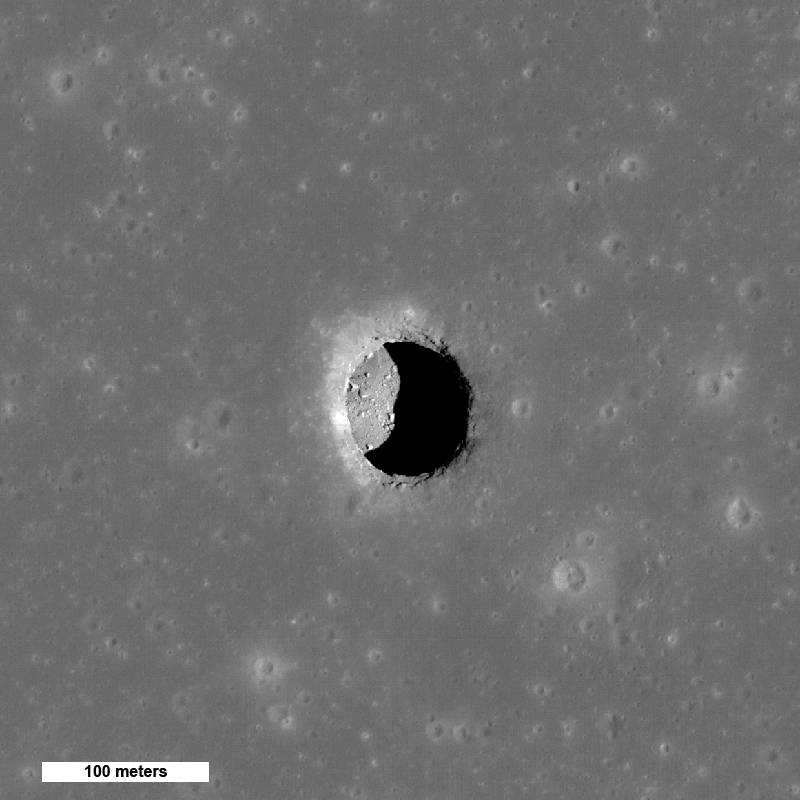
Phil Plait points out pits on the Moon!
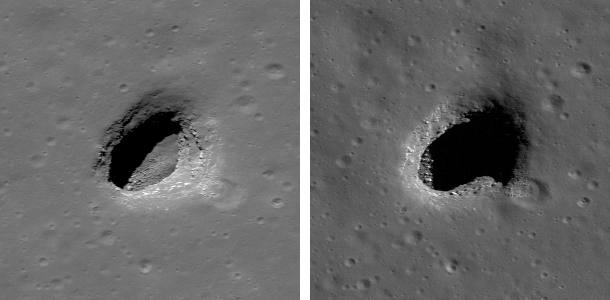
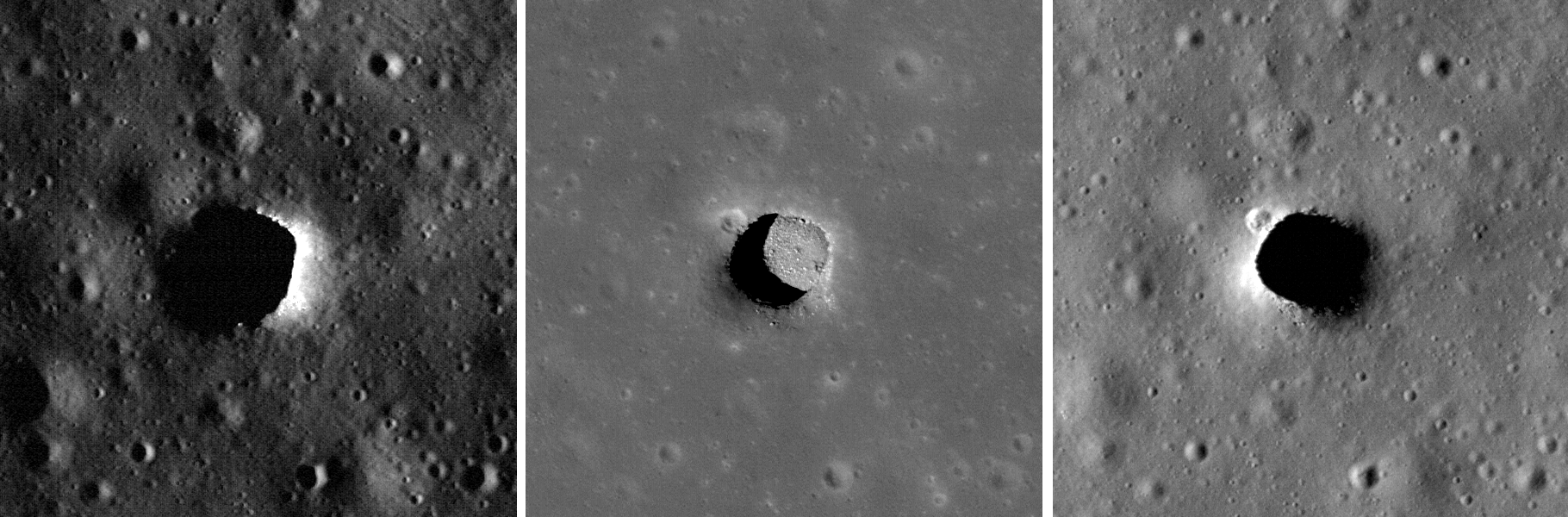
Click to enlarge. Images via NASA/GSFC/Arizona State University/LROC
Thursday, September 09, 2010
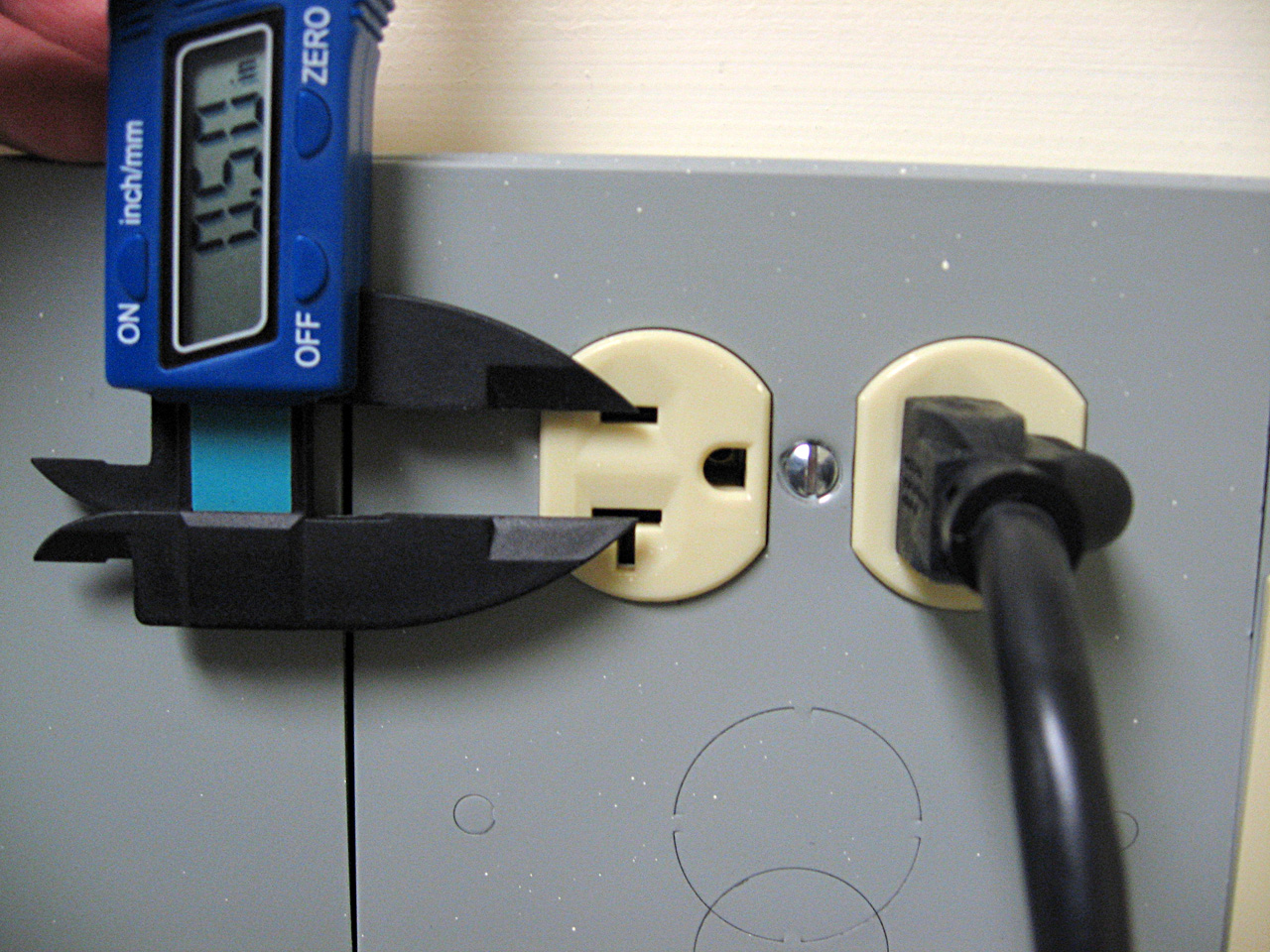
Notable: the size of the standard AC outlet
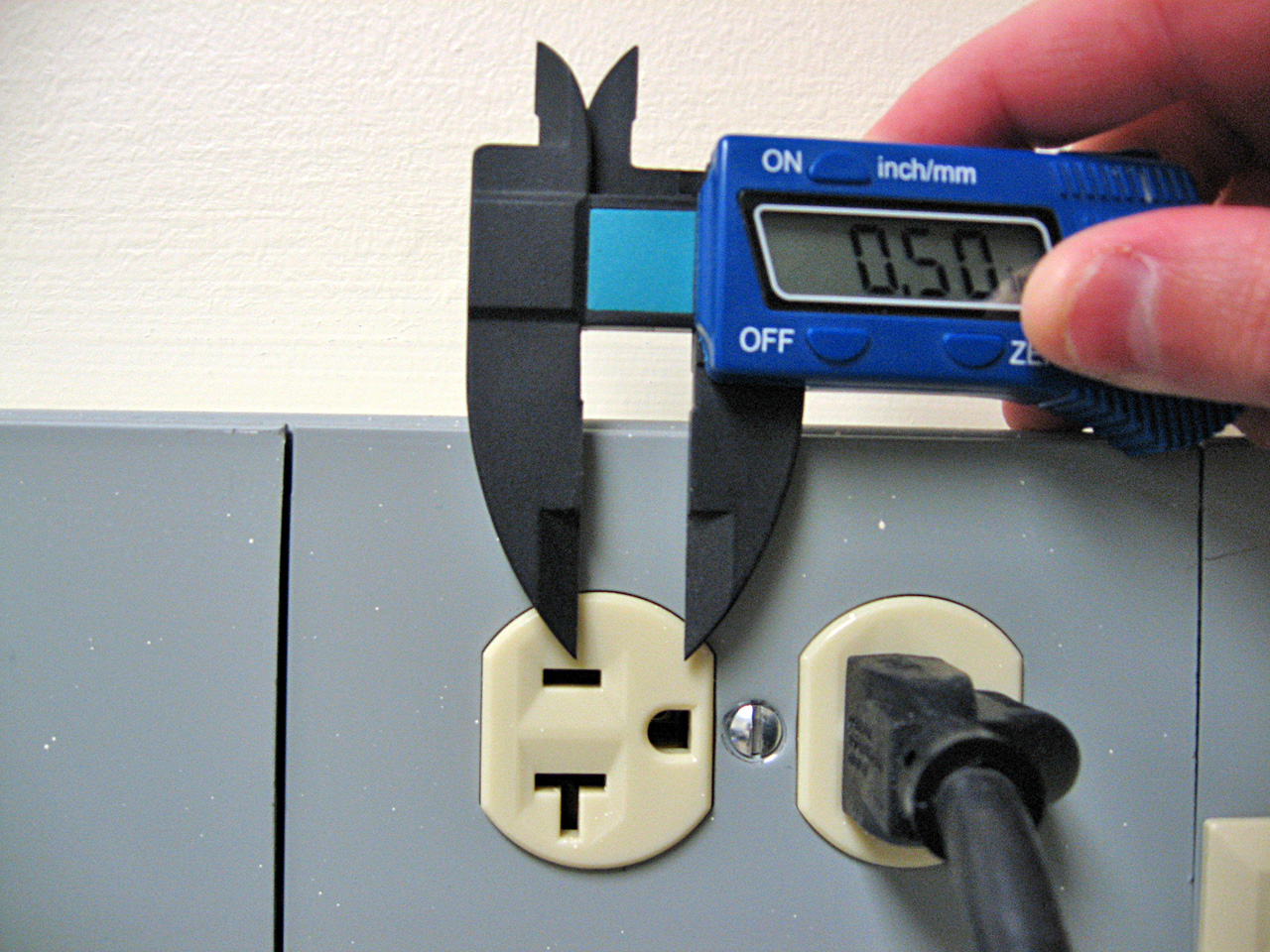
Did you know the distance between the center of the slots in the 120V standard AC outlet is exactly 1/2 inch? And so is the distance between the center of those and the center of the ground pin. 0.5". All of this only came out after I bought an inexpensive digital caliper and started measuring everything I could get my hands on.


Subscribe to:
Posts (Atom)