Friday, August 24, 2007

Bruce Schneier on the politics of fear

Bruce Schneier should be on your list of regular reading--he's not voluminous, and when he says something, people should listen, and again he's done it: The Director of National Intelligence claims discourse about how our government functions will kill people!:

Q. So you're saying that the reporting and the debate in Congress means that some Americans are going to die?

A. That's what I mean. Because we have made it so public. We used to do these things very differently, but for whatever reason, you know, it's a democratic process and sunshine's a good thing. We need to have the debate.


As Schneier says, refuse to be terrorized! Don't let America turn into a Police State with State Secrets and Secret Courts. Don't let "exceptions" to the Bill of Rights destroy our freedoms.

Sunday, August 19, 2007

Air Force discovers pulsars before Bell

You've probably already seen this, but it's interesting:

http://scienceblogs.com/catdynamics/2007/08/schisler.php

The Air Force early warning radars for the Arctic inadvertently discovered the pulsar before Jocelyn Bell Burnell did in 1967. This joins gamma-ray bursts and adaptive optics as another "thing invented or discovered by the military" before astronomers re-invented or discovered them.

True Patriotism and the REAL ID act

http://www.cnn.com/2007/POLITICS/08/16/real.id/index.html

After hearing claims that the REAL ID act wasn't about a national ID system, it wouldn't affect much, just standardizing the states' method of issuing driver's licenses, now we hear the truth from Michael Chertoff: They have created a domestic passport--you won't be able to travel without it. Some freedom of travel, eh?

The real patriots are the legislatures and governors of the free states, Idaho, Maine, Montana, New Hampshire (Live Free or Die), Oklahoma, South Carolina, and Washington, who stood up against the threats and FUD attacks of the neo-fascists.

Chertoff said there would be repercussions for states choosing not to comply.


Such as? Entering a national park? What fascist state is this? It is time everyone--all Americans, our elected representatives, and true patriots in the executive branch (wherever they might be hiding) to stand up and say NO! to this.

Many states have revolted. The governors of Idaho, Maine, Montana, New Hampshire, Oklahoma, South Carolina and Washington have signed bills refusing to comply with the act. Six others have passed bills and/or resolutions expressing opposition, and 15 have similar legislation pending.


and

New Hampshire passed a House bill opposing the program and calling Real ID "contrary and repugnant" to the state and federal constitutions. A Colorado House resolution dismissed Real ID by expressing support for the war on terror but "not at the expense of essential civil rights and liberties of citizens of this country."


I honestly hope the conservatives that are reasserting the states' rights which have been eviscerated in the past fifty years regain them at the Supreme Court, if only to remove the ironic ability of their sponsors' attempt to destroy what's left of our rights.

The ACLU has it right, too:
The databases will provide a one-stop shop for identity thieves, adds the ACLU on its Web site, and the U.S. "surveillance society" and private sector will have access to the system "for the routine tracking, monitoring and regulation of individuals' movements and activities."

The civil liberties watchdog dubs the IDs "internal passports" and claims it wouldn't be long before office buildings, gas stations, toll booths, subways and buses begin accessing the system.


Chertoff is, essentially, failing to uphold the United States Constitution, which he is bound to uphold. He is not a patriot, he is a fear-mongering statist, moving this country to the Police State which we used to fight against for so long.

Friday, August 17, 2007

Just saw the Space Station and the Shuttle

I just ran out and saw the Space Station and the ISS passing to the north, a touch dimmer than Jupiter. If I were inclined, I could see them in the west on their next orbit, but it's quite low. Tomorrow's pass in Chicago is perfect--let's hope the weather cooperates.

Thursday, August 16, 2007

New Yorker article on light pollution

Here's a reason to go out and buy the August 20th issue of the New Yorker: An article on light pollution!


I sincerely hope you've seen the Milky Way lately. I fear for you if you've never ever seen it.

I can count the few times I've been awed in my life on my fingers -- and several of those were seeing the Milky Way in a dark sky.

Planetary Society Blog article #1

Planetary Society Blog article #2

Monday, August 13, 2007

Good passes of the space station over Chicago for the next few days

Wednesday the 15th, starting at 9:43:32PM, reaches 10 degrees above the NW horizon, maximum altitude of 33 degrees at 9:46:11 in the NNE and fades into shadow then.

Thursday the 16th, two good passes:
8:31:17PM, reaches 10 degrees elevation in the NNW,
8:33:23 maximum elevation of 18 degrees in the NNE,
lowers to 10 degree elevation at 8:35:29 in the ENE

The very next orbit (i.e., you could record the time it takes the space station to completely orbit the earth!):
10:05:53PM, reaches 10 degrees elevation in the NW,
10:07:36 maximum elevation of 32 degrees in the NW and fades into shadow then.

Friday the 17th,
8:53:27PM, reaches 10 degrees elevation in the NW,
8:56:08 maximum elevation of 32 degrees in the NNE;
fades into shadow at 8:57:41 at 19 degrees above eastern horizon.

On Saturday the 18th, a fantastic pass, right overhead!
It reaches 10 degrees elevation at 9:15:45PM in the NW, passes overhead at 9:18:38, and passes into shadow at 9:19:09PM 57 degrees above the ESE horizon.

All predictions are from Heavens-Above.

Again, what you'll see is a moving, steady point of light that may be one of the brighter objects in the evening sky, possibly brighter than Jupiter, which is shining in the south. If the object has more than one light, or blinks, you are seeing an aircraft. The color can range from pure white to orange; it's orange when the solar panels on the station are facing the right way; it also fades into an orange when the sun is setting at the space station.

I have some images from last month's Space Shuttle mission to the ISS here.

Tuesday, August 07, 2007

Pretty picture of the day

A dye laser points the way for the VLT towards the center of the galaxy.


Grab the huge versions of these at the ESO press page.
Seen via Astronomy Blog

Friday, August 03, 2007

Biometric veins in the near infrared

Another company claims to have created an unbeatable biometric authentication.

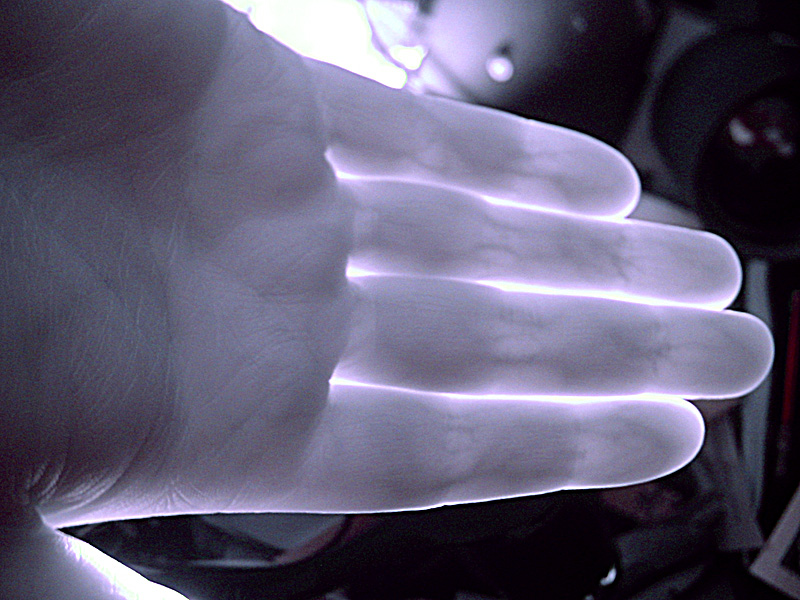
I have an image of my hand in the near-infrared, care to look?


heavy use of unsharp mask brings out the veins

I am sure it would only take an image like this and a master mold-maker to bypass such security.


Search this blog for posts containing "infrared".

Monday, July 30, 2007

A simple ion chamber to measure radioactivity


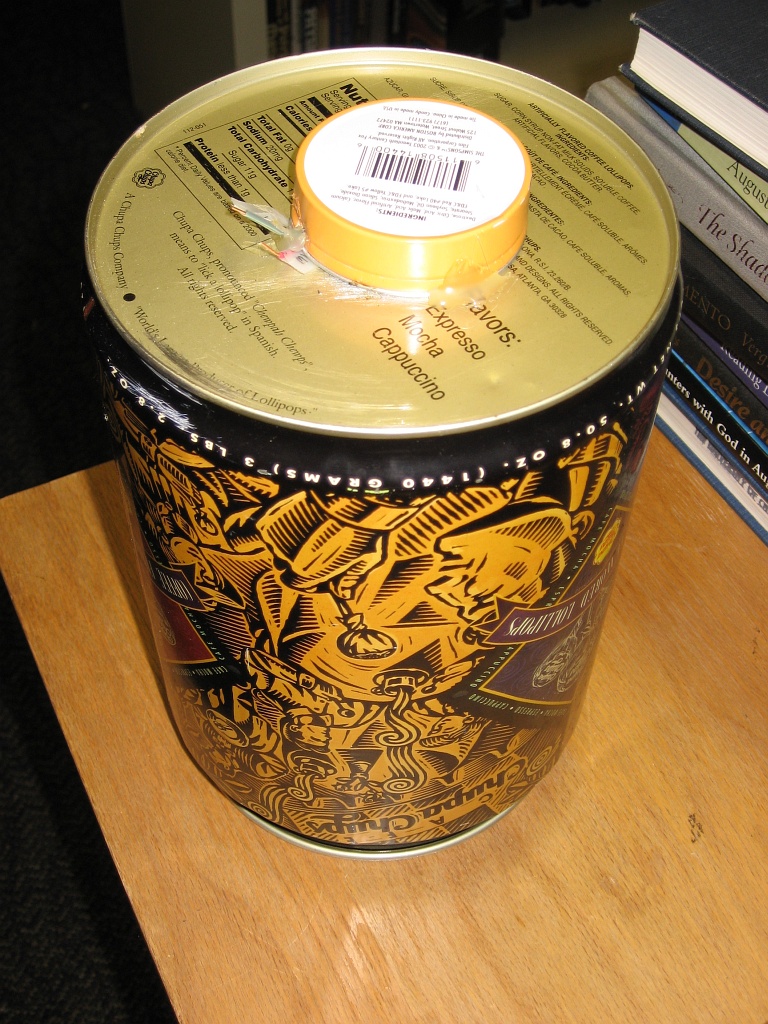
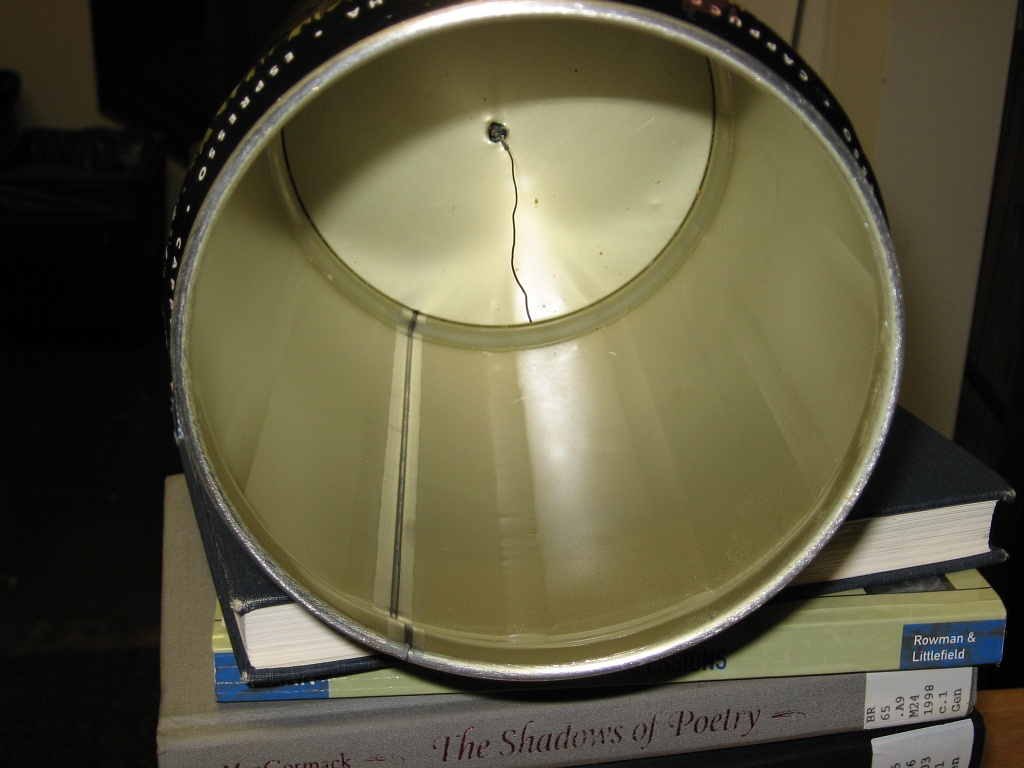
I built Charles Wenzel's simple ion chamber. It creates an electric field inside the can via a battery. A wire in the center of the can, isolated from the can, is connected to a transistor pair called a Darlington, essentially a pair of amplifiers. When ionizing radiation creates an ion in the can, the electric field drives the ion towards either the can or the wire, depending on the charge of the ion. This creates a very small current which barely turns on the darlington to allow the voltmeter to measure a small change in voltage.


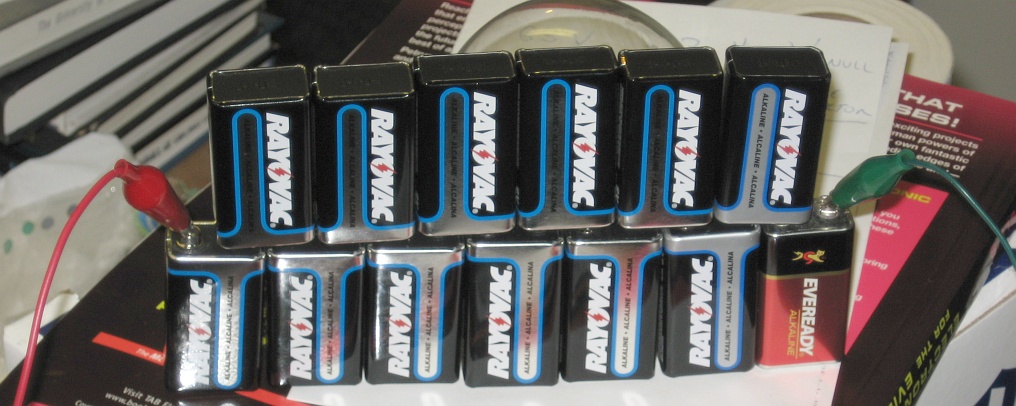
I could easily up the voltage on the chamber by snapping in more 9V batteries.


You can also light things up nicely: I had 122V DC at my disposal, although I wouldn't recommend running it for very long. Based on a rough calculation, the 40W lamp would run for an hour on this battery set, but the batteries aren't meant to source this much current (about 1/3 Amp).


I had an easy way of changing the chamber voltage, 9 volts at a time, so I measured the quiescent voltage and the voltage with a smoke detector alpha particle source in the chamber. I sealed the chamber by placing it on a sheet of aluminum foil.

VoltageNull voltagealpha source
36V4.8mV9.1mV
45V7.1mV14.9mV
54V11.3mV20.6mV
63V23.4mV41.5mV
72V1230mV1915mV
81V12000mV12000mV

Dear Blogger, why do you mess my table so?

Friday, July 27, 2007

Mt. St. Helens webcam

A wonderful service from the National Forest Service is a webcam showing Mt. St. Helens from Johnson Ridge Observatory--and now it's gone to a much higher resolution. It'll be interesting to see what sort of near-infrared performance the new NetCam XL camera has. The old camera would occasionally pick up the invisible glow of the hot dome at night.

Watch the slow growth of the reemergent lava dome in this movie from last year. (Others here).

Wednesday, July 25, 2007

Surplus lens

Yes, I had already bought this lens on my last American Science and Surplus trip. The most useful purchase that trip was a UV/IR blocker window--I'm using several of them in various projects. They were on sale at the store.

Astronomy communities


The media has globbed onto the existence of planned astronomical communities where bad lighting design is not allowed by rules and housing covenants. These are new places, places only needed in the recent past, because of the horrendous growth of light pollution. Continued light pollution increases of 5-10% per year mean the end of the visibility of the stars in just a few decades. Already 2/3rds of Americans haven't seen the Milky Way. By 2025 there will simply be no more dark sky in the United States. Simply no place. Current arguments about "why don't you move your scopes to a dark place" are ignorant by this measure and besides, are the people who created the light pollution paying for relocation? Destruction of useful observatories like Mt. Wilson and the current degradation of Palomar by misinformed politicians who'd rather be concerned about aesthetics than efficiency and science:

(Mayor Dick Murphy) said he also supports the change for aesthetic reasons: "People think they're ugly."

Astronomers also are concerned about a plan before the council to replace some hooded streetlights with decorative acorn-shaped lamps in various historic districts. The acorn lamps allow most of their light to shine upward, to the sky.

"They are blantantly inefficient," said Paul B. Etzel, director of the nearby Mount Laguna Observatory. "It's a 19th century solution to a 21st century problem."

Critics also point to higher costs. Getting rid of the low-sodium lights would cost nearly $2.8 million and raise the city's power bill by a half-million dollars a year, according to a city report.


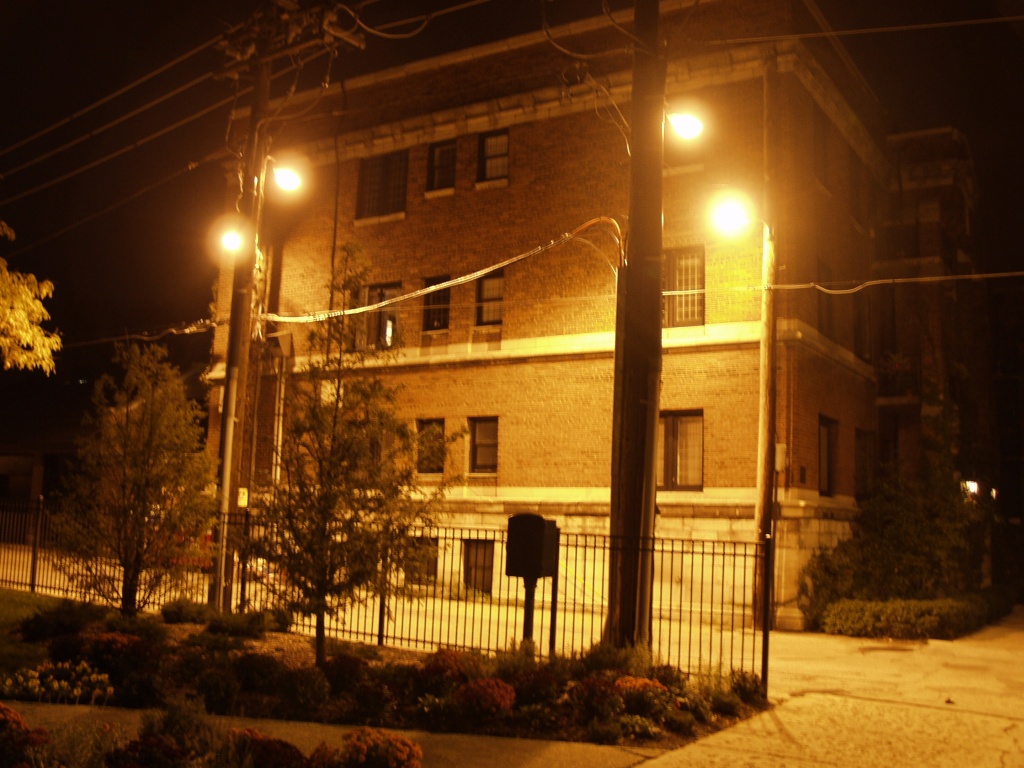
This alley has 4 250W lights plus a 150W streetlight within a thirty foot radius. A resident of this building can't get the city to remove or shield any of the lights.

Which constellation lost will make people realize the sky is gone? Orion? The asterism of the Big Dipper? Already seeing the Pleiades is tough in Chicago, and the faintest star of the Big Dipper is getting difficult to see.

I've seen it first hand in a place that doesn't need anymore light, yet we in Chicago increase the energy use in lighting by leaps and bounds whenever the mayor needs re-election or a University president feels to rule by fiat. I can only hope people will eventually realize spending tens of thousands of dollars for just the light that goes up into the sky (yes, really) is not smart for a campus nor the millions of dollars per year for a city like Chicago. The nation as a whole wastes--not uses, but wastes--$5 billion a year or more in outdoor lighting that doesn't hit its target.


Would you want to live with this light outside your bedroom, giving you breast cancer?

People think that brighter lighting decrease crime--but it doesn't, period, and in fact, I was shocked to discover someone actually checked: Brighter alley lights in Chicago increased crime in the alleys by 21% percent: Each of the three crime categories experienced an increase in the number of
reported incidents between the pre and post- installation period. Violent Index offenses
increased 14 percent (119 to 136), property Index offenses increased 20 percent (30 to
36) and non-Index offenses increased 24 percent (279 to 347). All this, using 160W more per fixture (there's 175,000 of them in the city), adding 28 Megawatts to the "Greenest" city.

Monday, July 23, 2007

Radioactive Bananas?


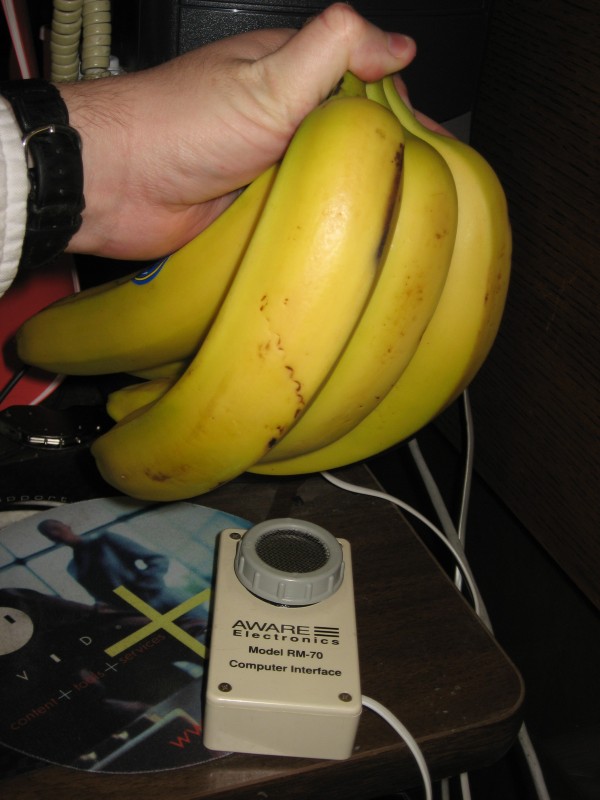
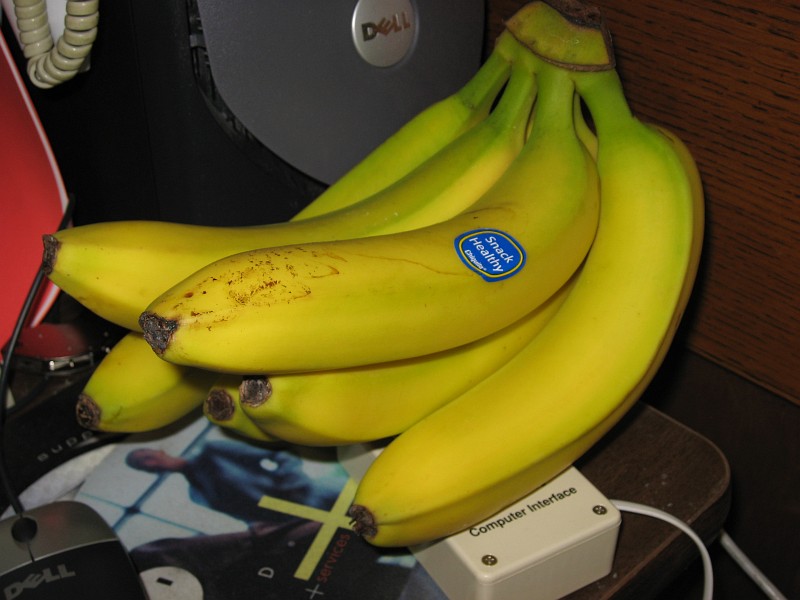
Are bananas radioactive? We've all heard they are rich in potassium, good to eat to restore electrolyte balance in the human body, but since they have potassium they're bound to have some potassium-40 in them, like our own bodies do.

How much 40K? Bananas have 400-450mg of potassium; interestingly the state of Colorado says potatoes are a better source (750mg per medium potato). Potassium-40 is isotopically 0.01177% of natural potassium, so that's 0.05mg or 50ug of 40K.

***This sentence was the error in the original post:
The specific activity of potassium-40 is about 30Bq/g (A Becquerel is one radioactive event per second), so there is only 1.5 Bq in a single banana. ***

In fact, the specific activity of potassium-40 is 258,000 Bq/g. 30Bq/g is the specific activity of generic potassium; that is, potassium that has 0.01177% K-40.
So, the banana actually has 13.5Bq.

It's not detectable, by me at least. My body has 4000Bq of K-40, but the geiger counter doesn't change from background when I'm near it. The geiger counter didn't see the bunch of bananas either.

Sorry, Kristin, the counter didn't move.

It does move for pure potassium chloride though.