This post is brought to you by the fact that I've been running a LiveCD version of the latest version of Ubuntu Linux on my home computer for the past week since my hard drive failed (which was running Windows XP). I did it because I wanted to be back up and running quickly, without having to replace the hard drive and reinstall Windows. A simple reboot with Ubuntu in the CD drive and I was back up and running. Most reading material is web based, and I use the built-in remote desktop application to access email on my work PC, so the only thing I've really lost is gaming, which I haven't had the time to do lately anyways. And besides, I have access to Desktop Tower Defense, so what gaming have I lost really?
And you know what? Ubuntu works. It works well. So much so that after putting a new hard drive in my home PC, I'm installing Ubuntu on it. I suppose I will set up a dual-boot system, or experiment with virtualization or a WINE Windows emulation system, but for the moment I am happy and established and most importantly, up and running, with a free OS that comes off of a CD.
My background with free OSes started a while ago, when I was a student employee at the Library. A fellow student employee who was overqualified for the job installed NetBSD on our then kick-ass Pentium 60 machine in the student/storeroom down in the subbasement of the Library. It offered two X window managers: gwm or twm; both were not ready for primetime. Things have come a long way since then (circa, uh, don't judge me on this, 1995).
I've been running Ubuntu as a server for testing purposes at work for over a year; the rough edges back then have been smoothed out (for instance, multi-CPU systems required a little extra to install, as well as setting screen resolution correctly); these things seem to have been correctly thought about in the latest version (7.10). At work I could access Windows file shares via Samba; I could offer up whatever I needed to via apache (http). But since I am a Windows System Administrator, the work portion of what I do was offered up via Windows 2003 Server and IIS 6. I have nothing really against Windows 2003--it's a fine OS, but IIS was up until 6.0 the crappiest web server around. It's a lot better now, but Apache works just as well, and I'm happy running both, although for me Apache is a test environment while work items run in IIS (because the vendor made it that way).
What really got me was the situation I was in: I had a bad hard drive, and I needed access to the web and my machine at work. The easiest solution was a CD with Ubuntu on it.
I think that Linux has arrived at the casual desktop, and it really works, and most hardware now works with it. I hope it's moved out of the enthusiast market and into the real world, where people don't necessary have the technical skills to replace the kernel or compile a program. I hope that people get fed up with infected and trojaned machines, and the monoculture of Windows gets diluted a bit with a more dynamic and robust computing environment. That's not to say I'm against Windows--after all, it gives me a paying job; but I like that I can recover from a hard drive failure with one CD and one reboot.
Thursday, November 29, 2007

Tuesday, November 20, 2007
infrared and visual split image
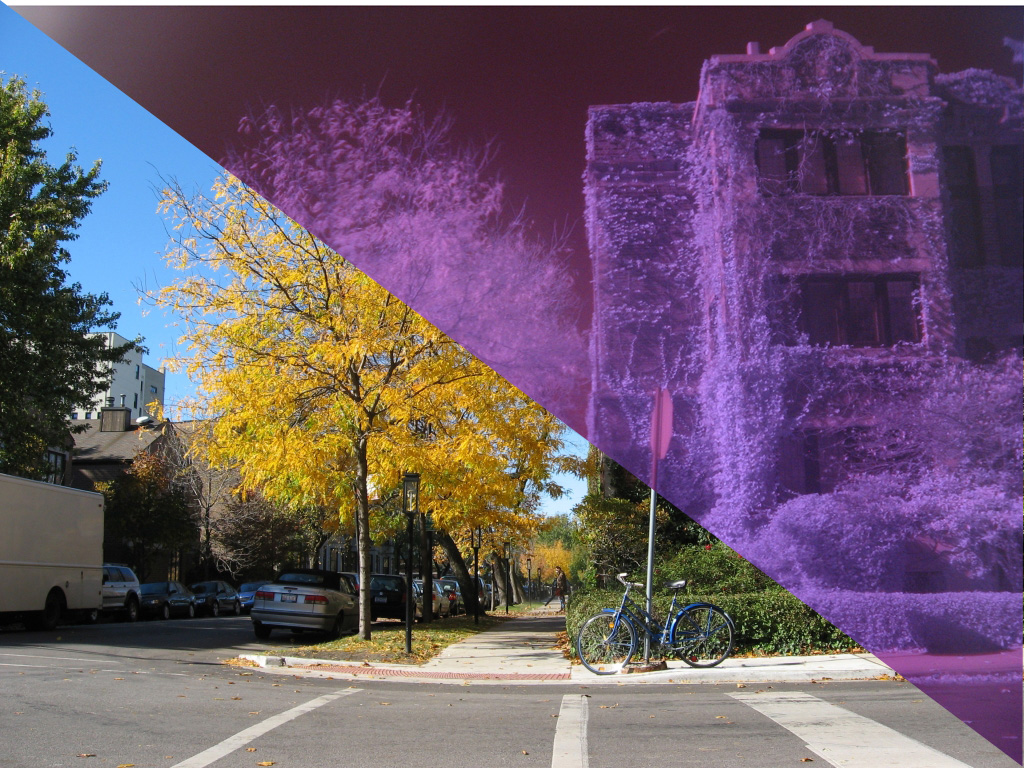
The Canon A540 does leak some near-infrared radiation through its IR blocking filter. I placed a two layer filter of exposed and developed color negative film in front of the camera for the infrared image.
1/2s at f/2.6 for the near-IR image.
1/400s at f/4.0 for the normal image.
That's about nine stops difference.
Link to the normal image
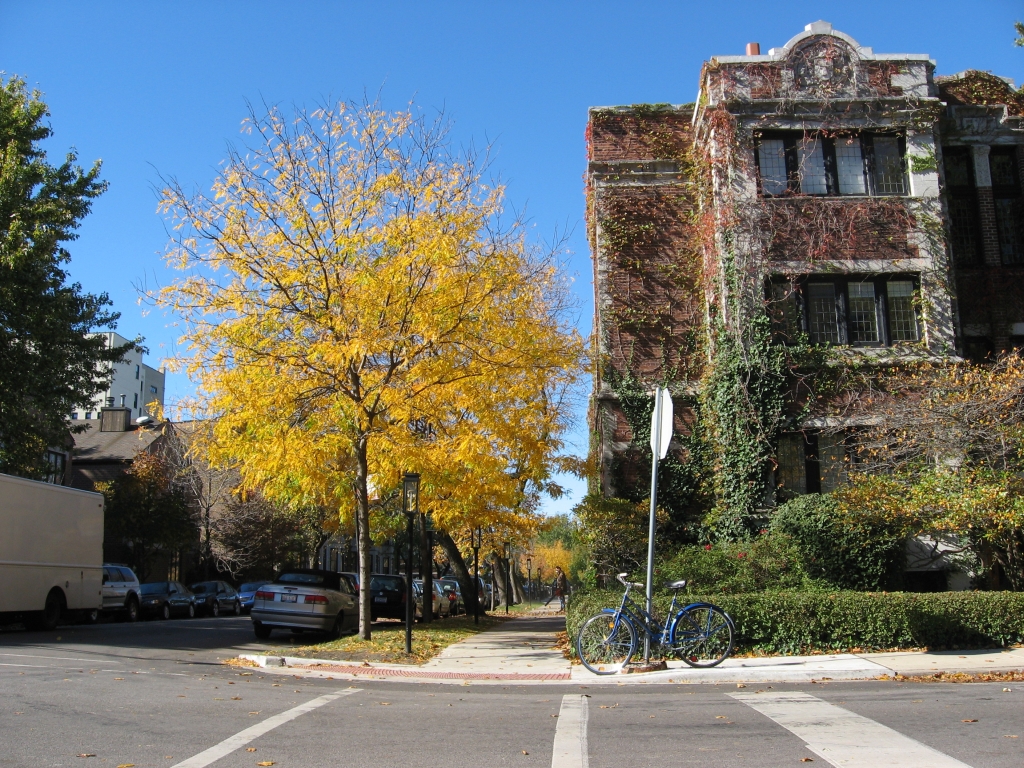
Link to the infrared image

P.S. Oh--here's a mouseover version.
Thursday, November 15, 2007
Friday, November 09, 2007
Incoming asteroid--errr, satellite
Astronomers at the Catalina Sky Survey near Tucson discovered an object on November 7th and when the orbit was calculated it was a Near Earth Object (or NEO) and would barely pass by Earth in only five days time. By barely, it was calculated at only a Earth's diameter away--a little under 8,000 miles.
Photometric measurements suggested the object was 20m in diameter, which is pretty big as things go--the Meteor Crater parent body was estimated at 30-50m.
But as Russian astronomer Denis Denisenko noted on the MPML, the object had a peculiar orbit: it passed quite close by Mars at nearly the same time as an ESA orbiter called Rosetta. See a view at Mars here. And, Rosetta happens to have the largest solar panels short of the ISS, two 14 meter long panels that make 64 square meters in total, matching the expected brightness of the object. Sure enough, Rosetta is due at Earth for a orbit changing interaction with Earth in five days so it can rendezvous with a comet in 2014. The people in charge of maintaining minor planet orbits decried the lack of coordination between the artificial satellite organizations and the minor planet community--as satellites are launched it's easy to watch them go away, but the NEO watchers are rightfully concerned about inbound objects, and the data about spacecraft outside of near-Earth space is skimpy.
Photometric measurements suggested the object was 20m in diameter, which is pretty big as things go--the Meteor Crater parent body was estimated at 30-50m.
But as Russian astronomer Denis Denisenko noted on the MPML, the object had a peculiar orbit: it passed quite close by Mars at nearly the same time as an ESA orbiter called Rosetta. See a view at Mars here. And, Rosetta happens to have the largest solar panels short of the ISS, two 14 meter long panels that make 64 square meters in total, matching the expected brightness of the object. Sure enough, Rosetta is due at Earth for a orbit changing interaction with Earth in five days so it can rendezvous with a comet in 2014. The people in charge of maintaining minor planet orbits decried the lack of coordination between the artificial satellite organizations and the minor planet community--as satellites are launched it's easy to watch them go away, but the NEO watchers are rightfully concerned about inbound objects, and the data about spacecraft outside of near-Earth space is skimpy.
Wednesday, November 07, 2007
Comet Holmes article in Tribune
Tooting my own horn.
. . . .Comet 17P/Holmes
Watch this . . . (well written Chicago Tribune story by Ryan Haggerty)
"It's certainly exciting," said Dean W. Armstrong, a member of the Ryerson Astronomical Society at the University of Chicago. Armstrong heard about the comet via e-mail. "It's much better than your average comet. To be able to see it in the city, to be able to see it with your own eyeballs without going out into the country is wonderful. It gives people a chance to reconnect to the night sky."
. . . .Comet 17P/Holmes
Watch this . . . (well written Chicago Tribune story by Ryan Haggerty)
"It's certainly exciting," said Dean W. Armstrong, a member of the Ryerson Astronomical Society at the University of Chicago. Armstrong heard about the comet via e-mail. "It's much better than your average comet. To be able to see it in the city, to be able to see it with your own eyeballs without going out into the country is wonderful. It gives people a chance to reconnect to the night sky."
Monday, November 05, 2007
Comet Holmes fainter tonight, 11/5
We fought with clouds tonight and bad seeing (and bad focus), but we all agreed the comet was larger and fainter tonight. The nucleus was too faint to see with our direct vision in the six-inch. The "blob" of material is taking on a more lenticular shape and the nucleus has some sort of trail extending from it.

Comet Holmes through the eyepiece
As I mentioned earlier, Comet 17P/Holmes is very bright. It's bright enough to point a regular digital camera into the eyepiece of a hundred-year-old telescope and get a reasonable image.

Comet Holmes on October 29th from Ryerson Observatory at the University of Chicago

Comet Holmes on October 29th from Ryerson Observatory at the University of Chicago
Thursday, November 01, 2007
Messier 15 from last night
We had a nice clear evening last night and took some photos over at Ryerson Observatory. I processed one last night real quick like. This globular cluster is M15, in the constellation Pegasus.

M15. 23x5seconds, 0.25m f.6, Starlight Express SXV-H9. Processed in Iris
We also took images of M2, M31 (Andromeda Galaxy), Comet Holmes, and Neptune (including Triton!), but I'll have to process those.

M15. 23x5seconds, 0.25m f.6, Starlight Express SXV-H9. Processed in Iris
We also took images of M2, M31 (Andromeda Galaxy), Comet Holmes, and Neptune (including Triton!), but I'll have to process those.
Monday, October 29, 2007
Comet Holmes from Chicago
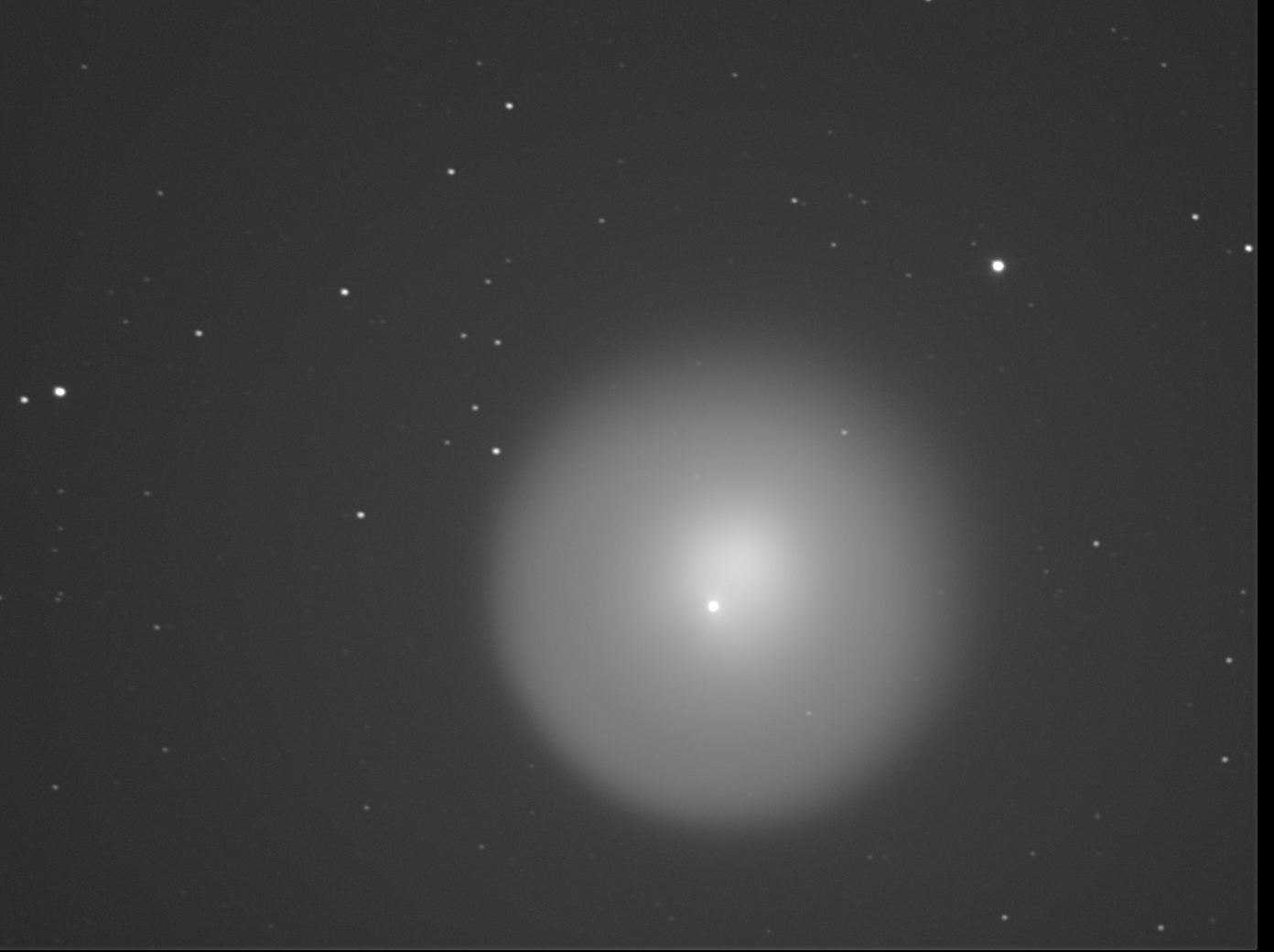
We had a great clear Monday after the RAS meeting so we got everyone to come up to the observatory to see the great outburst of Comet Holmes. Photometrically it seems the same brightness, but in binoculars or in the telescope it's much bigger and fainter than a few days ago.

Comet Holmes at Ryerson Observatory. 36x5s exposures, 0.25m f/6.
We imaged it through our 10-inch reflector while looking at it through the six-inch refractor. I processed the images to match the visual look. This comet is so bright I was able to take reasonable images with my digital camera just pointed at the eyepiece, with a few seconds of exposure, but I can't find my memory card reader, so those will have to wait.
So--it's still naked-eye, and now obviously not a star, so get out and take a look--the lower right "star" of an isoceles triangle containing Mirfak, above the bright star Capella in the northeast. (See a finder chart here).
A lot of people were asking details about why exactly the comet increased in brightness a millionfold. Without reading further, I vaguely heard a suggestion that the heat from perihelion takes a while to move deeper into the comet to where there is still volatile ices to blow out. Right now, the comet is moving out between Mars and Jupiter.
A fantastic historical read is Fred Whipple's paper in Icarus, volume 60, issue 3: "Comet P/Holmes, 1892III: A case of duplicity?" (link may need a subscription). I quote:
Don't read anything into his comet satellite hypothesis though.
Reading further back, Bobrovnikoff wrote in 1943:
Comet Holmes at Ryerson Observatory. 36x5s exposures, 0.25m f/6.
We imaged it through our 10-inch reflector while looking at it through the six-inch refractor. I processed the images to match the visual look. This comet is so bright I was able to take reasonable images with my digital camera just pointed at the eyepiece, with a few seconds of exposure, but I can't find my memory card reader, so those will have to wait.
So--it's still naked-eye, and now obviously not a star, so get out and take a look--the lower right "star" of an isoceles triangle containing Mirfak, above the bright star Capella in the northeast. (See a finder chart here).
A lot of people were asking details about why exactly the comet increased in brightness a millionfold. Without reading further, I vaguely heard a suggestion that the heat from perihelion takes a while to move deeper into the comet to where there is still volatile ices to blow out. Right now, the comet is moving out between Mars and Jupiter.
A fantastic historical read is Fred Whipple's paper in Icarus, volume 60, issue 3: "Comet P/Holmes, 1892III: A case of duplicity?" (link may need a subscription). I quote:
It may be added that the comet was discovered as a bright object nearly 5 months earlier than its perihelion passage, although the observing geometry was favorable all the time (at perihelion, the comet should have been only 1.5 mag fainter than near opposition 5 months later). It was also the first short period comet of q > 2 ever discovered.
Barnard's 1913) description on November 9.2 at Lick Observatory is revealing:
"'Its appearance was absolutely, different from any comet 1 have ever seen--a perfectly circular and clean cut disk of dense light, almost planetary in outline with a faint, hazy nucleus and a slight condensation some 5 seconds south following the nucleus (brightness -- Andromeda Nebula, diameter 260" at 8h0 '" P.S.T. and 286" at 9h40"').'" He observed the comet to brighten perceptibly by the next night at which time he saw an outer faint diffused envelope some 12' (800,000 km) in diameter.
Barnard's description carries great weight because he was a superb and experienced observer, having already discovered 15 comets and observed many more. His comments were generally confirmed by many other observers over thc world. Interest in the comet flared as the comet burst again to nearly naked eye brilliance on January
16, 1893, after having laded some 5-6 mag by late December and early January.
On subsequent returns P/Holmes hits remained extremely faint and inactive.
- Circular -- check
- Sudden nearly naked-eye burst -- check
- Andromeda galaxy reference -- looked at Andromeda tonight right afterwards -- check
- About 10 arcminutes in diameter -- check
Don't read anything into his comet satellite hypothesis though.
Reading further back, Bobrovnikoff wrote in 1943:
The comet was not well observed in December, 1892, and in the first part of January, 1893. On January 16, Palisa, in Vienna, found with the 27-inch refractor, instead of a diffuse comet of 10th or 12th magnitude as expected, a yellow star of 8th magnitude with an envelope of 20" in diameter. The comet increased in brightness the next day and could be seen with the naked eye. After January 18 it began to decline in brightness, and by the beginning of April it became very faint.
Saturday, October 27, 2007
Go see Comet Holmes.
If it's clear where you are, go outside right now and see Comet Holmes with your eyeballs, even with a nearly full moon nearby and even if you live in a horribly light polluted city. Binoculars will help, but you can see the comet with just your eyes right now, although it looks just like a star.
Look to the Northeast. Capella is the bright white star. Look up further towards the zenith to a compact triangle of stars, with the brightest star on the top apex. That star is Mirfak. Comet Holmes is the one on the lower left, the one closest to the line between Mirfak and Capella. Tonight, Capella and the moon form the bottom two points of a skinny-ish trapezoid, with Mirfak and Algol the top two.
Binoculars will reveal the star as a glowing blob, much bigger than the nearly stellar yellow object I saw on Wednesday. A telescope will reveal a stellar nucleus and a glowing blob surrounding it, getting bigger every day.
Finding charts (albeit poor in magnitude distinction are here). Sky and Telescope has one too--just move Capella up higher in the sky the later in the evening. A report here
Look to the Northeast. Capella is the bright white star. Look up further towards the zenith to a compact triangle of stars, with the brightest star on the top apex. That star is Mirfak. Comet Holmes is the one on the lower left, the one closest to the line between Mirfak and Capella. Tonight, Capella and the moon form the bottom two points of a skinny-ish trapezoid, with Mirfak and Algol the top two.
Binoculars will reveal the star as a glowing blob, much bigger than the nearly stellar yellow object I saw on Wednesday. A telescope will reveal a stellar nucleus and a glowing blob surrounding it, getting bigger every day.

Finding charts (albeit poor in magnitude distinction are here). Sky and Telescope has one too--just move Capella up higher in the sky the later in the evening. A report here

Friday, October 26, 2007
Mars color
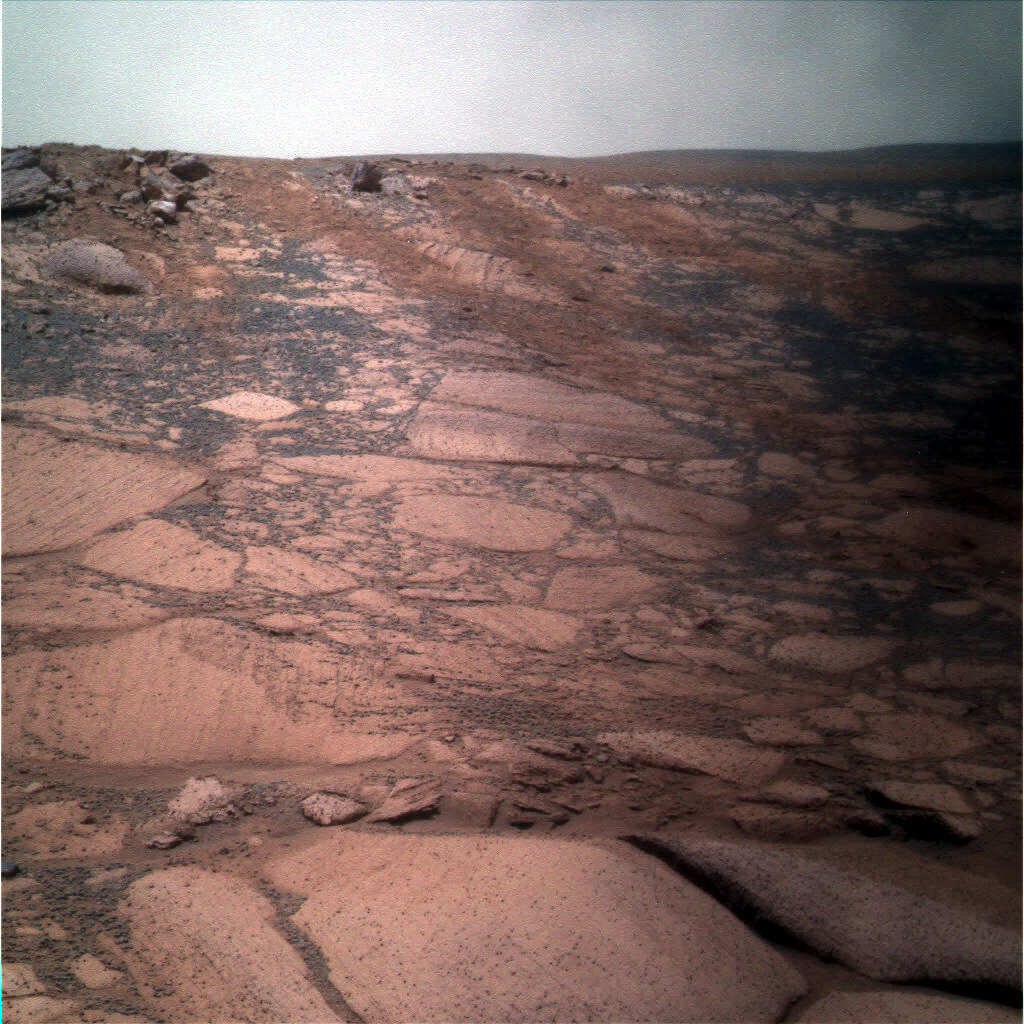
A commenter on this image asked about the "blue" sky in my synthesized image, composed of UV, green, and near-IR frames. Color was suspect, but it's all I had at the time.
I took much more recent data from a few days ago (sol 1321) and used subframes that were actually blue, green, and red. With equal strengths you get the image above. The sky is essentially overexposed.
Without further investigation I'd guess the gradient across the frame is from dust accumulation on the camera lens.
Tuesday, October 23, 2007
Thursday, October 18, 2007
Phil Plait talks about the Moon's orbital plane
Phil Plait looks at the low southern moon here that I mentioned last month
Thursday, October 04, 2007
50th anniversary of Sputnik
Things have been very busy and as a result I've been unable to post--but today is the 50th anniversary of man's entry into space with the launch of Sputnik. Last night the visitors to the Ryerson Astronomical Society's Wednesday viewing saw the largest satellite (artificial) in orbit: the International Space Station, as it rose above the horizon, passed Jupiter, and went into the Earth's shadow. Tonight in Chicago, you can see it twice, once at 6:57PM and again, once around the Earth, at 8:30PM. Details are always at Heavens-Above.
P.S. It's also World Space Week. Go to the RAS lecture on Monday about Sputnik.
P.S. It's also World Space Week. Go to the RAS lecture on Monday about Sputnik.
Sunday, September 23, 2007
Fall equinox
It's the autumnal equinox today, the day when the Sun appears to cross over into the southern sky. The stirrings of winter are beginning--little reminders of the fragile nature of our comfort zone on this planet. This last week in the evening twilight the first-quarter moon barely peeked above the trees and buildings to the south, showing roughly where the Sun would be in three months time. It seemed a little low for the winter noon, though, so I checked and indeed the Moon is at its greatest distance from the ecliptic, some 5 degrees south. I have some discussion of the tilt at this previous post. And, to confirm it, there was a lunar eclipse in late August, meaning the nodes (the points where the Moon's orbit meet the ecliptic) of the Moon's orbit were aligned in the Earth-Sun line, which meant my first-quarter moon should have been above or below the ecliptic.
And it now occurs to me the root of eclipse and ecliptic are the same, a point I never realized. This will require another post.
And it now occurs to me the root of eclipse and ecliptic are the same, a point I never realized. This will require another post.
Subscribe to:
Posts (Atom)