Showing posts with label comet. Show all posts

Thursday, November 04, 2010

Comet Hartley 2 close-up by EPOXI

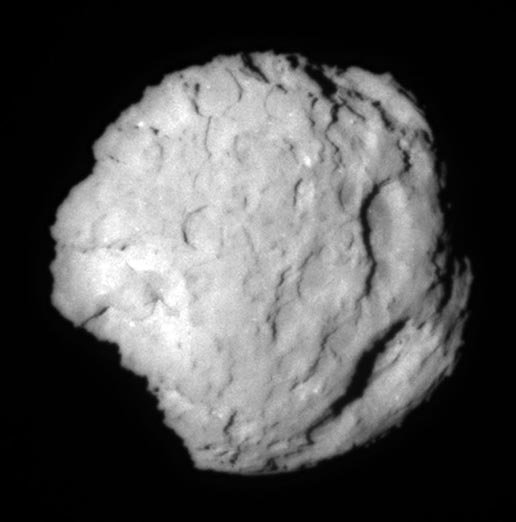
Oh man, this is great. The radar images from last week indicated the comet was dog-boned shaped but the close-ups from the former Deep Impact/now EPOXI mission are great and confirmed the nature of this heterogeneous object. In other words, this looks just like some of the asteroids out there.


Credit: NASA / JPL / UMD / Emily Lakdawalla
Click to enlarge

Tuesday, February 02, 2010

An asteroid collision

Color me surprised: I did not believe, when this object was first reported, and further debate on the Minor Planet Mailing List, that this was in fact a collision.

Tuesday, February 24, 2009

Comet Lulin from Chicago

The RAS observed Comet Lulin in Chicago yesterday. Unforunately it wasn't 100% clear, with some sort of high cirrus haze up, and with all the light pollution, only two of us saw the blob that was the comet. For proof of where it was, I took a quick snapshot through the eyepiece to confirm the location for others looking.

Monday, December 10, 2007

New Comet? Or is it Comet Holmes outbursting ahead of schedule?

UPDATE #2: It's not a comet, it's a fuel dump from a classified rocket launch.

On the CCD mailing list:
Folks,

I just went outside and there is at least a mag 2 comet visible at the zenith. I don’t think this is Holmes….Get outside now!!!

Jon Talbot

Is it Comet Holmes outbursting short of 60 days later?

UPDATE: On the AAVSO mailing list, someone pins it down to Lacerta, and probably gets it right (satellite fuel dump):
Folks,

I just went out at 00:00UT on Dec 11 UT. I looked up and in Lacerta directly between Cygnus and Cas was a large, bright diffuse object, looking similar to a comet. I'm talking bigger than Comet Holmes and probably 2nd mag. I got my 10X50 binocs and checked it out. It is slowly moving past the stars to the NE. It has a bright pin-like jet toward the NW, which can be seen unaided eye. The only thing I can figure out is that this was ejected from a satellite/rocket as some upper atmosheric experiment. It was out there as of 5 miutes ago. Anyone see it??? Any ideas on what it is???

Chris Stephan SET
Robert Clyde Observatory
184 Orday Rd.
Sebring, FL. 33875

Friday, November 09, 2007

Incoming asteroid--errr, satellite

Astronomers at the Catalina Sky Survey near Tucson discovered an object on November 7th and when the orbit was calculated it was a Near Earth Object (or NEO) and would barely pass by Earth in only five days time. By barely, it was calculated at only a Earth's diameter away--a little under 8,000 miles.

Photometric measurements suggested the object was 20m in diameter, which is pretty big as things go--the Meteor Crater parent body was estimated at 30-50m.

But as Russian astronomer Denis Denisenko noted on the MPML, the object had a peculiar orbit: it passed quite close by Mars at nearly the same time as an ESA orbiter called Rosetta. See a view at Mars here. And, Rosetta happens to have the largest solar panels short of the ISS, two 14 meter long panels that make 64 square meters in total, matching the expected brightness of the object. Sure enough, Rosetta is due at Earth for a orbit changing interaction with Earth in five days so it can rendezvous with a comet in 2014. The people in charge of maintaining minor planet orbits decried the lack of coordination between the artificial satellite organizations and the minor planet community--as satellites are launched it's easy to watch them go away, but the NEO watchers are rightfully concerned about inbound objects, and the data about spacecraft outside of near-Earth space is skimpy.

Wednesday, November 07, 2007

Comet Holmes article in Tribune

Tooting my own horn.
. . . .Comet 17P/Holmes
Watch this . . .
(well written Chicago Tribune story by Ryan Haggerty)


"It's certainly exciting," said Dean W. Armstrong, a member of the Ryerson Astronomical Society at the University of Chicago. Armstrong heard about the comet via e-mail. "It's much better than your average comet. To be able to see it in the city, to be able to see it with your own eyeballs without going out into the country is wonderful. It gives people a chance to reconnect to the night sky."

Monday, November 05, 2007

Comet Holmes fainter tonight, 11/5

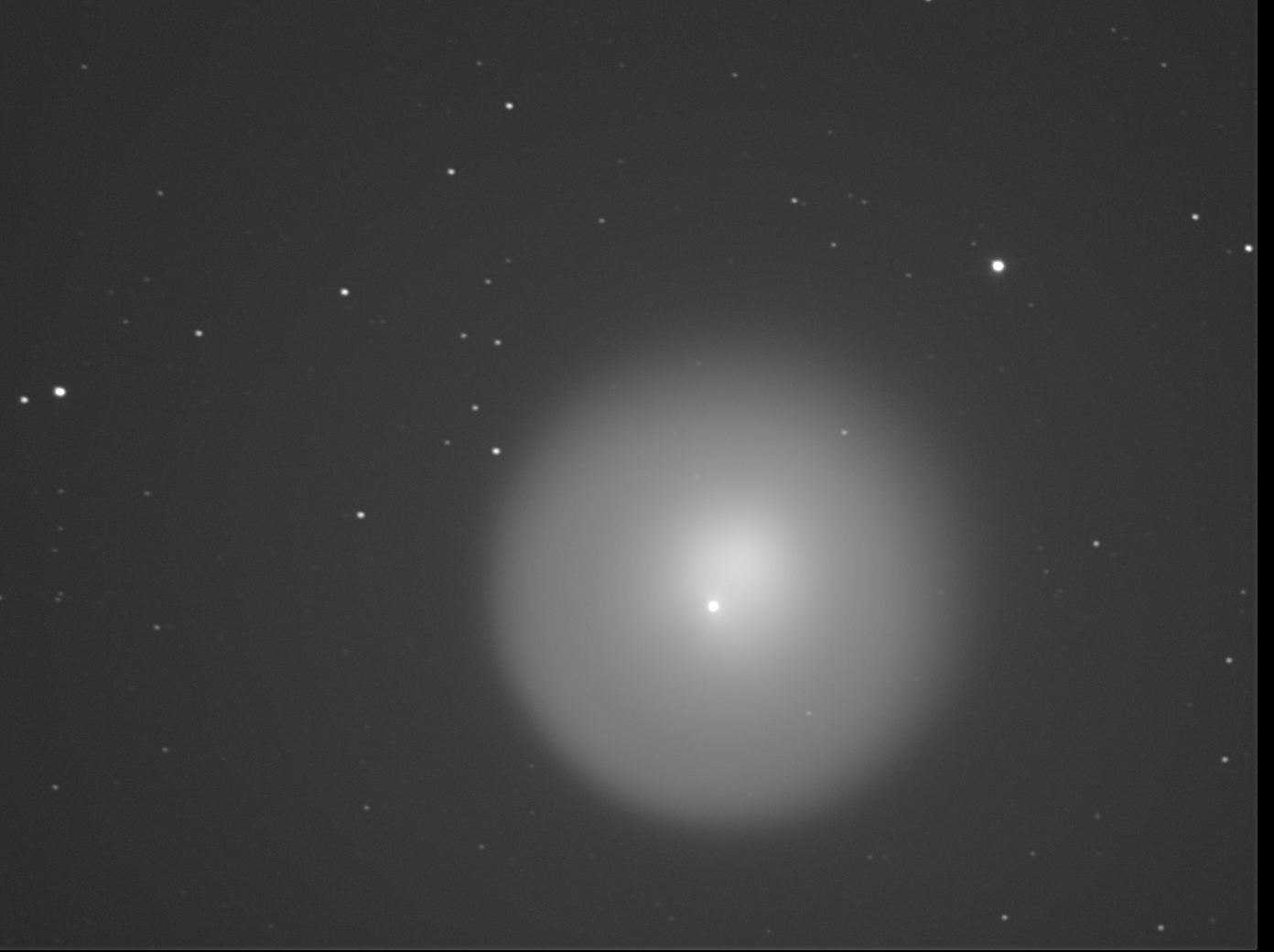
We fought with clouds tonight and bad seeing (and bad focus), but we all agreed the comet was larger and fainter tonight. The nucleus was too faint to see with our direct vision in the six-inch. The "blob" of material is taking on a more lenticular shape and the nucleus has some sort of trail extending from it.

Comet Holmes through the eyepiece

As I mentioned earlier, Comet 17P/Holmes is very bright. It's bright enough to point a regular digital camera into the eyepiece of a hundred-year-old telescope and get a reasonable image.


Comet Holmes on October 29th from Ryerson Observatory at the University of Chicago

Monday, October 29, 2007

Comet Holmes from Chicago

We had a great clear Monday after the RAS meeting so we got everyone to come up to the observatory to see the great outburst of Comet Holmes. Photometrically it seems the same brightness, but in binoculars or in the telescope it's much bigger and fainter than a few days ago.


Comet Holmes at Ryerson Observatory. 36x5s exposures, 0.25m f/6.

We imaged it through our 10-inch reflector while looking at it through the six-inch refractor. I processed the images to match the visual look. This comet is so bright I was able to take reasonable images with my digital camera just pointed at the eyepiece, with a few seconds of exposure, but I can't find my memory card reader, so those will have to wait.

So--it's still naked-eye, and now obviously not a star, so get out and take a look--the lower right "star" of an isoceles triangle containing Mirfak, above the bright star Capella in the northeast. (See a finder chart here).

A lot of people were asking details about why exactly the comet increased in brightness a millionfold. Without reading further, I vaguely heard a suggestion that the heat from perihelion takes a while to move deeper into the comet to where there is still volatile ices to blow out. Right now, the comet is moving out between Mars and Jupiter.

A fantastic historical read is Fred Whipple's paper in Icarus, volume 60, issue 3: "Comet P/Holmes, 1892III: A case of duplicity?" (link may need a subscription). I quote:

It may be added that the comet was discovered as a bright object nearly 5 months earlier than its perihelion passage, although the observing geometry was favorable all the time (at perihelion, the comet should have been only 1.5 mag fainter than near opposition 5 months later). It was also the first short period comet of q > 2 ever discovered.
Barnard's 1913) description on November 9.2 at Lick Observatory is revealing:
"'Its appearance was absolutely, different from any comet 1 have ever seen--a perfectly circular and clean cut disk of dense light, almost planetary in outline with a faint, hazy nucleus and a slight condensation some 5 seconds south following the nucleus (brightness -- Andromeda Nebula, diameter 260" at 8h0 '" P.S.T. and 286" at 9h40"').'" He observed the comet to brighten perceptibly by the next night at which time he saw an outer faint diffused envelope some 12' (800,000 km) in diameter.
Barnard's description carries great weight because he was a superb and experienced observer, having already discovered 15 comets and observed many more. His comments were generally confirmed by many other observers over thc world. Interest in the comet flared as the comet burst again to nearly naked eye brilliance on January
16, 1893, after having laded some 5-6 mag by late December and early January.
On subsequent returns P/Holmes hits remained extremely faint and inactive.


  • Circular -- check

  • Sudden nearly naked-eye burst -- check

  • Andromeda galaxy reference -- looked at Andromeda tonight right afterwards -- check

  • About 10 arcminutes in diameter -- check


Don't read anything into his comet satellite hypothesis though.

Reading further back, Bobrovnikoff wrote in 1943:

The comet was not well observed in December, 1892, and in the first part of January, 1893. On January 16, Palisa, in Vienna, found with the 27-inch refractor, instead of a diffuse comet of 10th or 12th magnitude as expected, a yellow star of 8th magnitude with an envelope of 20" in diameter. The comet increased in brightness the next day and could be seen with the naked eye. After January 18 it began to decline in brightness, and by the beginning of April it became very faint.
Saturday, October 27, 2007

Go see Comet Holmes.

If it's clear where you are, go outside right now and see Comet Holmes with your eyeballs, even with a nearly full moon nearby and even if you live in a horribly light polluted city. Binoculars will help, but you can see the comet with just your eyes right now, although it looks just like a star.

Look to the Northeast. Capella is the bright white star. Look up further towards the zenith to a compact triangle of stars, with the brightest star on the top apex. That star is Mirfak. Comet Holmes is the one on the lower left, the one closest to the line between Mirfak and Capella. Tonight, Capella and the moon form the bottom two points of a skinny-ish trapezoid, with Mirfak and Algol the top two.

Binoculars will reveal the star as a glowing blob, much bigger than the nearly stellar yellow object I saw on Wednesday. A telescope will reveal a stellar nucleus and a glowing blob surrounding it, getting bigger every day.

Finding charts (albeit poor in magnitude distinction are here)
. Sky and Telescope has one too--just move Capella up higher in the sky the later in the evening. A report here

Wednesday, January 10, 2007

Comet McNaught


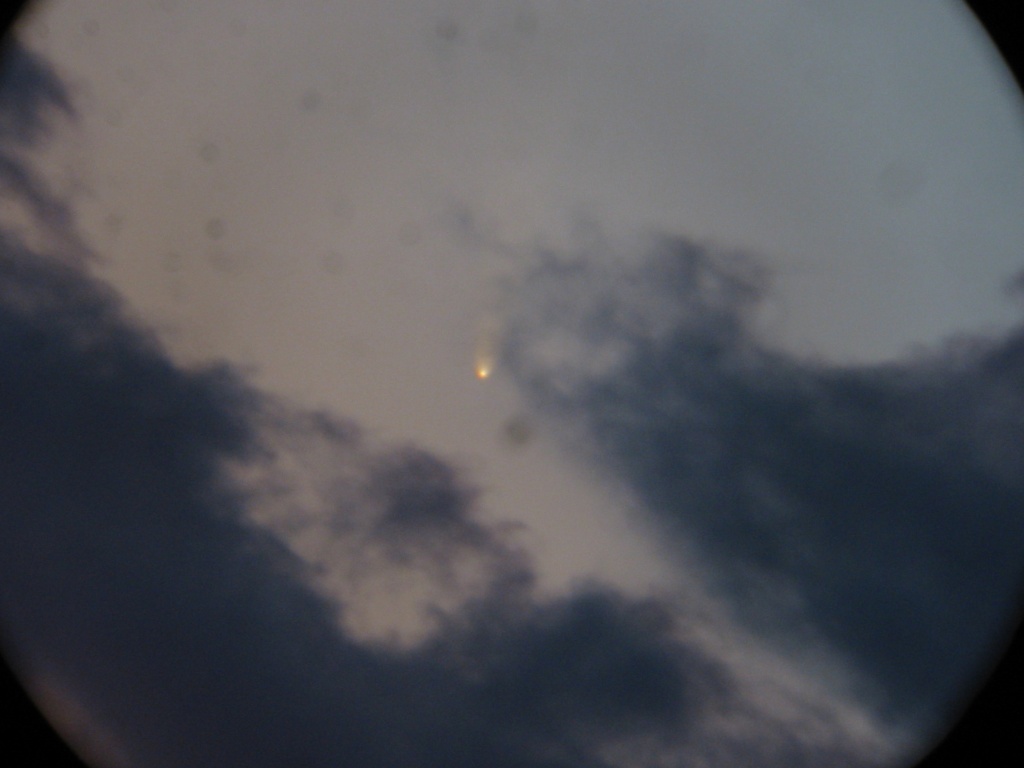
Last night it started clearing up right near sunset, and through scattered clouds I was able to see a blazing new comet, C/2006 P1 McNaught, near perihelion. A bright coma and tail was visible golden deep in the murk of the western horizon. It reminded me much of Comet Hale-Bopp, except H-B was that bright and in a dark sky--this one is only 10 degrees from the Sun.
This picture is a view through a six-inch refractor at approximately 40x, taken afocally (aka put the camera up to the eyepiece).

How to find it

Sunday, January 15, 2006

Comet Wild 2 and Stardust


Phil Plait's Bad Astronomy has a good post about the source of Stardust's material: http://www.badastronomy.com/bablog/2006/01/14/the-return-of-stardust/

P.S. I should note the parent spacecraft has to alter its orbit to avoid the Earth and continue on its extended mission.

Monday, January 09, 2006

Stardust return

Stardust will return comet dust samples to Earth Saturday night. I was amused by this statement in an Associated Press article:

Residents in parts of Northern California, Oregon, Washington, Idaho, Nevada and Utah should see the Stardust capsule as it streaks across the pre-dawn sky. Prime viewing will be along Nevada's Interstate 80 where residents can view the capsule's front.


My first thought was "Residents? Along I-80?"

Tongue-in-cheek, of course.