Tuesday, May 31, 2005

Visual/Infrared comparisons


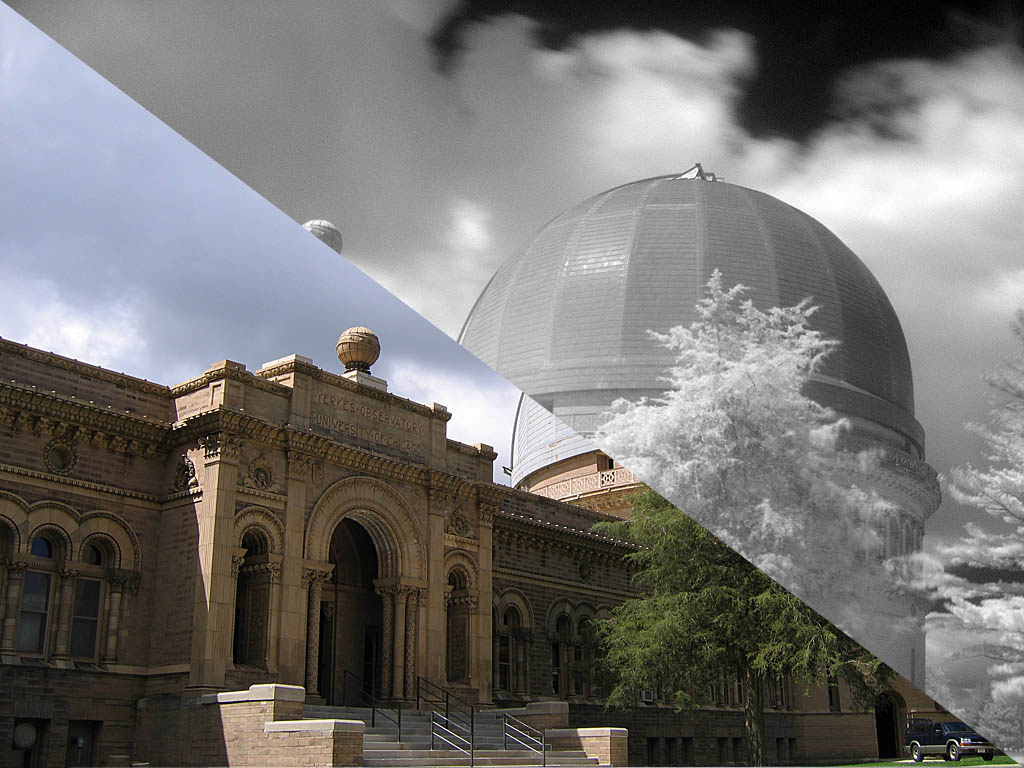
This is a split screen image of Yerkes Observatory in the visual and near-infrared. I moved the camera in between images and wasn't planning in advance, but the comparison still works. You can see the pine tree turns white, the blue sky turns very dark, and the tones of the brickwork and dome sheeting subtly change.

Car Windows
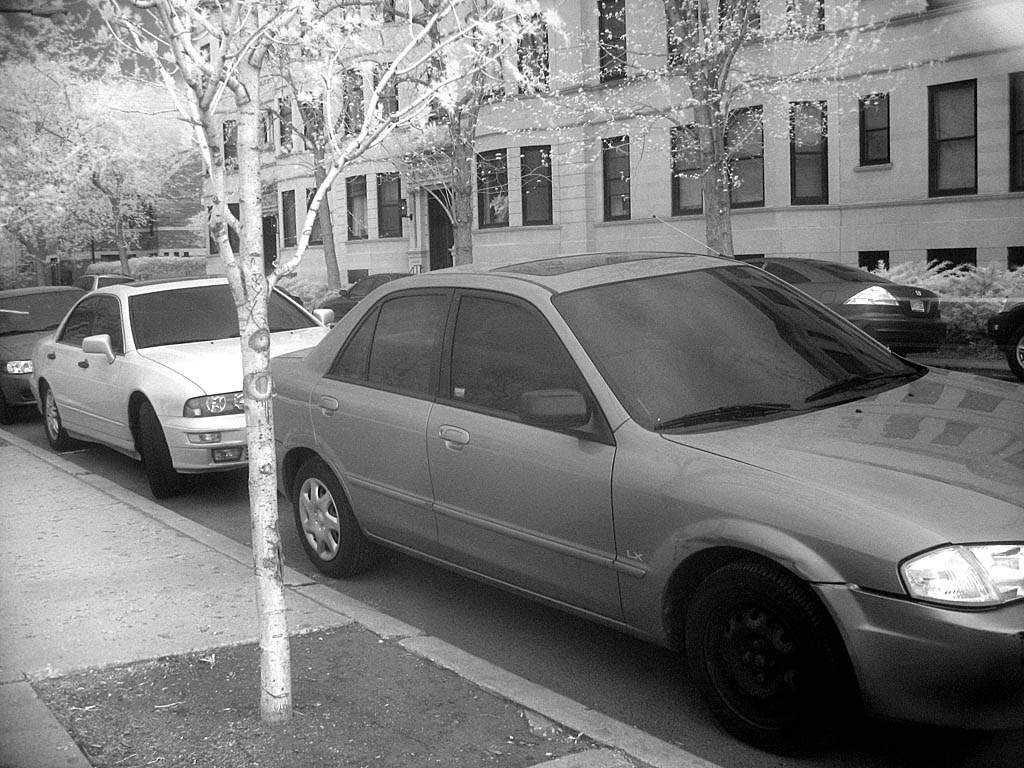
Automobile windows, we are all taught, are wonderful examples of the greenhouse effect. Visible light streams in, is absorbed by the car's interior, and converted to heat. The thermal infrared light is then reradiated by the interior but unable to escape the glass, and the car heats up.

Manufacturers are well aware of this fact, and today's cars have a higher glass to surface ratio than older ones. Given this, why aren't we melting the plastics in the car?

We could tint the windows, to reduce the total light into the car, but this is dangerous at night, and is completely impractical for the windshield.

The answer is in the glass itself. Automotive glass contains a special additive to absorb near-infrared light. NIR is worthless to human vision, but can contribute significantly to the heat load of a car. (I can't remember the reference, but I've read it can be 50%).

Here is an image of a car that visually had no tinted windows; indeed, no one can opaque their windshield legally:

A spectral graph of a glass like that is here. (Link used to go to a nice graph but it's missing).

Currency
You can see that American currency has some sort of blank stripe code on the back of the new bills: http://www.lib.uchicago.edu/~dean/infrared/slides/IMG_4784.html.
I saw this at here; and then a simple search shows that it is no secret but a great anti-counterfeiting technique: http://www.accubanker.com/support/irmappings.phtml

Plants
These need a separate post.
P.S. Here's an image of a Linne statue with a false-color mapping.
My infrared gallery
IR hosta
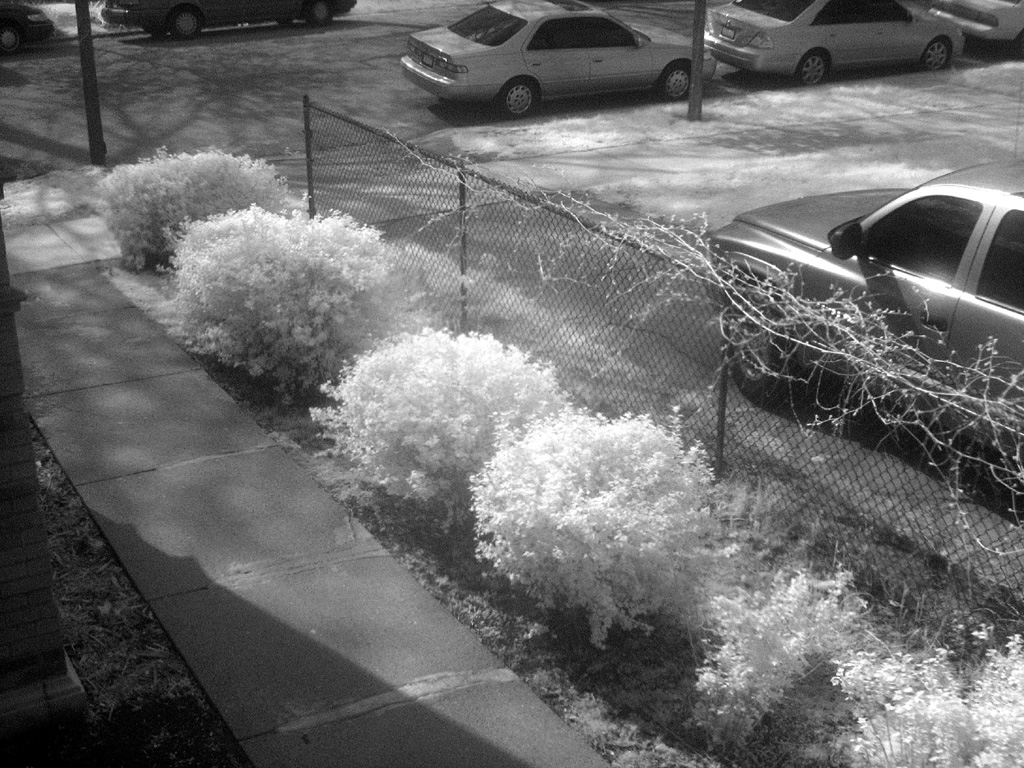
Bushes in the near-IR

Sunday, May 22, 2005

Infrared gallery

I have placed most of the near infrared images I've taken at http://www.lib.uchicago.edu/~dean/infrared/.
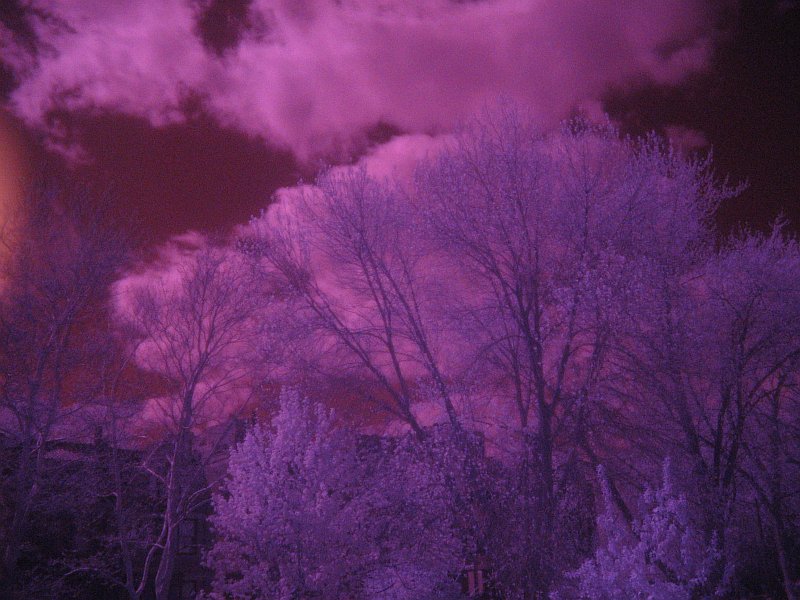
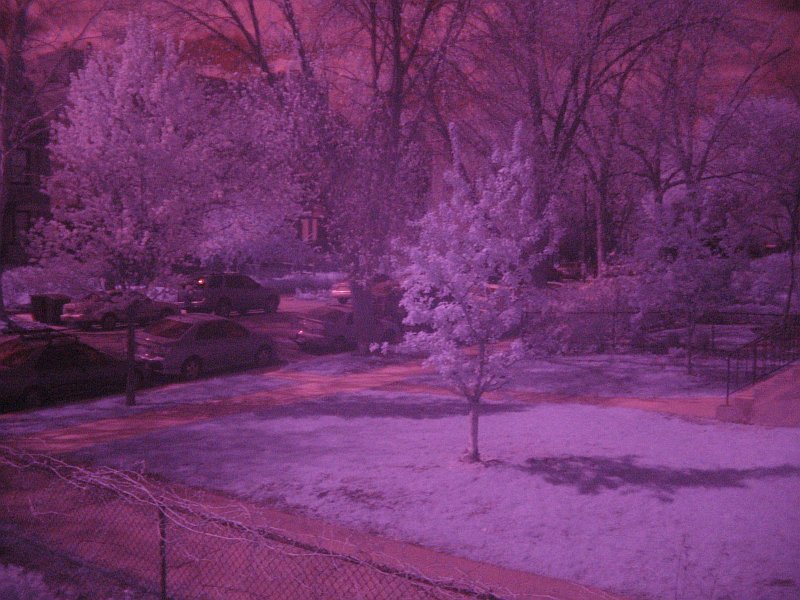
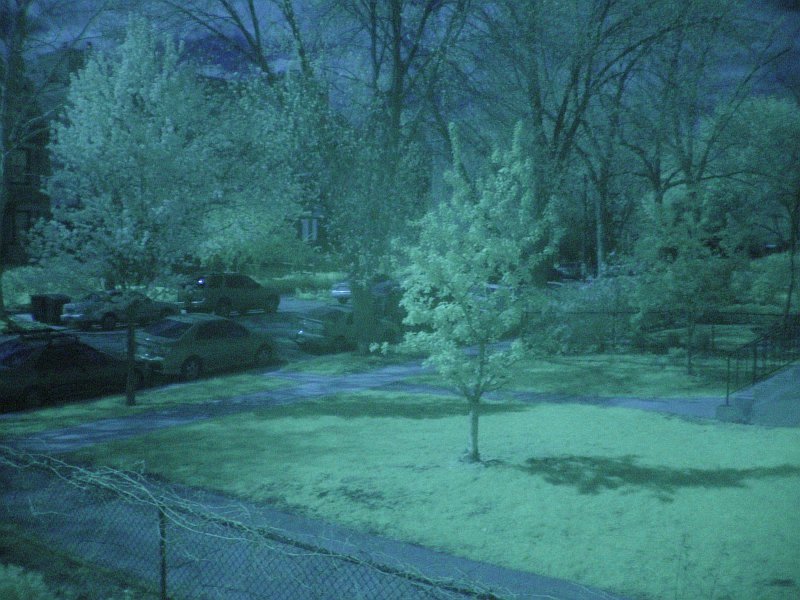
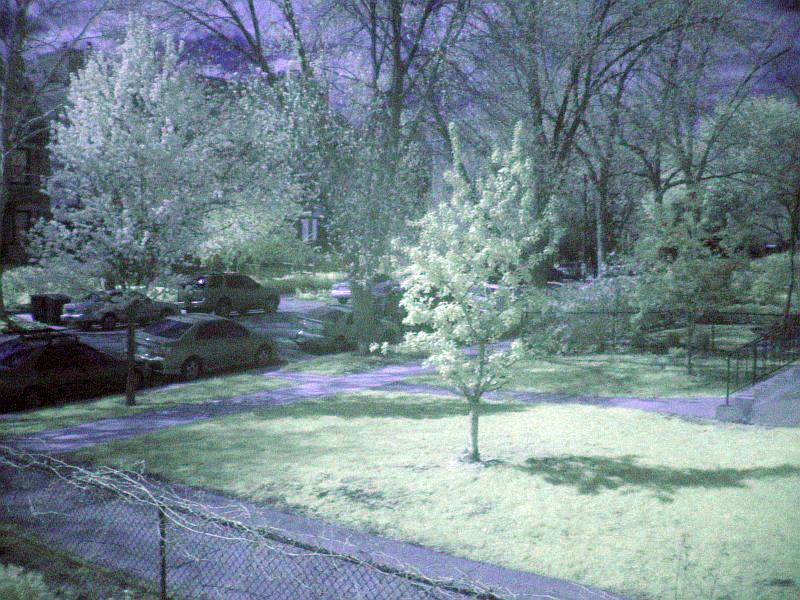
All of the images were normalized with "Auto Levels" in Photoshop and desaturated to greyscale. The raw images are very purple and underexposed.


The filter material
was color negative film, fully exposed and processed, stacked
up in three. This sandwich is opaque to the eye except for
bright filaments. There is leakage around the sides of the filter when I place it on the camera lens, and since it's just negative film, there are significant reflections between the three pieces, creating a hotspot in the center of the frame.


In the camera, all three channels respond,
although the green is weaker than red and blue. The response
from all three channels must be the residual near-IR leakage
through the color filters, and scenes appear to be the same if
you compare each color channel. With a two layer sandwich you
begin to see more red light come through, and this creates a
neat contrast between near-infrared-red and near infrared:
http://www.lib.uchicago.edu/~dean/blog/ir2-auto.jpg. There is
a normal visual comparison at
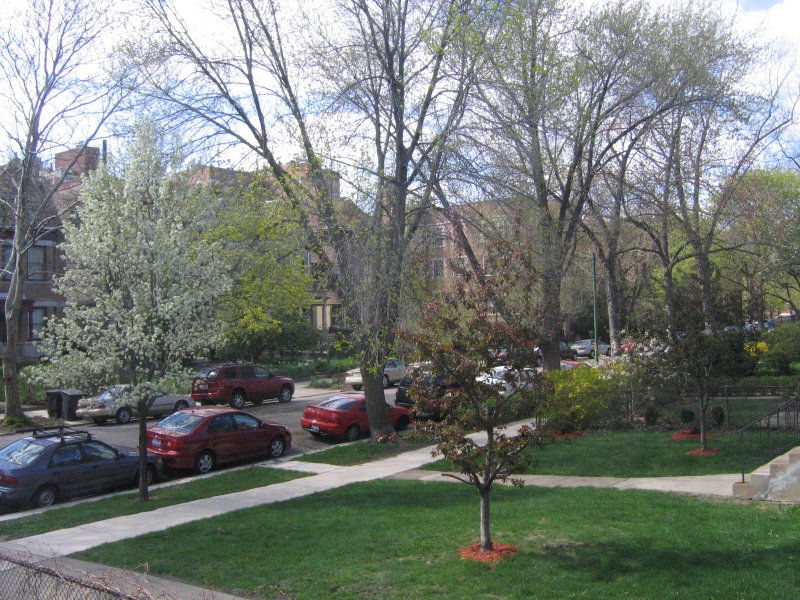
http://www.lib.uchicago.edu/~dean/blog/ir-normal.jpg.
The exposures are roughly 1000x longer with the filter in bright sunlight.


In the next post, I'll discuss some interesting details about near-infrared light: plants, automotive windows, and currency.

And split screen comparisons with normal visual images.

Visual Infrared Comparisons
Plants in the near infrared
Linne Statue in the near infrared
IR bushes
IR hosta (or plantain lily)

Tuesday, May 17, 2005

Aurora photos from Yerkes Observatory

This Saturday members of the Ryerson Astronomical Society visited Yerkes Observatory to use the 41-inch reflector. Luckily the clouds cleared for observing until midnight or so, when the clouds reappeared. While taking a break, I noticed a faint glow low to the north, and assumed it was scattered light from the setting first quarter moon, but then I realized the moon was too far to the west for that to happen. Then the glow turned green, and I knew we had an aurora. The clouds cleared out, and we were treated to a fantastic display of the northern lights. It started out green and in the north, and spread overhead, where it suddenly changed color and we saw light pastel blue and violets in addition to the green. The display continued until dawn at 4AM.

http://astro.uchicago.edu/RAS/rchive/yerkes-aurora/index.html
Tuesday, May 03, 2005

IR bushes


Plus, a graph of the transmission of fully exposed and developed color negative film, from recorded by here:

This helps explain how dust removal scanners with ICE work--the film dyes are transparent in the infrared, but dust isn't. An infrared scan of the negative shows a clear negative with only the dust visible. Silver grains in black and white film are uniformly opaque to light and so ICE won't work with it.

Saturday, April 30, 2005

Thursday, April 28, 2005

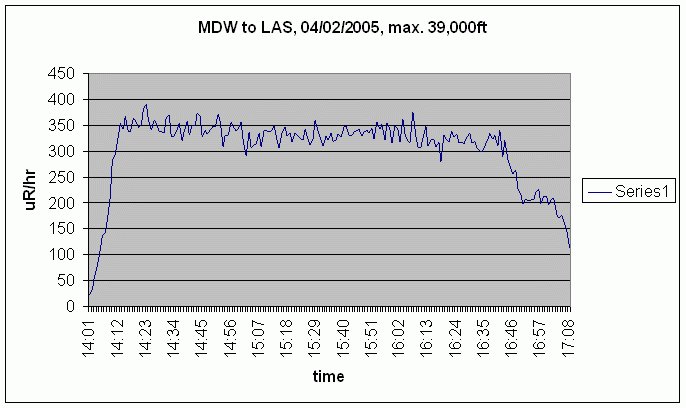
Another airline plot

This was a trip to Las Vegas. Maximum altitude was at 39,000ft, and the flightpath was a relatively northern one across Nebraska and Colorado, then turned south in Utah. We flew for a while in southern Utah at a lower altitude while getting into the inbound approach, and you can see that on the graph.

http://www.lib.uchicago.edu/~dean/blog/mdwtolas.jpg

Wednesday, April 27, 2005

more near-IR tests

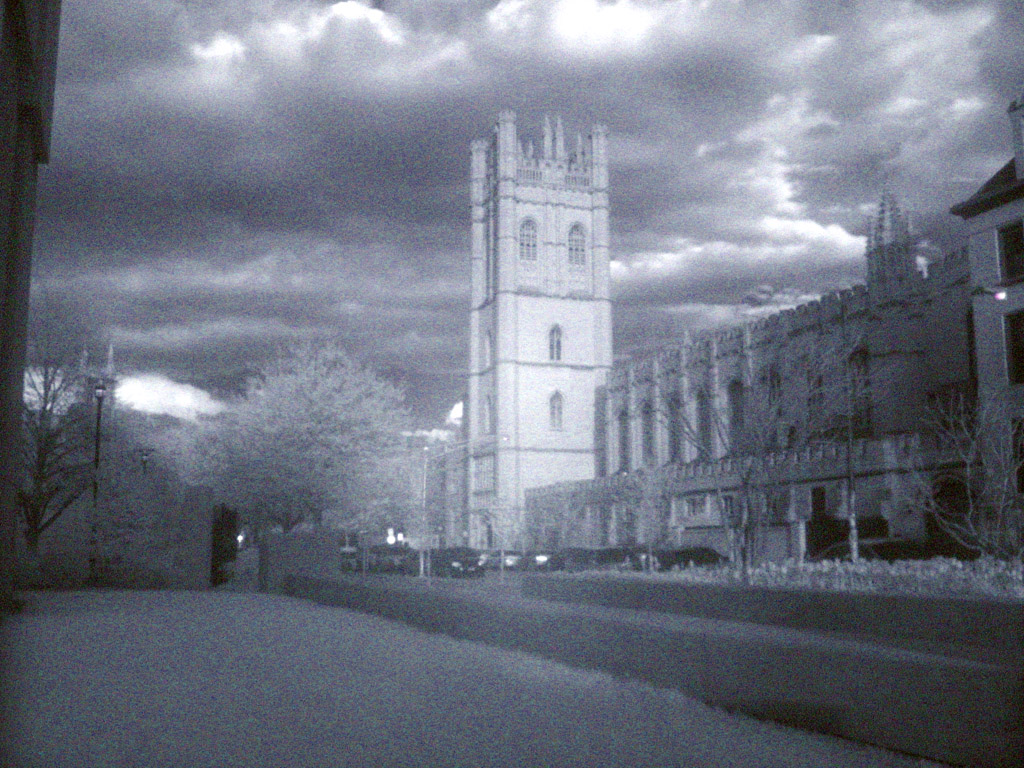
I added a third layer of color negative to the filter, and this makes the sandwich completely opaque to the naked eye. The sun is barely visible (but not at all safe to look at) through it. I can get a reasonable if slightly underexposed image of open shaded areas with an exposure of 4 seconds at f/5.6 at ASA 400. With the third layer there is no difference between the red and blue filters, so I believe whatever I am getting is residual IR leakage.

http://www.lib.uchicago.edu/~dean/blog/reynoldsclub-ir.jpg


That isn't snow, it's grass.

A clue to what wavelengths we are seeing is the fact that the streetlight happened to be on, and we can see it, and HPS lights emit a very intense 819.3nm and 819.5nm doublet.

Monday, April 25, 2005

near-IR world

http://www.lib.uchicago.edu/~dean/blog/ir1.jpg
http://www.lib.uchicago.edu/~dean/blog/ir2.jpg
http://www.lib.uchicago.edu/~dean/blog/ir-normal.jpg
These were shot with a near-IR filter over my camera
(a near infrared filter being two pieces of fully exposed color negative film).

If you swap the RGB colors around, you can eventually get something almost, but not quite entirely unlike, normal. http://www.lib.uchicago.edu/~dean/ir2-rgb-bgr.jpg

Some more (post-processing):
http://www.lib.uchicago.edu/~dean/blog/ir1-auto.jpg


http://www.lib.uchicago.edu/~dean/blog/ir2-colorswap.jpg

From looking at the RGB histograms out of the camera, it appears that the red and blue filters let the most near-IR through. Traditionally this is the case. The red lets very near-IR through, and the blue lets in IR at double the blue wavelength (a 450nm blue filter will let in 900nm IR, e.g.). The blue channel shows the most chlorophyll fluorescence too.

Thursday, April 21, 2005

Lunar maria colors

A nice image of exaggerated maria colors on the Moon: http://www.rc-astro.com/img/moon_colors_2005-04-18_web.jpg.

Visually, you can see this, especially between Mare Serenitatis and Mare Tranquilatis (wow I can't believe I spelled that right the first time). They are the two prominent, quasi-circular touching maria on the left side. The color difference for maria basalts is the difference in composition of TiO2.

Tranquilatis, the bluer one, is very rich in TiO2.

Giguere, Thomas A.; Taylor, G. Jeffrey; Hawke, B. Ray; Lucey, Paul G.
The titanium contents of lunar mare basalts
Meteoritics & Planetary Science, vol. 35, no. 1, pp. 193-200 (2000).

Saturday, April 16, 2005

Another down

Another down. However, this rejection letter was very nice, as opposed to Arizona's. Mahalo, Hawaii.

Friday, April 15, 2005

I've been on vacation

I've been away. I didn't do much. I note that I heard many more stations in Nevada with an Icom R-71a in the 15 MHz and 17MHz broadcast bands than in Chicago. It probably proves that the old tube Hallicrafters S-40A needs work on stage 4, 15-40MHz. I heard Radio Netherlands on multiple frequencies, and it was neat to note one of the stations was 1/4 second behind the others. Steven and I have decided that proves it has 1 satellite hop extra to that relay station than the others. (Geosynchronous orbit is 23,000miles, roughly 1/8 light-second away). I bet stringing a simple wire out to the west edge of the roof (past the skylight) would give us a great signal and some immunity to the elevator noise. The current antennas, save for the magnetic one, aren't shielded and pick up noise (and signals too) from the coax braids, since they aren't correctly balanced.

Friday, March 11, 2005

VLF radio part 1

A long time ago I dabbled in Very Low Frequency radio. These are radio waves with frequencies under 20kHz. They have obscenely huge wavelengths and as a result can penetrate into "conductors" a significant distance before being absorbed/reflected. The Navy used to use VLF for communicating with submerged submarines at 76Hz and 58Hz. There is a navigational system located down near 100kHz called LORAN-C, and the WWVB signal at 60kHz. Lightning is the dominant natural signal in this wavelength band. But, nearly everything creates electrical noise down there. For instance, let's talk about switching power supplies.

Nowadays nearly everything is powered via a switching power supply, as opposed to a linear supply. What's the difference? A linear supply uses transformers to convert the AC running at 120 volts and 60Hz into a lower, often 13.8 Volts 60Hz AC. This is then rectified into pulsing DC via a set of diodes and smoothed out with capacitors. It's wasteful--a percentage of the power is lost via heating in the transformers. They have to be very large to keep the 60Hz oscillating magnetic field inside the transformer.

Switching power supplies first convert the AC into a high voltage DC (around 200-300V). Then, the DC is switched quickly on and off at a high frequency, often 50kHz or higher. This is then put into a much much smaller transformer since high frequency transformers can be much much smaller and still be efficient as a big transformer running at a lower frequency. On the other side, power requirements are measured and there is feedback to provide a pulse-width-modulated approach to supply the power needed.
http://mrtmag.com/mag/radio_switching_vs_linear/
gives a good overview.

Anyways, they are noisy. The world is a very noisy place in the VLF band.

Long ago, my friend John Crocker ran a 1000ft wire down the length of the Midway, stuck a ground rod into the earth, and placed a pair of high-impedance headphones in between. The VLF radio waves are directly converted into audio frequencies.

Read VLF Radio Part 2: Sferics

Wednesday, March 09, 2005

Pentax Takumar lens

I bought a 55mm f/1.8 Pentax screw mount lens off of Ebay last week to use as a wide-field imager in front of the Starlight Express SXV-H9 CCD camera. The total cost was $11. What I didn't expect was that the rear element of this lens was made with a thorium-rich glass. The radiation might preclude use of this lens. I get counts of 6000 microrem/hr with the counter at the surface of the element. I did some counting last night:

With the detector 2 cm away and 10 samples of 10 seconds each:
Bare: 2743
Single sheet of paper: 2466
Aluminum (1/16 inch thick): 577
Aluminum and paper: 563
With geiger counter reversed: 80
With geiger counter reversed and Al: 60
From side of geiger counter: 96
From side with Al: 87
Background count was 12.

Then, I did some distance counting.
Distance Count rate
2cm 2721
4cm 1145
6cm 647
8cm 391
10cm 282
12cm 203
14cm 165
16cm 130
18cm 98
20cm 87
22cm 80
24cm 57
26cm 59
28cm 47
30cm 38
32cm 42
...
40cm 26

I also measured the rates with the 1/16 inch thick Aluminum sheet in the way--this way, I was hoping for only the photonic component of the radiation, so no air absorption.
6cm 156
8cm 88
10cm 64
12cm 48
16cm 30
20cm 18

Graphs are needed, I know. I just wanted to post something. Everyone else is busy with end of quarter work.