Showing posts with label geiger counter. Show all posts

Tuesday, May 16, 2023

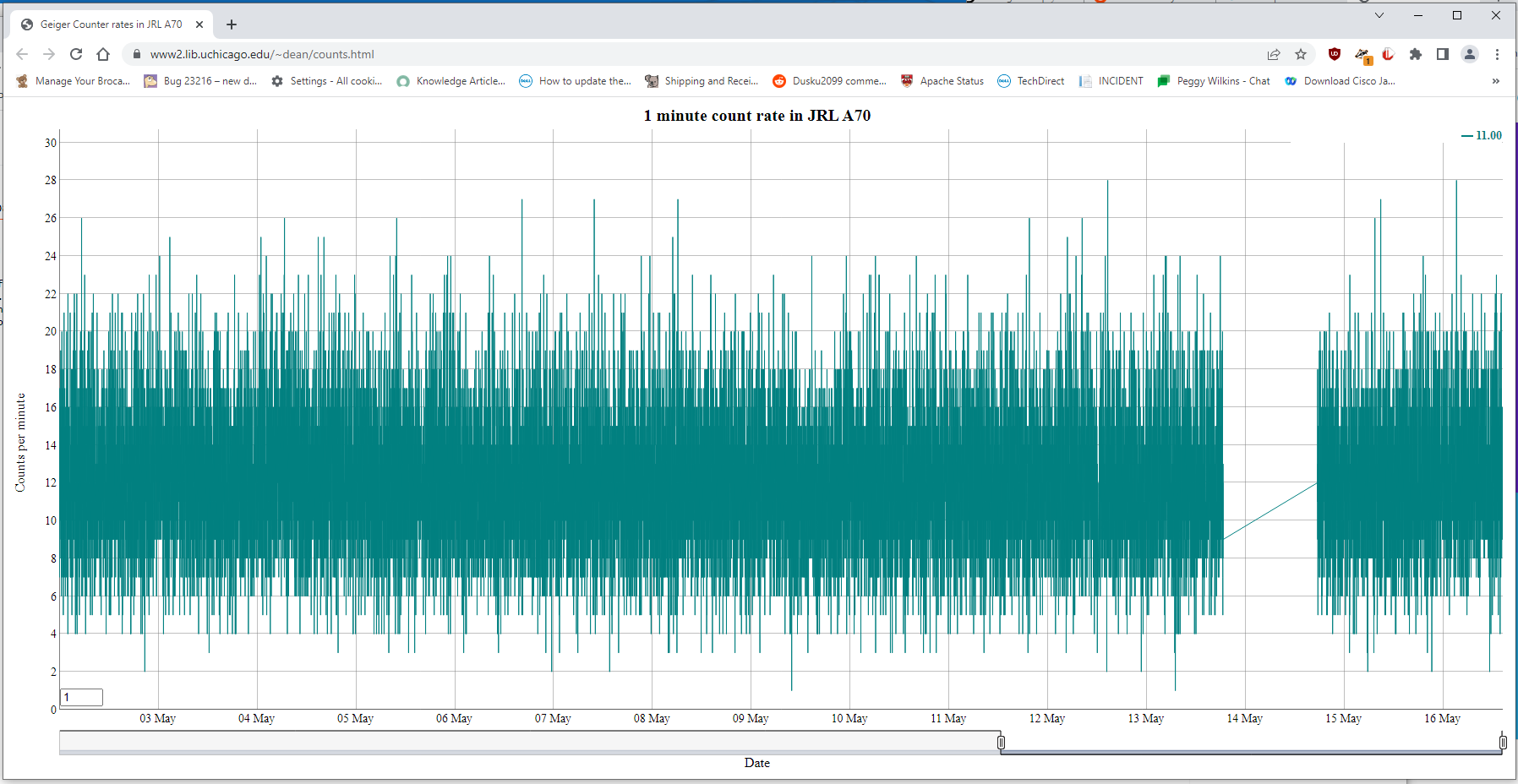
Geiger counter back up in Regenstein Library

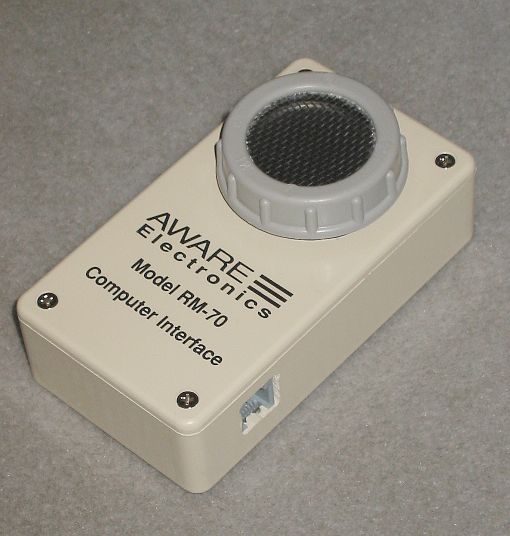
My long suffering Geiger Counter is back up and running. I used ChatGPT to create a sample Arduino sketch to interact with the pulses coming from the counter and send a per-minute count to the serial port. Then I have a Powershell script write the date-time and the number of counts to a CSV file on a web server. Then I have dygraph.js make a picture of the results. One flaw that is evident is if the Geiger counter connection gets loose, and it does, once it reconnects it looks like there's a sudden surge of rate, which is fake. Also, this whole thing is reliant on powershell running on a Windows box that gets patched frequently. Oh and ChatGPT will make very big mistakes that you absolutely have to catch.
Enjoy this subpar code!
const int geigerPin = 2; // the pin number connected to the Geiger counter output
volatile int count = 0; // variable to count the number of pulses


void setup() {
  // put your setup code here, to run once:

  pinMode(geigerPin, INPUT); // set Geiger counter pin as input
  Serial.begin(9600); // initialize serial communication
  attachInterrupt(digitalPinToInterrupt(geigerPin), pulseCount, FALLING); // interrupt on falling edge of Geiger counter pulse
  pinMode(13, OUTPUT); 
  pinMode(5, OUTPUT);


}

void loop() {
  // put your main code here, to run repeatedly:

  delay(60000); // wait for 1 minute
  detachInterrupt(digitalPinToInterrupt(geigerPin)); // disable interrupt
  float cpm = count; // * 60.0 / 60000.0; // calculate counts per minute -- this seems wrong
  // Serial.print(cpm); // print counts per minute //
  Serial.println(cpm); // print counts per minute
  count = 0; // reset count
  attachInterrupt(digitalPinToInterrupt(geigerPin), pulseCount, FALLING); // re-enable interrupt
}

void pulseCount() {
  count++; // increment pulse count
    digitalWrite(13, HIGH);
    tone(5, 3800, 5);
    delay(50);
    digitalWrite(13, LOW);
  }
  

Powershell:
# Configure serial port settings
$port = new-Object System.IO.Ports.SerialPort COM3,9600,None,8,one


# Loop indefinitely
while ($true) {
# Read integer from serial port
$port = new-Object System.IO.Ports.SerialPort COM3,9600,None,8,one
$port.Open()
$number = $port.ReadLine()

# Write number to file
$path = "\\samba\dean\web\counts.csv"
$timestamp=get-date -format s
# // $NewLine = "{0},{1}" -f $date,$number
# Format the data as a CSV string
    $data = "{0},{1}" -f $timestamp , $number.Trim()
#// $NewLine | add-content -path $file
# $string=$date,$number
# //Add-Content $path $string
# Append the data to the file
    Add-Content $path $data

 echo $data
 $port.Close()
  }
  

Wednesday, February 20, 2019

The problem with the uranium at the Grand Canyon story

There's a hot story right now about three buckets of uranium ore that was stored at a museum at the Grand Canyon, with a claim of it being quite radioactive and a particular employee claiming the whole thing was covered up. The problem is the employee's numbers are off by a factor of 1,000. The presentation slide has the outside background rate at 2 mRem/hr. That's gotta be wrong; an average exposure in the Colorado Plateau is about 90 mRem per year, which would be something like 0.01mRem/hr aka 10 uR/hr. The buckets at the surface were really more like 300uRem/hr, or 3mRem/hr.

Sunday, August 14, 2011

7.72 microRads/hr

A 39 day long sampling of every minute leads the geiger counter to a long term average of 7.72 uR/hr. That's 56658 sampling points. That's about what's it's always been.

http://www.blogger.com/img/blank.gif

Friday, June 03, 2011

Natural background radiation in Chicago

A recent inquiry brings up the question of what's the normal natural background radiation rate in Chicago? Using the EPA's online tool, we see the budget for naturally occurring sources listed as
(all numbers per year)
26 mrem for cosmic radiation
2 mrem for elevations up to 1000ft
46 mrem from terrestrial K, U, Th in soil (aka not Colorado Plateau or Gulf and Atlantic Coasts but normal US soil)
0 mrem from radon&daughter products (I'm excluding it here from this calculation but it's a sizeable percentage of your yearly dose)

74 mrem total, which comes out to about 8.4 urem/hr or microrems per hour. The long-term average in my basement office runs at about 7.6uR/hr.

From Duval, J.S., Aerial gamma-ray surveys of the conterminous United States and Alaska, you can see here that the approximate average exposure rate from naturally occurring U, K, and Th in the ground is about 4.5uR/hr at 1m above the ground for Chicago. I say about because the survey didn't look at heavily urbanized ground. But with the high resolution data and a geologic map you should be able to predict what it should be.


The Straight Dope unfortunately printed an error about it in 1980, claiming the rate in Chicago was 2 millirems per hour. That's really off; it's 1/250 of that.

Wednesday, March 16, 2011

Geiger Counter back up

My long-suffering Geiger counter is now back up and running.
http://www.lib.uchicago.edu/~dean/float.htm.

Now, as has been pointed out, this particular instance of this experiment is really an experiment, and is run only by me, for only experimental purposes. It doesn't represent any opinion or endorsement or opinion of any entity, whether the University of Chicago Library or the University or anything else. It is not a service. It represents nothing, is not calibrated, and should not be relied upon by anyone for anything. Don't email or call anyone but myself about it.

This instance is located in my office on the A-level of the Regenstein Library, the first basement level of a six-story building. The levels average about 8 microrads/hr here. Outside at Ryerson Physical Laboratory on the fifth floor, levels average to about 12 microrads/hr, which indicate the shielding provided by the Regenstein against the cosmic ray flux.

The problem I've been having with this counter was with the associated AW-SRAD software, which runs under DOS, doesn't appear to support virtual COM ports above COM4. On my Windows XP PC I had installed an Arduino which offered a similar USB Serial converter and I theorize at some point there was a conflict and the Geiger counter with its FTDI USB to serial converter took a high COM port at COM5. After removing the Arduino, I then disabled the real serial port at COM1 and forced via Device Manager->Ports->USB Serial Ports the port to go to COM1.

Tuesday, March 15, 2011

What's in the steam coming from a nuclear reactor

I've hesitated to comment much on the ongoing Japanese tragedy, but I wish to talk a little about the output coming out from the reactor whenever they open the valves to reduce the pressure inside. In commerical nuclear reactors not using heavy-water for their coolant (aka most non-Canadian western reactors) the pure water coolant is exposed to the intense neutron flux as it passes through the reactor. The neutrons can interact with the oxygen nuclei in the water to form nitrogen-16, a very short lived radioisotope with a half-life of seven seconds. After a few minutes away from the core there is none of it left so the only hazard is near the output pipe, and there are places they store the output for just a little while to let all of the N-16 to decay back into oxygen-16.
The other common isotope coming out is tritium coming from the small amount of deuterium in normal water, leaking through the fuel rod cladding, and other spalling type nuclear reactions in the materials in the core. The tritium is a low radioactive hazard but has a 12-year half-life.

If the reactor is hot, water will decompose into hydrogen and oxygen, especially with the right catalysts.

So if you were to open the output valve on a reactor to relive the steam pressure inside (because the regular cooling is not working), you would get quite a bit of that nitrogen-16. It would be gone by the time a few minutes of wind-time, but it is quite the hazard to the plant. I wonder how much of the periodic bursts of site limit radioactivity is related to that.

The introduction of seawater into the cores introduces the possibility of neutron activation of a number of other elements (sodium, chlorine, etc.) into radioactive isotopes that last longer and can have more of an issue in life time and clean up.

None of this discussion is about the breaking or melting of the cladding and detection of fission products (like what you see when checking people on their clothing for particles), which seems to have occurred in some fashion.

A good primer on what might be going on, without hysteria is over at MIT.

Thursday, April 01, 2010

Geiger counter problems interfacing with PC

I've been unable to get the DOS software AW-SRAD to work with the geiger counter for some time, on multiple machines, with Windows XP. It's a bummer. I can input the sound pulses from the clicker unit I made into a sound card, but I have no idea how to then get the PC to do something with that. I'm not a programmer. The original geiger counter set up was really simple: it toggled the RING indicator on the serial port.

Thursday, September 24, 2009

Geiger counter current draw

This circuit connected to my geiger counter uses on average 80uA-- that's 0.08mA. On a click, it will bump up to 0.1mA. On startup just for a second it uses 3mA. At those rates, and with a standard 9V battery (at 650mAh), it would run about 9 months continously.

Saturday, September 12, 2009

Geiger counter offline

I've been having serial port problems with my geiger counter that has been running since December 1st, 2005, and so at the moment there is no reading.

Thursday, July 24, 2008

Granite counters: the claim of radiation risk

granite

The New York Times has a surprising article today about the radiation risks of granite counters.

Granite is an intrusive rock--slowly cooled from magma several kilometers below the surface, the rock grows large crystals from the hundred-thousand to million year cooling period. It is also chemically more "continental"; that is, more quartz, more "felsic" minerals, as opposed to the "mafic" minerals that contain much olivine and pyroxene, two minerals rich in iron and magnesium. True granite is a chemically specific intrusive, and much of what is called granite isn't, but a cousin of it. Roughly you can say to expect quartz, feldspar (of some type, there are several), and a sheet silicate like mica or biotite.

Despite the popular image of the Earth's crust riding on an ocean of molten magma, there is little liquid under our feet. While it's hot, there is enough pressure to keep things solid. Occasionally something will upset that balance and allow the rock to melt, whether by bringing hot material up to a lower pressure (like at the mid-ocean ridges) or by adding a special ingredient to make it melt (like water released by ocean sediments subducting under a continent). Melting is complicated and rarely complete, and some minerals melt at a lower temperature than others, leaving behind and chemically changing what sort of rock it is. Granite is like this. It melts at a lower temperature than basaltic materials. It often contains more water. And it brings with it certain compatible elements including uranium and thorium. This is why granites are more radioactive than most rocks. They can contain 10-20x more uranium and thorium than the solid left behind. Some of the more exotic "granites" are pegmatites--the extremely large crystal remnants of the last little bits of liquid at the end of solidification--and they contain the highest amounts of these elements.

But is this a hazard? Granites I've encountered have rates ranging from nothing to about 10x background. This isn't that much. Time spent at cruising altitude is about 40x background at 500ft. It certainly wouldn't be worth the fuss of ripping up a kitchen, unless it was proven to be the source of elevated radon levels. After reading the literature about naturally occurring radon sources, I have difficulty assigning the radon to just a small granite piece. Any soil or rock within 4 gas-diffusion-days of the basement or slab can be a source of radon for a home, and the total amount of uranium in that quantity is going to exceed the amount in the countertop (especially the part of the countertop that is within radon's half-life time of the surface). If you covered your walls in granite it might be different.

Tuesday, January 22, 2008

NYC detector bill

This will probably be my last comments on the proposed New York City bill to regulate detectors, hopefully because it sounds like some people realize the inanity of the bill; two very insightful sentences in this article from the Downtown Express
:

(NYPD Deputy Commissioner for counter terrorism)Falkenrath would not commit to publishing a list of approved devices or approved device specifications, because he said that list could give terrorists information about what the city is capable of detecting.

Vallone replied that the council normally does not pass bills with such broad language, but that he would defer to the Police Department’s judgment in this case.


So in other words, you need a permit for your detectors, but they won't tell you which detectors you'll need a permit for. Nor could manufacturers build devices to specifications for sale in NYC, because they wouldn't be able to know what those specifications were.

Friday, January 18, 2008

More on the New York Geiger Counter law

From the report of the committee on public safety:

However, the emergence and commercialization of new and highly sophisticated technology developed for the purpose of detecting weapons of mass destruction brings with it the possibility that the private sector will acquire detection capabilities which were previously used only by properly trained military and law enforcement officials.


I love how science and education had nothing to do with the invention or previous use of this technology. Geiger counters must have sprung from the forehead of the Police Commissioner! They couldn't have been invented in 1911, because the government says they're new.

P.S. No more Cloud Chamber experiments either, because those would detect radiation. Can't alarm the masses.

New York wants to ban geiger counters

I'm not making this up:
http://cityroom.blogs.nytimes.com/2008/01/08/a-license-to-check-for-wmds/

is reporting that New York City wants to require "licenses" for any detector for nuclear, biological, or chemical detectors. We know how "permitting" devices works in Chicago--they never banned handguns in the city, they simply stopped issuing permits for them.

Geiger Counter
Is this Mr. Dangerous?

What exactly is so bad for someone to possess a detector? The claim is that the Police Department wants to prevent mass panic. In reality, they want to control information. They want to prevent citizens from making their own judgement and force them to rely on "authorities". Why not make a law to make it a crime to create a false panic? There's probably one already on the books, so we don't even need any more laws to deal with it. How many false panics have we had? What? None?

This as more than an attempt to prevent false panic from misinformed geiger counter owners. I see it as the city declaring that individuals are not allowed to think or do on their own, that they must be informed only by the authorities, that the police always know what's best. That's a bunch of bull.

The bill is so broadly and poorly written as to make illegal chlorine pool testers, geiger counters, and even your own nose. What if I make a radiation detector out of a fluorescent light bulb or LED? Are you going to require permits for those too?

EDIT: Schneier compares it to locked fire alarm boxes that slowed the response to the Great Chicago Fire.

Monday, July 30, 2007

A simple ion chamber to measure radioactivity


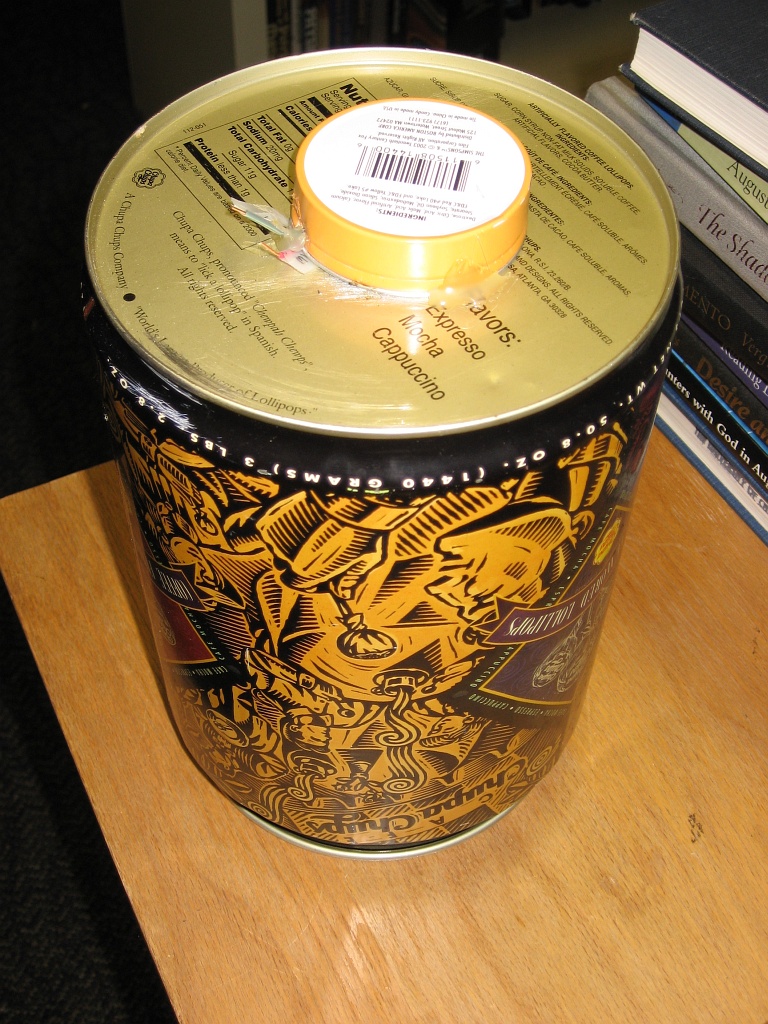
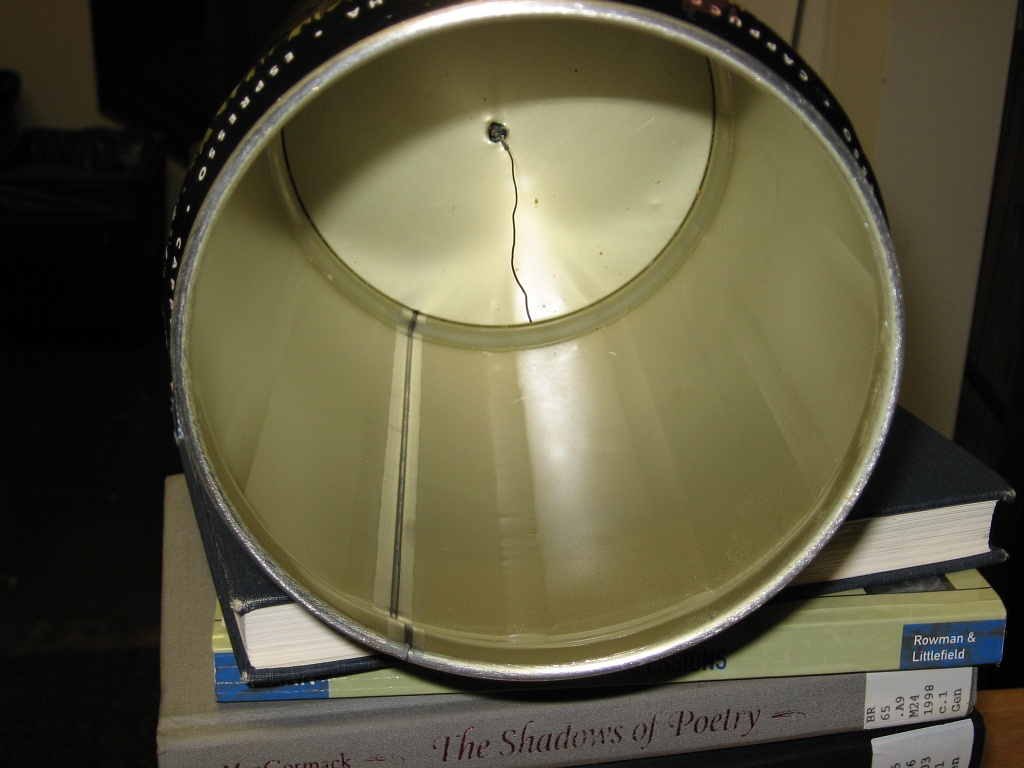
I built Charles Wenzel's simple ion chamber. It creates an electric field inside the can via a battery. A wire in the center of the can, isolated from the can, is connected to a transistor pair called a Darlington, essentially a pair of amplifiers. When ionizing radiation creates an ion in the can, the electric field drives the ion towards either the can or the wire, depending on the charge of the ion. This creates a very small current which barely turns on the darlington to allow the voltmeter to measure a small change in voltage.


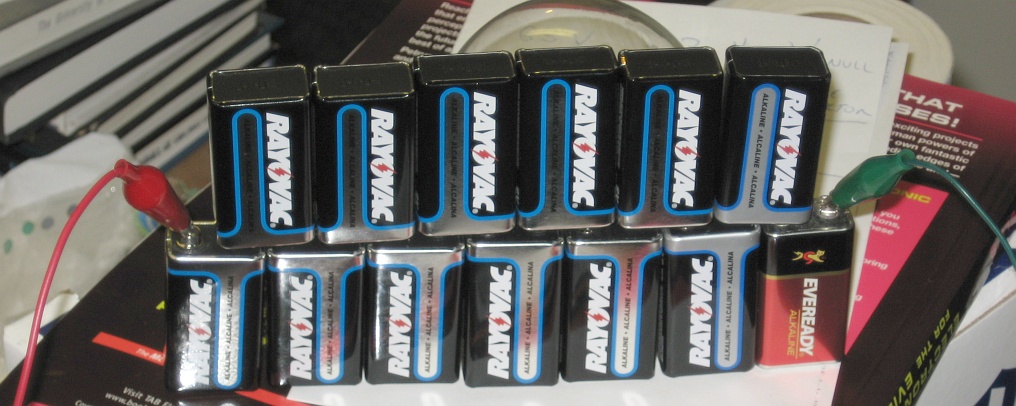
I could easily up the voltage on the chamber by snapping in more 9V batteries.


You can also light things up nicely: I had 122V DC at my disposal, although I wouldn't recommend running it for very long. Based on a rough calculation, the 40W lamp would run for an hour on this battery set, but the batteries aren't meant to source this much current (about 1/3 Amp).


I had an easy way of changing the chamber voltage, 9 volts at a time, so I measured the quiescent voltage and the voltage with a smoke detector alpha particle source in the chamber. I sealed the chamber by placing it on a sheet of aluminum foil.

VoltageNull voltagealpha source
36V4.8mV9.1mV
45V7.1mV14.9mV
54V11.3mV20.6mV
63V23.4mV41.5mV
72V1230mV1915mV
81V12000mV12000mV

Dear Blogger, why do you mess my table so?

Thursday, December 01, 2005

live radiation reports from my office

http://www.lib.uchicago.edu/~dean/float.htm

It's completely temporary, and could go down at any time, but the average radiation rate for the last minute in my basement office is available at the link. The long term average for the geiger counter is about 7.6 microrads / hour. If the rate goes up to 30 or so, it's likely I put a small dixie cup of western Michigan beach sand on it (the sand is enriched in monzanite which has a small amount of thorium in it).

UPDATE: Back up and running: http://dwarmstr.blogspot.com/2011/03/geiger-counter-back-up.html

Friday, September 09, 2005

potassium part 2

Sure enough, as I suspected in my previous post, taking the potassium chloride out of the container brought the count rate up 50% to 120 microrads/hr. I celebrated by tasting it, confident in my body's metabolic control over potassium. It was salty.

Tuesday, September 06, 2005

Radioactive potassium

A store-bought container of potassium chloride, aka Salt Substitute, contains enough of the naturally occurring potassium-40 isotope ( 0.0117% abundance per the CRC, page 4-24) to produce 5.5x the amount of background radiation when placed on a geiger counter, with the container intact. The rate would have been higher if I had taken the salt out of the container, as the metal base shields some percentage of the 1.31MeV(max) beta electrons.


Paul Frame at Oak Ridge has a great site about radioactive consumer products at http://www.orau.org/ptp/collection/consumer%20products/consumer.htm
and see the potassium info page at http://www.orau.org/ptp/collection/consumer%20products/potassiumgeneralinfo.htm

Saturday, April 30, 2005

Thursday, April 28, 2005

Another airline plot

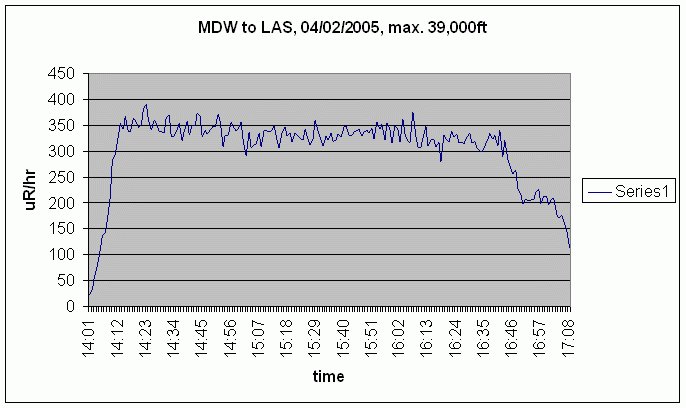
This was a trip to Las Vegas. Maximum altitude was at 39,000ft, and the flightpath was a relatively northern one across Nebraska and Colorado, then turned south in Utah. We flew for a while in southern Utah at a lower altitude while getting into the inbound approach, and you can see that on the graph.

http://www.lib.uchicago.edu/~dean/blog/mdwtolas.jpg

Saturday, February 12, 2005

Geiger counter photos


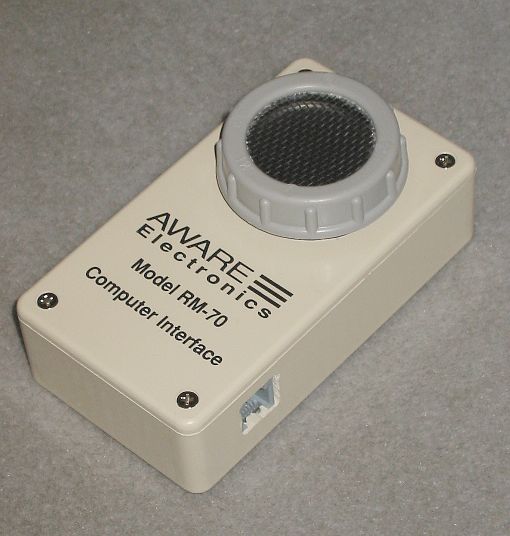
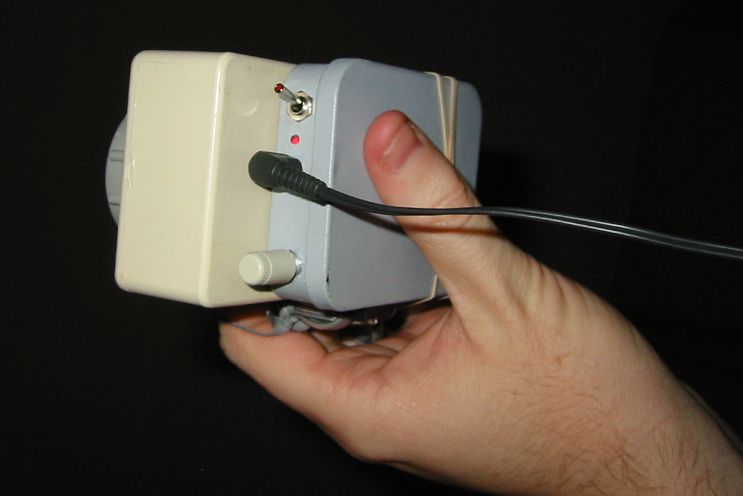
The clicker unit attached to the geiger counter


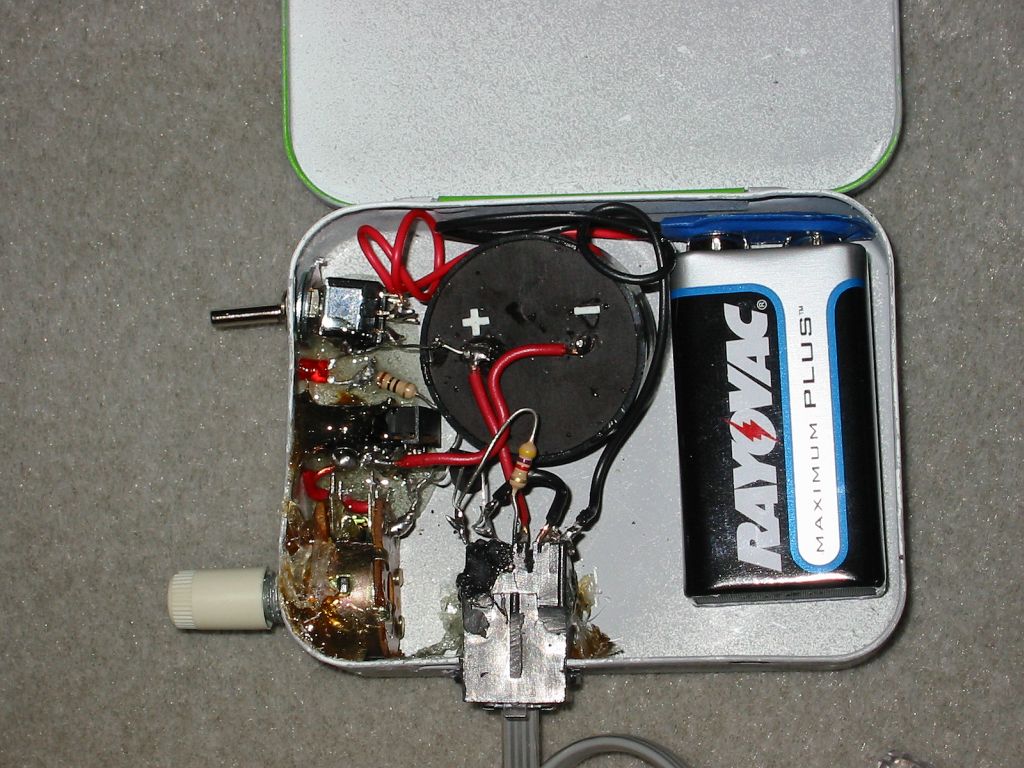
I made the clicker unit with robust design in mind. Therefore, I epoxied everything to the case and it looks really crappy, but it's not going to fall apart in someone's pocket. You can see the basic circuit--9 volt battery switched, which powers the counter through the phone jack. The detection indicator is a negative voltage swing on another line from the phone jack, which switches a PNP transistor. The transistor opens to allow current to flow through the potentiometer, the headphones, and the speaker. The LED is controlled directly by the indicator pulse, without transistor switching.

What's wrong with the design? The headphones should be bypassed when they aren't plugged in, but they aren't, so the speaker does not click without headphones. And, when the headphones are in, there isn't enough oomph to drive the 8 ohm speaker. I tried bypassing the headphones, but I didn't try until after I had assembled the unit, and everything was too cramped to solder.


P.S. What software tools do you use to generate nice schematics? Preferably free or open-source.