
Saturday, April 17, 2010
Moments in spaceflight
Soichi Noguchi captures a poignant moment as the Shuttle leaves the International Space Station. Click to enlarge to a higher quality image.

Thursday, April 15, 2010
Eyjafjallajökull eruption
I was just reading about the Eyjafjallajökull eruption yesterday and the rather bold tourist enterprise sprung up to visit it, when I see it has erupted in an explosive manner. The new path to the surface for the magma opened under the ice sheet (jokull) instead of bare ground, and water/magma interactions produce copious amounts of gas. Gas is a bad thing when it comes to magma. It makes thing go boom. Instead of a lava fountain and a tourist stop in Iceland, now we have flooding as the glacier melts, and air travel restrictions as the volcano generates large plumes up into the atmosphere from the phreatic eruption. The Icelanders are concerned about the flooding and the fluorine from the ashfall. For the geology, the composition of the magma (how much silica is in it, how much gas is in it), its interaction with the surrounding rock, and how the magma changes in composition as time increases are the interesting things. For the British sitting waiting for the air to clear, realize that ash is just magma pulverized through explosive means. Blame the gas.
Here is some good information on the location and the inflation/deflation data.
Here is some good information on the location and the inflation/deflation data.
Thursday, April 01, 2010
Geiger counter problems interfacing with PC
I've been unable to get the DOS software AW-SRAD to work with the geiger counter for some time, on multiple machines, with Windows XP. It's a bummer. I can input the sound pulses from the clicker unit I made into a sound card, but I have no idea how to then get the PC to do something with that. I'm not a programmer. The original geiger counter set up was really simple: it toggled the RING indicator on the serial port.
Tuesday, March 30, 2010
For Photographers, the Image of a Shrinking Path
For Photographers, the Image of a Shrinking Path
By STEPHANIE CLIFFORD
Published: March 29, 2010
Amateur photographers, happy to accept small checks for snapshots, are underpricing professionals.
I made some comments about this issue last year in this post: http://dwarmstr.blogspot.com/2009/06/intersection-of-onlinesharing-culture.html. Since then, I made that Faustian bargain of getting an image of mine on a book cover without payment save a few copies of the book (although I haven't gotten them yet, CRC Press). The publisher said they had no budget for images, it would likely sell very few copies (a very technical book), etc... should I have done it?
Conversely, if you are a corporation, why shouldn't you find free or cheap photography instead of paying for it? Photography has been freelance for sometime, and never unionized that I am aware of.
By STEPHANIE CLIFFORD
Published: March 29, 2010
Amateur photographers, happy to accept small checks for snapshots, are underpricing professionals.
I made some comments about this issue last year in this post: http://dwarmstr.blogspot.com/2009/06/intersection-of-onlinesharing-culture.html. Since then, I made that Faustian bargain of getting an image of mine on a book cover without payment save a few copies of the book (although I haven't gotten them yet, CRC Press). The publisher said they had no budget for images, it would likely sell very few copies (a very technical book), etc... should I have done it?
Conversely, if you are a corporation, why shouldn't you find free or cheap photography instead of paying for it? Photography has been freelance for sometime, and never unionized that I am aware of.
Thursday, March 25, 2010

Thursday, March 04, 2010
Evening ISS passes for the next few days in Chicago
http://www.heavens-above.com/PassSummary.aspx?satid=25544&lat=41.781312&lng=-87.605097&loc=Chicago&alt=0&tz=CST
4 Mar -2.4 19:27:17 10 WSW 19:30:00 44 NW 19:30:00 44 NW
5 Mar -3.3 18:17:05 10 SW 18:19:55 60 SE 18:22:47 10 ENE
6 Mar -2.2 18:42:14 10 WSW 18:45:00 41 NNW 18:47:31 12 NE
7 Mar -1.0 19:08:01 10 WNW 19:10:16 20 NNW 19:11:50 14 NNE
8 Mar -2.1 17:57:05 10 W 17:59:50 39 NNW 18:02:35 10 NE
It might actually be clear!
4 Mar -2.4 19:27:17 10 WSW 19:30:00 44 NW 19:30:00 44 NW
5 Mar -3.3 18:17:05 10 SW 18:19:55 60 SE 18:22:47 10 ENE
6 Mar -2.2 18:42:14 10 WSW 18:45:00 41 NNW 18:47:31 12 NE
7 Mar -1.0 19:08:01 10 WNW 19:10:16 20 NNW 19:11:50 14 NNE
8 Mar -2.1 17:57:05 10 W 17:59:50 39 NNW 18:02:35 10 NE
It might actually be clear!
Thursday, February 25, 2010
Live video feed from the International Space Station
This is great; I've been holding off on sharing this because I felt like it was too special to share widely. But here's the deal--there is a live video feed on the International Space Station. And usually it's pointing out at Earth. So literally you can watch the Earth go by live. You can experience sunrise and sunset in orbit. You can see the biggest cities' light pollution on the dark part of the orbit and sun glints of the Pacific or the swirls in the clouds in the Southern Ocean.
Here's the Live ISS video feed. If you stop the video, reload the page rather than restarting the video; otherwise regular NASA TV will start up.
See where the ISS is via http://www.heavens-above.com/orbit.aspx?satid=25544&lat=41.781312&lng=-87.605097&loc=Chicago&alt=0&tz=CST and http://www.n2yo.com
.
There are some parts of the orbit with no video download. It is also sensitive to the TDRSS capacity.
While writing this, I am watching sunrise on the ISS just south of South Africa. It is beautiful.
Here's the Live ISS video feed. If you stop the video, reload the page rather than restarting the video; otherwise regular NASA TV will start up.
See where the ISS is via http://www.heavens-above.com/orbit.aspx?satid=25544&lat=41.781312&lng=-87.605097&loc=Chicago&alt=0&tz=CST and http://www.n2yo.com
.
There are some parts of the orbit with no video download. It is also sensitive to the TDRSS capacity.
While writing this, I am watching sunrise on the ISS just south of South Africa. It is beautiful.
Thursday, February 18, 2010
Can you stand it? Cloud footage running backwards
I'm going to be honest:
I can't stand anyone running cloud video footage in reverse. This drives me crazy; whether it's my physics and chemistry of the atmosphere classes or just my sensibilities but whenever I see it it drives me crazy (c.f. Survivor this season). If the cloud droplets are evaporating or condensing the wrong way, anyone with meteorological experience (or someone who has watched Koyaanisqatsi) will call shenanigans. Convection has a distinct look to it; as well as evaporation; and when producers try to reverse the video it shows.
h
I can't stand anyone running cloud video footage in reverse. This drives me crazy; whether it's my physics and chemistry of the atmosphere classes or just my sensibilities but whenever I see it it drives me crazy (c.f. Survivor this season). If the cloud droplets are evaporating or condensing the wrong way, anyone with meteorological experience (or someone who has watched Koyaanisqatsi) will call shenanigans. Convection has a distinct look to it; as well as evaporation; and when producers try to reverse the video it shows.
h
Monday, February 15, 2010
Re: Video of the day, rocket destroys sun dog
Regarding that SDO video, a friend points out another video of the same event:
http://www.spasmsofaccommodation.com/2010/02/sonic-boom-meets-sun-dog.html
http://www.spasmsofaccommodation.com/2010/02/sonic-boom-meets-sun-dog.html
Thursday, February 11, 2010
Video of the day: rocket destroys a sun dog
Sun Dogs are bright refractions of the Sun coming from horizontal ice crystals in the atmosphere. The ice crystals are usually oriented horizontally because that it their stable falling pattern. Watch as the rocket carrying the Solar Dynamic Observatory pierces through a cirrus cloud and the sound waves from the rocket completely obliterate the preferred ice crystal orientation.
http://www.spaceweather.com/swpod2010/11feb10/anna-herbst1.mov?PHPSESSID=ndlp741nbtasb6f51eloa6dp81
http://www.spaceweather.com/swpod2010/11feb10/anna-herbst1.mov?PHPSESSID=ndlp741nbtasb6f51eloa6dp81
Tuesday, February 02, 2010
An asteroid collision
Color me surprised: I did not believe, when this object was first reported, and further debate on the Minor Planet Mailing List, that this was in fact a collision.

Thursday, January 28, 2010
The orange object next to the full moon tonight
The bright orange "star" next to the Full Moon tonight and Friday is the planet Mars, which happens to be closest to Earth tonight (ok last night) during this current cycle (Mars and Earth come close to each other every 2 years and 2 months). And closest in only the sense of currently: it's still 99 million kilometers away.
Wednesday, January 27, 2010
Joule Thief: a simple DC voltage booster
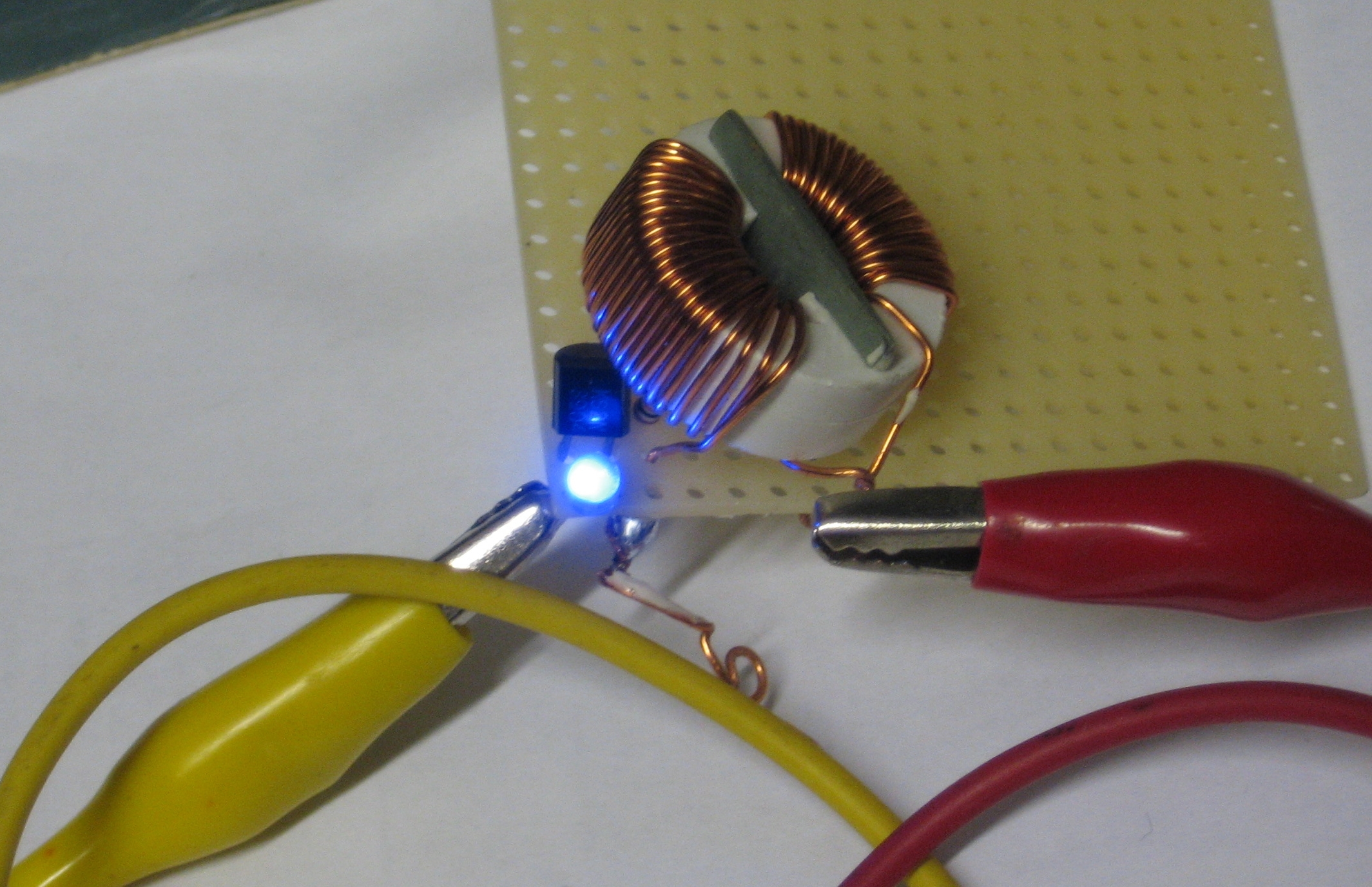
A joule thief circuit lit from a 0.5V AAA battery. Click to enlarge.
A Joule thief is a simple circuit that acts as a DC to DC booster, raising a supply voltage by several volts. In this iteration it uses the exhausted voltage of a alkaline battery and boosts it enough to light a blue LED that requires 2.8V to light. With an otherwise dead 0.5V AAA battery, it will light a blue LED and run for days, using (at the moment) just under 2mA of current. It's much much dimmer than using a fresh battery or running the LED with a proper current through it. Giving the Joule thief circuit 3V from two fresh batteries pulls 75mA through the LED, making it very, very bright and probably short-lived.
A schematic is below. The circuit works like this: When first turned on, current flows into the inductor and produces a magnetic field in the toroid. While this is happening, no voltage appears at the base of the transistor, so the transistor remains off. The LED sees at first no voltage and while the inductor fills up, it only sees a maximum voltage of the battery, which is not enough to pass the diode. Once the inductor is charged, the battery voltage appears at the base of the transistor, turning it on. This allows the right side of the inductor to want to dump the energy it has stored in its magnetic field as quickly as possible, and this gives us a high-voltage that appears across the inductor. When that voltage exceeds 2.8V the LED turns on and lights up until the voltage drops below, triggering the sequence to begin again. I measured the frequency of the on/off oscillation and it seems to run at about 34kHz; the multimeter said between 68 and 72kHz but a radio showed there was 34kHz signal as well, which I assume was the fundamental (and the 68kHz one a harmonic). It did change in frequency a bit while on.
 Bre Pettis/Windell Oskay
Friday, January 22, 2010
Las Vegas precipitation
Las Vegas received more rain last week, 1.69 inches, than it did in all of 2009, when it received 1.59 inches. The "average" is about 4 inches annually. If the rains continue into a full El Nino style winter, the area will bloom green in spring with the normally brown/gray mountains turned into green.
Source: http://www.lvrj.com/news/breaking_news/Rainfall-expected-to-taper-off-today-82379942.html
Source: http://www.lvrj.com/news/breaking_news/Rainfall-expected-to-taper-off-today-82379942.html
Wednesday, January 20, 2010
2010 AL30 animation
Patrick Wiggins makes a cool animation of an object passing by the Earth last week:
http://users.wirelessbeehive.com/~paw/temp/2010AL30.2.GIF
I liked it better than some of the other animations I've seen of the same object, since he didn't center the object on every frame but let it move to the right. This gives the effect of it speeding up.
http://users.wirelessbeehive.com/~paw/temp/2010AL30.2.GIF

I liked it better than some of the other animations I've seen of the same object, since he didn't center the object on every frame but let it move to the right. This gives the effect of it speeding up.
Subscribe to:
Posts (Atom)