Sunday, January 15, 2006

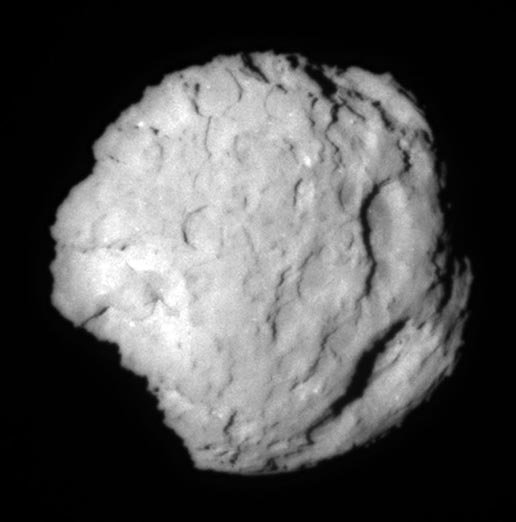
Comet Wild 2 and Stardust


Phil Plait's Bad Astronomy has a good post about the source of Stardust's material: http://www.badastronomy.com/bablog/2006/01/14/the-return-of-stardust/

P.S. I should note the parent spacecraft has to alter its orbit to avoid the Earth and continue on its extended mission.

Monday, January 09, 2006

Stardust return

Stardust will return comet dust samples to Earth Saturday night. I was amused by this statement in an Associated Press article:

Residents in parts of Northern California, Oregon, Washington, Idaho, Nevada and Utah should see the Stardust capsule as it streaks across the pre-dawn sky. Prime viewing will be along Nevada's Interstate 80 where residents can view the capsule's front.


My first thought was "Residents? Along I-80?"

Tongue-in-cheek, of course.

Concerning two Nebulae in the Pleiades (Barnard's and the Merope)

After seeing today's APOD, I've decided to force myself to finish this long-overdue post.


(Here's a photo of the Pleiades taken in the 1950's from Ryerson through a Schmidt camera. Merope is at the top).

While at Lick Observatory, E.E. Barnard noticed a small bright nebula right next to the very bright star Merope in the Pleiades. The existence of the faint bluish nebula surrounding Merope had been discovered by Wilhelm Tempel in 1859, although argued about until photography proved its existence. Barnard though found a bright, tiny nebula extremely close to Merope on the evening of November 14th, 1890. He writes in Astronomische Nachrichten, volume 126, p.293:


On Nov. 14 while examing the cluster, I discovered a new and comparatively bright round cometary nebula close south and following Merope, every precaution was taken to prove that it was not a ghost of Merope by examing the other stars of the group under the same conditions. I have since seen it several times and on Dec. 8th I could see it with some difficulty in the 12 inch by occulting Merope with a wire in the eyepiece. With the great telescope the nebula can be seen fairly well with Merope in the field and is conspicuous when the star is placed just outside the north edge of the field. It is about 30" in diameter, of the 13m, gradually brighter in the middle and very cometary in appearance. It was examined with powers of 300, 520 and 1500 with all of which it was comparatively easy.


In later papers like Astronomische Nachrichten, volume 127, p.135 he reports it seems significantly different from the wispy reflection nebulae that surround Merope and the other Pleiades and that it hadn't been photographed before merely because it was so close to the blindingly bright Merope.


I caught some of the wispy Merope Nebula with a non-blue sensitive CCD camera from Chicago a while ago.

Since reflection nebulas are made of small dust particles, smaller than a wavelength of light, they scatter smaller wavelength light much more effectively than longer wavelengths and turn quite blue (like tobacco smoke seen from the side). When you see blue smoke coming from car's exhaust (and that oil is burning in the engine), you can make a smart guess that the particulates are under 700nm in size. If they were any bigger, they would look white.

Some confusion has occurred in discussing this nebula. The small bright nebula is "Barnard's Merope Nebula" or IC 349. The diffuse nebula surrounding Merope is called "Merope Nebula" which is NGC 1435.

Johannes Schedler's Merope close-up is a fantastic capture of both the nebula, bright Merope, and the faint wispy Pleiades nebula.

Roland Christen's close-up

Herbig later describes the nebula is great detail: Herbig: IC 349: Barnard's Merope Nebula and details how it's not the same dust that makes up the wispy Pleiades nebula, but something different, something with a separate velocity through space.

Later, he has Hubble look at it: http://imgsrc.hubblesite.org/hu/db/2000/36/images/a/formats/web_print.jpg

Barentine and Esquerdo also talk about it here: http://www.journals.uchicago.edu/AJ/journal/issues/v117n3/980312/980312.html (may require subscription).
Wednesday, January 04, 2006

New Horizons--aka the Pluto and Kuiper Belt mission


The New Horizons spacecraft is nearing a possible launch in mid-January. Despite the moniker its mission is to explore the Pluto/Charon system and any Kuiper Belt objects beyond. We know from looking at their spectrums that Pluto and Charon are different--Pluto is covered in nitrogen ice (brrr) and Charon has water ice. Pluto itself has significant albedo differences, including presumably brighter icier poles and darker warmer equatorial regions (although mixed in everywhere are bright and dark areas--are they cryovolcanoes and geysers or just cratering?). Young, Galdamez, Buie, Binzel, and Tholen used a series of mutual occultations of Pluto and Charon to figure this out in this paper (Link may require a subscription to read).
The Official New Horizons web site

Was this a wasteful governmental project? Nope. It cost less than 1/10 (one-tenth) of a single B-2, or about the same as the Ketchikan, Alaska bridge to nowhere. For the same price we get the first close-up views of the Kuiper Belt.

I have an older animated image I took of Pluto taken from Ryerson here. It shows Pluto appearing to move over an hour and a half, near the center left of the image.
Via http://planetary.org/blog/article/00000334/.

Friday, December 30, 2005

Rockefeller Chapel and the Moon, 2001 July 3rd

.
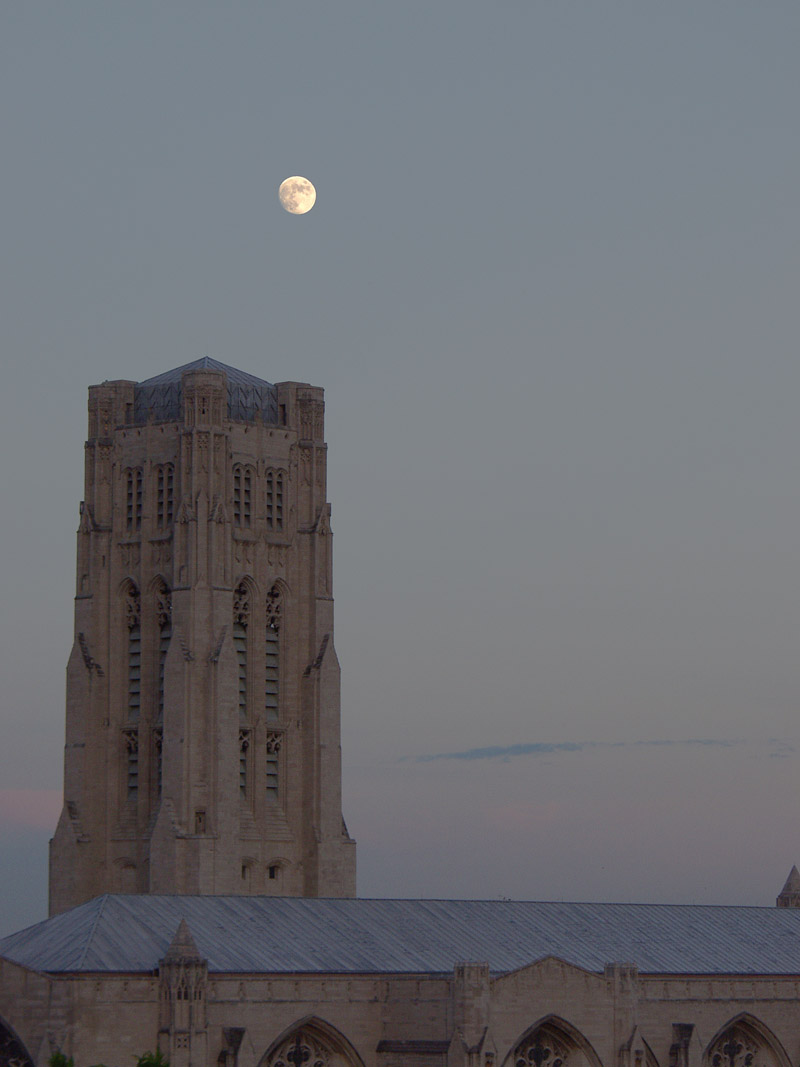
The Gibbous Moon rising over Rockefeller Chapel, taken over 4 years ago from Ryerson.
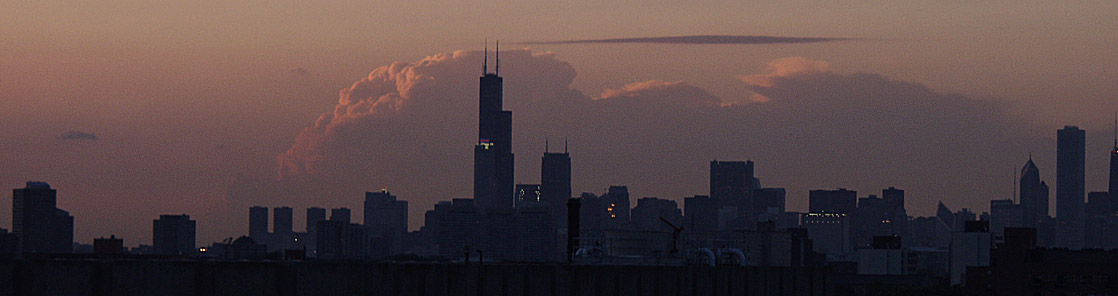
I took this image with an Olympus E-10. It was a humid but nice evening. What can't be seen are the hordes of gnats flying around nor the thunderstorm to the west. I also took an image of the Sears Tower with a tall thunderstorm behind it, with the idea to use the known distance and height of the tower to determine something about the cloud behind it (although you need one more bit of information about the cloud to figure it out).

Saturday, December 24, 2005

Posner's failed analysis of domestic spying

Posner writes a defense against the illegal searches of domestic communications:
Posner wrote:
The collection, mainly through electronic means, of vast amounts of personal data is said to invade privacy. But machine collection and processing of data cannot, as such, invade privacy. Because of their volume, the data are first sifted by computers, which search for names, addresses, phone numbers, etc., that may have intelligence value. This initial sifting, far from invading privacy (a computer is not a sentient being), keeps most private data from being read by any intelligence officer.


You can't open up my mail (or e-mail) and look for names, addresses, and phone numbers without violating my privacy. The courts have held that e-mail headers are like pen information on phone calls, but the contents of the message are private. Get that? It doesn't matter what or who in the government opens my private communication, they've opened it and it's a clear violation of the Fourth Amendment.

You've got to have a warrant, mister, with a good reason, signed by a judge (hopefully not Posner), describing exactly what you are looking for and why you think you have sufficient cause. You can't open up everyone's communications fishing for crimes.

P.S. Richard Posner later writes during a chat:
I don't think most people would mind the government's scrutinizing their conversations for information of potential intelligence value if they trusted the government not to misuse the information.

Uhh... yeah, we mind. This fellow probably shouldn't be a judge based on his poor reading of the Constitution. It's not what "most people" would mind, it's whether these things violate the Constitution. And they do.

ILL update

That loser student lied about the ILL/DHS visit! The liar!

Wednesday, December 21, 2005

Computer abuse in copy-protection rootkit software

Ed Felten in Freedom to Tinker finally brings up what's been missing in the debate about aggressive copy-protection schemes, namely, that they are violating computer abuse laws left and right, and the companies should be prosecuted to the full extent of the law, and penalized just as hard as the "computer hackers" are--putting the CEO of Sony, SunnComm/Mediamax, or First4Internet in jail for four years would show 1. Computer abuse, either by individual or corporation, is not tolerated and 2. Corporations, if they argue they deserve rights just like people, should get the punishments delivered to them as well. Computer abuse applies not only to the crazy copy-protection rootkits but to most spyware as well.

Monday, December 19, 2005

The Sun as a 2.4 GHz source, redux.

I previously wrote an entry about how you can see the Sun interfering with the weather radar at sunrise and sunset, seen here. The weather radar uses radio waves at about 3 GHz. Seen linked at Hackaday is a 2.4GHZ field strength meter using a microwave diode, a few capacitors and a simple "quad" antenna and measured using a digital multimeter. They report that the Sun generates a reading on their device!

Saturday, December 17, 2005

Checking out "Little Red Book" brings visit by government agents

Update Wanker student lied... It's a hoax... South Coast story. To say again.. liar liar liar. I hate liars.

This is unacceptable.

Agents' visit chills UMass Dartmouth senior

How the DHS is searching Inter-Library Loan requests is unknown, probably through one of the big ILL mediators like OCLC's Illiad.

Academic freedom to read and discuss whatever, to expose yourself to all ideas, including foreign ones, is paramount to a democracy. The DHS is inviting fascism by doing this.

Since I am an employee of an academic library, my employment is dependent on the ability of students and faculty trusting that their choices in what they choose to read is relatively private. We offer the ability to patrons to find out who has a particular book out, but only if they agree to the same reciprocal privileges. It's a tradeoff--I could find out who has checked out a copy of Mao Tse-Tung, but someone else looking for a copy of "Uranium" would know I had it borrowed. But with a secret warrant, the government can know what you have read without any notice to anyone. Unacceptable.

I would encourage anyone concerned about this to obviously complain to your elected officials, but also ask about your local library's policies regarding data retention, and encourage them to clean out the data as appropriate. Is your library's policy written and available to you?

Here is the ALA's Library Bill of Rights.

Thursday, December 08, 2005

Amboy Crater Beetle


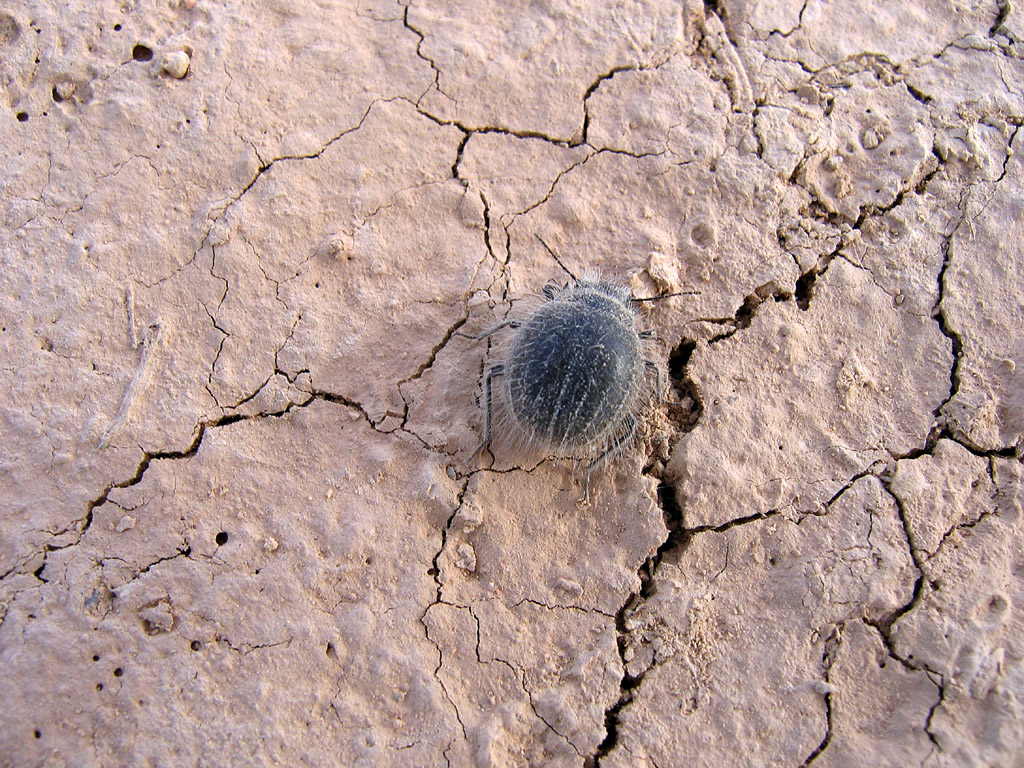
I am a small fuzzy beetle living in the sands among the lava flows of Amboy Crater!

Thursday, December 01, 2005

live radiation reports from my office

http://www.lib.uchicago.edu/~dean/float.htm

It's completely temporary, and could go down at any time, but the average radiation rate for the last minute in my basement office is available at the link. The long term average for the geiger counter is about 7.6 microrads / hour. If the rate goes up to 30 or so, it's likely I put a small dixie cup of western Michigan beach sand on it (the sand is enriched in monzanite which has a small amount of thorium in it).

UPDATE: Back up and running: http://dwarmstr.blogspot.com/2011/03/geiger-counter-back-up.html

Monday, November 07, 2005

Nova: Volcano under the City

An episode of Nova I watched because it was 1. in HD and 2. Geoscience related. As unfortunately usual, another earth science Nova with excessive overdramatization. Like an earlier episode about the scablands of eastern Washington, the dramatics overwhelm any science presented. The research wasn't really explained until near the end, when they finally mentioned WHY volcanologists were going after fresh lava. Let's balance the danger/people/adventure aspect with more science. That's what Nova was for, wasn't it? Scientific American Frontiers does a much better job explaining science and what scientists do. Nova always had a bit of the National Geographic travelogue in it, but it's gone way too much to that now.

"Constant observation is necessary, for when it erupts, a new name could be added to the most deadly disasters in human history....Nyiragongo!"

Wednesday, November 02, 2005

United colors of plutonium

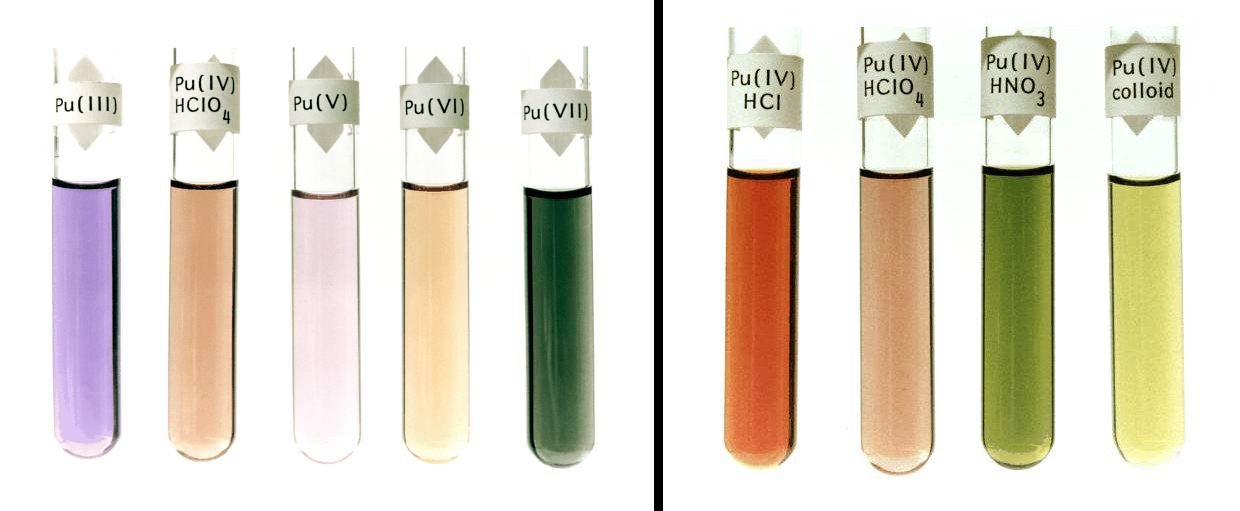
Plutonium, like a lot of the other transition metals, has a number of oxidation states and all of them are colorful. The valence ranges from +3 to +7, with +4 being the most common state.


This image was provided through Los Alamos or Lawrence Livermore National Laboratories; Wikipedia claims it's from LLNL but LANL uses it on a page at their site. The four colors on the right are the +4 valence forming different complexes with different anions.


I edited the image and concatenated the colors together for a palette. It looks like some sort of bad hotel color scheme.


P.S. There is some discussion of the first separation of plutonium here: http://chemcases.com/2003version/nuclear/nc-04.htm

Monday, October 31, 2005

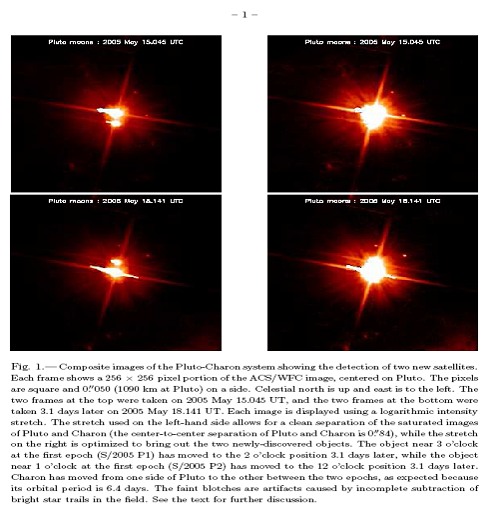
Two new satellites of Pluto/Charon!

http://www.boulder.swri.edu/plutonews/.

Once again, Minor Planet Mailing List has the scoop. Two ~100km bodies orbiting in the same plane as Charon and at 23rd magnitude found via the Hubble Space Telescope. Good thing we haven't dumped it in the ocean yet.

IAU official announcement


This image from Alan Stern (SwRI), Hal Weaver (JHU APL), Max Mutchler (STScI), Andrew Steffl (SwRI), Bill Merline (SwRI), Marc Buie (Lowell Observatory), John Spencer (SwRI), Eliot Young (SwRI), and Leslie Young (SwRI).