Monday, December 19, 2005
The Sun as a 2.4 GHz source, redux.
I previously wrote an entry about how you can see the Sun interfering with the weather radar at sunrise and sunset, seen here. The weather radar uses radio waves at about 3 GHz. Seen linked at Hackaday is a 2.4GHZ field strength meter using a microwave diode, a few capacitors and a simple "quad" antenna and measured using a digital multimeter. They report that the Sun generates a reading on their device!

Saturday, December 17, 2005
Checking out "Little Red Book" brings visit by government agents
Update Wanker student lied... It's a hoax... South Coast story. To say again.. liar liar liar. I hate liars.
This is unacceptable.
Agents' visit chills UMass Dartmouth senior
How the DHS is searching Inter-Library Loan requests is unknown, probably through one of the big ILL mediators like OCLC's Illiad.
Academic freedom to read and discuss whatever, to expose yourself to all ideas, including foreign ones, is paramount to a democracy. The DHS is inviting fascism by doing this.
Since I am an employee of an academic library, my employment is dependent on the ability of students and faculty trusting that their choices in what they choose to read is relatively private. We offer the ability to patrons to find out who has a particular book out, but only if they agree to the same reciprocal privileges. It's a tradeoff--I could find out who has checked out a copy of Mao Tse-Tung, but someone else looking for a copy of "Uranium" would know I had it borrowed. But with a secret warrant, the government can know what you have read without any notice to anyone. Unacceptable.
I would encourage anyone concerned about this to obviously complain to your elected officials, but also ask about your local library's policies regarding data retention, and encourage them to clean out the data as appropriate. Is your library's policy written and available to you?
Here is the ALA's Library Bill of Rights.
This is unacceptable.
Agents' visit chills UMass Dartmouth senior
How the DHS is searching Inter-Library Loan requests is unknown, probably through one of the big ILL mediators like OCLC's Illiad.
Academic freedom to read and discuss whatever, to expose yourself to all ideas, including foreign ones, is paramount to a democracy. The DHS is inviting fascism by doing this.
Since I am an employee of an academic library, my employment is dependent on the ability of students and faculty trusting that their choices in what they choose to read is relatively private. We offer the ability to patrons to find out who has a particular book out, but only if they agree to the same reciprocal privileges. It's a tradeoff--I could find out who has checked out a copy of Mao Tse-Tung, but someone else looking for a copy of "Uranium" would know I had it borrowed. But with a secret warrant, the government can know what you have read without any notice to anyone. Unacceptable.
I would encourage anyone concerned about this to obviously complain to your elected officials, but also ask about your local library's policies regarding data retention, and encourage them to clean out the data as appropriate. Is your library's policy written and available to you?
Here is the ALA's Library Bill of Rights.
Thursday, December 08, 2005
Amboy Crater Beetle
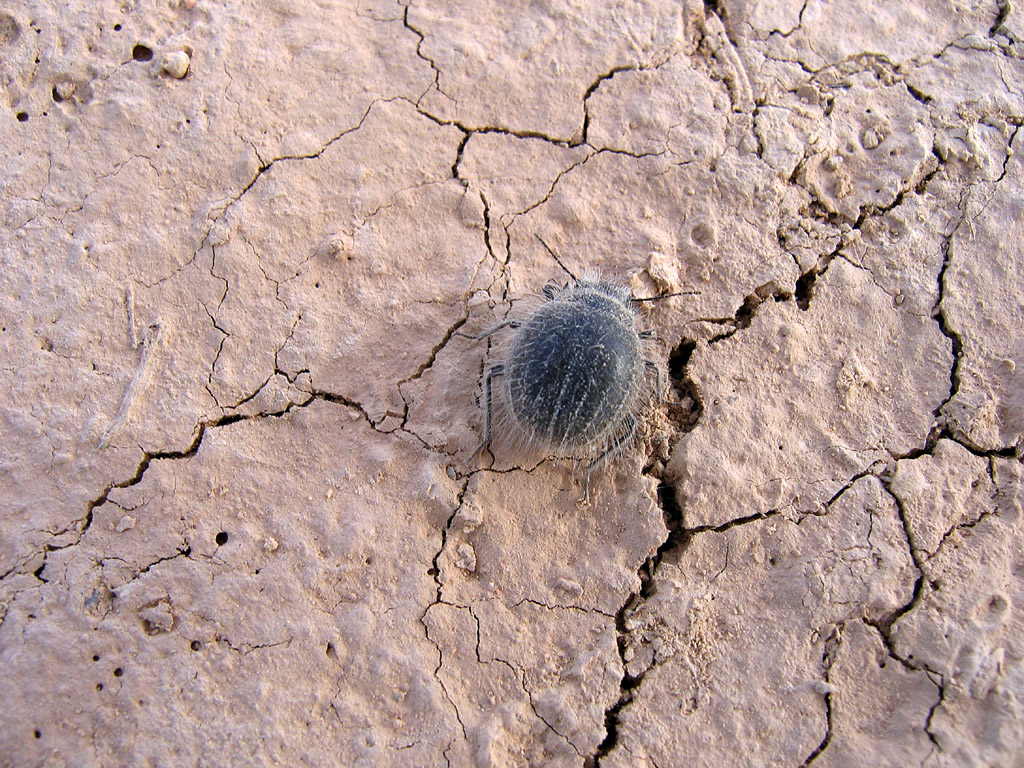
I am a small fuzzy beetle living in the sands among the lava flows of Amboy Crater!
Thursday, December 01, 2005
live radiation reports from my office
http://www.lib.uchicago.edu/~dean/float.htm
It's completely temporary, and could go down at any time, but the average radiation rate for the last minute in my basement office is available at the link. The long term average for the geiger counter is about 7.6 microrads / hour. If the rate goes up to 30 or so, it's likely I put a small dixie cup of western Michigan beach sand on it (the sand is enriched in monzanite which has a small amount of thorium in it).
UPDATE: Back up and running: http://dwarmstr.blogspot.com/2011/03/geiger-counter-back-up.html
It's completely temporary, and could go down at any time, but the average radiation rate for the last minute in my basement office is available at the link. The long term average for the geiger counter is about 7.6 microrads / hour. If the rate goes up to 30 or so, it's likely I put a small dixie cup of western Michigan beach sand on it (the sand is enriched in monzanite which has a small amount of thorium in it).
UPDATE: Back up and running: http://dwarmstr.blogspot.com/2011/03/geiger-counter-back-up.html
Monday, November 07, 2005
Nova: Volcano under the City
An episode of Nova I watched because it was 1. in HD and 2. Geoscience related. As unfortunately usual, another earth science Nova with excessive overdramatization. Like an earlier episode about the scablands of eastern Washington, the dramatics overwhelm any science presented. The research wasn't really explained until near the end, when they finally mentioned WHY volcanologists were going after fresh lava. Let's balance the danger/people/adventure aspect with more science. That's what Nova was for, wasn't it? Scientific American Frontiers does a much better job explaining science and what scientists do. Nova always had a bit of the National Geographic travelogue in it, but it's gone way too much to that now.
"Constant observation is necessary, for when it erupts, a new name could be added to the most deadly disasters in human history....Nyiragongo!"
"Constant observation is necessary, for when it erupts, a new name could be added to the most deadly disasters in human history....Nyiragongo!"
Wednesday, November 02, 2005
United colors of plutonium
Plutonium, like a lot of the other transition metals, has a number of oxidation states and all of them are colorful. The valence ranges from +3 to +7, with +4 being the most common state.

This image was provided through Los Alamos or Lawrence Livermore National Laboratories; Wikipedia claims it's from LLNL but LANL uses it on a page at their site. The four colors on the right are the +4 valence forming different complexes with different anions.
I edited the image and concatenated the colors together for a palette. It looks like some sort of bad hotel color scheme.

P.S. There is some discussion of the first separation of plutonium here: http://chemcases.com/2003version/nuclear/nc-04.htm
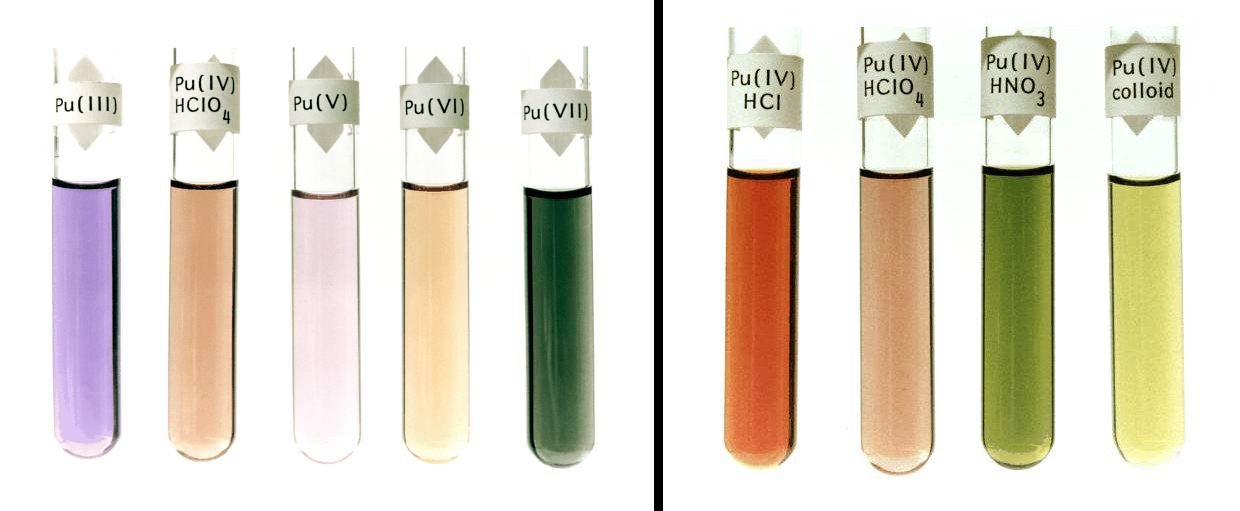
This image was provided through Los Alamos or Lawrence Livermore National Laboratories; Wikipedia claims it's from LLNL but LANL uses it on a page at their site. The four colors on the right are the +4 valence forming different complexes with different anions.

I edited the image and concatenated the colors together for a palette. It looks like some sort of bad hotel color scheme.

P.S. There is some discussion of the first separation of plutonium here: http://chemcases.com/2003version/nuclear/nc-04.htm
Monday, October 31, 2005
Two new satellites of Pluto/Charon!
http://www.boulder.swri.edu/plutonews/.
Once again, Minor Planet Mailing List has the scoop. Two ~100km bodies orbiting in the same plane as Charon and at 23rd magnitude found via the Hubble Space Telescope. Good thing we haven't dumped it in the ocean yet.
IAU official announcement

This image from Alan Stern (SwRI), Hal Weaver (JHU APL), Max Mutchler (STScI), Andrew Steffl (SwRI), Bill Merline (SwRI), Marc Buie (Lowell Observatory), John Spencer (SwRI), Eliot Young (SwRI), and Leslie Young (SwRI).
Once again, Minor Planet Mailing List has the scoop. Two ~100km bodies orbiting in the same plane as Charon and at 23rd magnitude found via the Hubble Space Telescope. Good thing we haven't dumped it in the ocean yet.
IAU official announcement
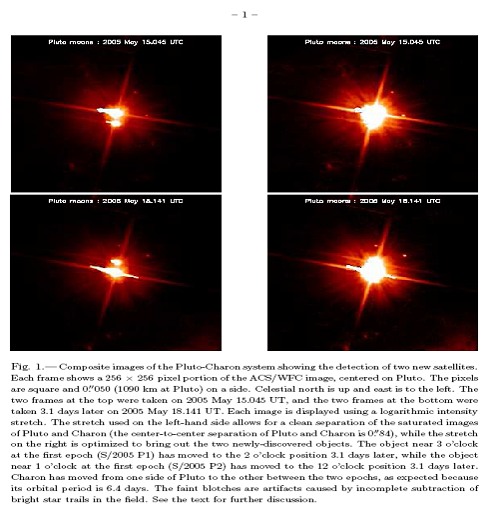
This image from Alan Stern (SwRI), Hal Weaver (JHU APL), Max Mutchler (STScI), Andrew Steffl (SwRI), Bill Merline (SwRI), Marc Buie (Lowell Observatory), John Spencer (SwRI), Eliot Young (SwRI), and Leslie Young (SwRI).
Wednesday, October 26, 2005
Faulty logic
Is lithium safe for the environment?
Yes. Much of the concern with the environment centers on heavy metals.
Lithium is the lightest metal known.
Content-light, I know, I'm working on something.
Monday, October 24, 2005
Monday, October 17, 2005
LA Times on 2003 UB313
"Ortiz's boss, astronomer Jose Carlos del Toro Iniesta, concedes that those rights will most likely be awarded to Brown.
"I think there is no longer a debate," he said in an e-mail message to The Times. "Dr. Ortiz acknowledges that Brown's team spotted the object in their archives prior to him.""
http://www.latimes.com/news/local/la-me-planet16oct16,1,3949603,full.story
"I think there is no longer a debate," he said in an e-mail message to The Times. "Dr. Ortiz acknowledges that Brown's team spotted the object in their archives prior to him.""
http://www.latimes.com/news/local/la-me-planet16oct16,1,3949603,full.story
Saturday, October 15, 2005
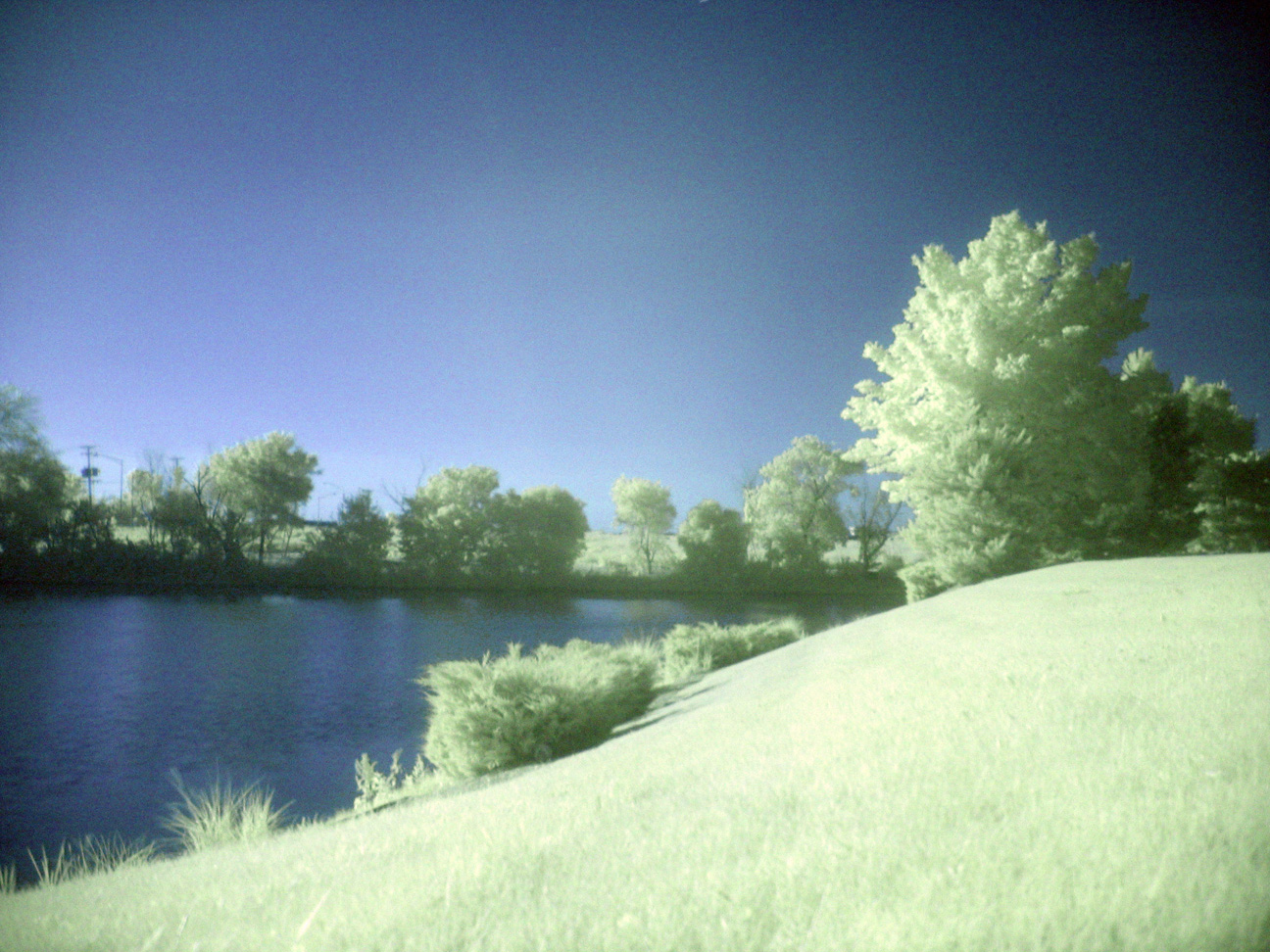
Linne statue in the near infrared
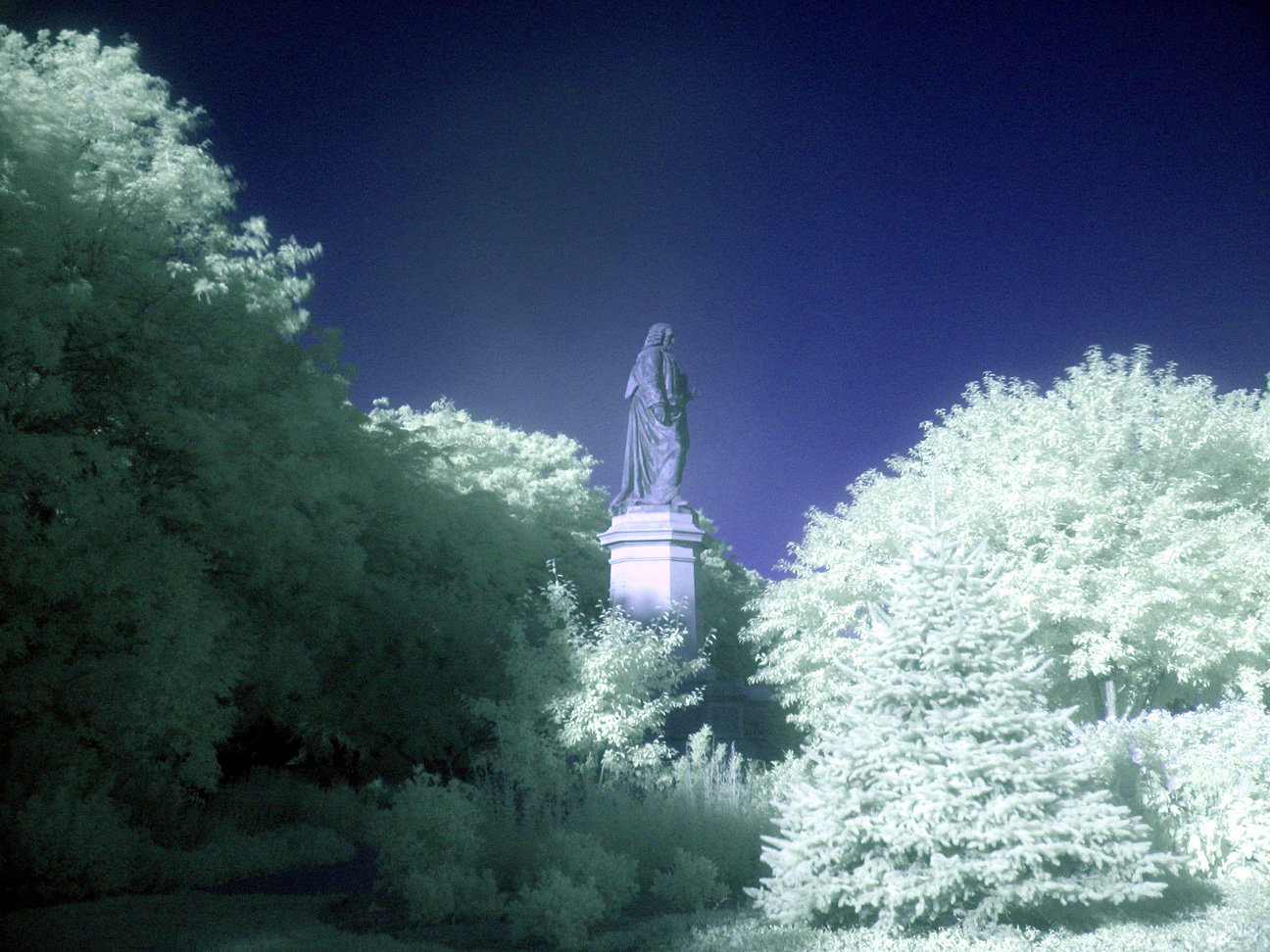
I took this photo over the summer. The Linne statue is on the Midway on the University of Chicago campus and to the eye is covered in a light greenish patina but goes quite dark in the near infrared.
P.S. One thing I forgot to mention is that I changed the hue so that the vegetation is green and the sky is blue. Another one like that is here. Also I corrected the incorrect link to the big Linne image.
Thursday, October 13, 2005
ABC Primetime: Radioactive Road Trip
What a piece of alarmist drivel. ABC Primetime "exposed" the security of university teaching and research reactors.
"Oh my god! Tours of reactors without background checks!"
"40kg of highly-enriched weapons-grade uranium in the reactor--without security!"
It might be 40kg, but it's sitting in rods with so highly radioactive nuclides it would kill them in a second. No one could handle it at all, and could never actually process it to get the uranium out.
"Big backpacks on campus--they could be full of books--I mean bombs!"
"Building plans on-line! of buildings on campus!" Wouldn't want students to find where their classes were or anything.
"Two nuclear bombs worth of uranium--to make topazes more blue." Yes, again, completely untouchable uranium.
Yes, journalism students looking like, I don't know, students, got tours of university facilities. God forbid!
Universities are places far removed from the insanity that is the paranoia filled United States of today. They allow for actual learning free from irrational thought.
MIT got boned because ABC drove a moving truck near the containment vessel and then followed the clip with a shot of the Oklahama City Bombing. It's a frickin' containment vessel made of inches thick steel and feet of concrete. It can't be broken.
Did ABC show ANY ANY nuclear engineers on camera? Just the NRC head, who knew how to deal with media--apologize and promise to tighten things up. Ask an engineer about a reactor and learn about the safety features. You can't get bomb material from a reactor without industrial processes. Ask the US Government on the square miles of buildings they used to extract plutonium at Hanford.
"Oh my god! Tours of reactors without background checks!"
"40kg of highly-enriched weapons-grade uranium in the reactor--without security!"
It might be 40kg, but it's sitting in rods with so highly radioactive nuclides it would kill them in a second. No one could handle it at all, and could never actually process it to get the uranium out.
"Big backpacks on campus--they could be full of books--I mean bombs!"
"Building plans on-line! of buildings on campus!" Wouldn't want students to find where their classes were or anything.
"Two nuclear bombs worth of uranium--to make topazes more blue." Yes, again, completely untouchable uranium.
Yes, journalism students looking like, I don't know, students, got tours of university facilities. God forbid!
Universities are places far removed from the insanity that is the paranoia filled United States of today. They allow for actual learning free from irrational thought.
MIT got boned because ABC drove a moving truck near the containment vessel and then followed the clip with a shot of the Oklahama City Bombing. It's a frickin' containment vessel made of inches thick steel and feet of concrete. It can't be broken.
Did ABC show ANY ANY nuclear engineers on camera? Just the NRC head, who knew how to deal with media--apologize and promise to tighten things up. Ask an engineer about a reactor and learn about the safety features. You can't get bomb material from a reactor without industrial processes. Ask the US Government on the square miles of buildings they used to extract plutonium at Hanford.
Tuesday, October 11, 2005
Chinese Space Launch this week
The Chinese are planning on launching a manned space mission this week.
 Photo from
Xinhua.
Xinhua report.
BBC report
Photo from 
Xinhua.
Xinhua report.
BBC report
Sunday, October 09, 2005
NYTimes Article: How the City Sank excerpt
How the City Sank
"The pump operator's story reflects a spirit of civic responsibility that rallied in humble quarters like these when Hurricane Katrina roared through the Gulf Coast, soon to be followed by Hurricane Rita. At the same time, it illustrates the degree to which the once-solid foundations of that system have become an illusion. For decades now, we have been witnessing the slow, ruthless dismantling of the nation's urban infrastructure. The crumbling levees in New Orleans are only the most conspicuous evidence of this decline: it's evident everywhere, from Amtrak's aging track system to New York's decaying public school buildings.
Rather than confront the causes of that deterioration, we are encouraged to overlook it, lost in a cloud of tourist distractions like casinos, convention centers, spruced-up historic quarters and festival marketplaces.
The inadequacy of that vision has now become glaringly obvious. And the problem cannot simply be repaired with reinforcement bars or dabs of cement. Instead, our decision makers will have to face up to what our cities have become, and why.
The great American cities of the early 20th century were built on the vision of its engineers, not just architects. That spirit can be found in the aqueduct that William Mulholland built in the 1910's, transforming the parched Los Angeles desert into a sprawling urban oasis. And it paved the way for the soaring skylines of Chicago and Manhattan architects."
"The pump operator's story reflects a spirit of civic responsibility that rallied in humble quarters like these when Hurricane Katrina roared through the Gulf Coast, soon to be followed by Hurricane Rita. At the same time, it illustrates the degree to which the once-solid foundations of that system have become an illusion. For decades now, we have been witnessing the slow, ruthless dismantling of the nation's urban infrastructure. The crumbling levees in New Orleans are only the most conspicuous evidence of this decline: it's evident everywhere, from Amtrak's aging track system to New York's decaying public school buildings.
Rather than confront the causes of that deterioration, we are encouraged to overlook it, lost in a cloud of tourist distractions like casinos, convention centers, spruced-up historic quarters and festival marketplaces.
The inadequacy of that vision has now become glaringly obvious. And the problem cannot simply be repaired with reinforcement bars or dabs of cement. Instead, our decision makers will have to face up to what our cities have become, and why.
The great American cities of the early 20th century were built on the vision of its engineers, not just architects. That spirit can be found in the aqueduct that William Mulholland built in the 1910's, transforming the parched Los Angeles desert into a sprawling urban oasis. And it paved the way for the soaring skylines of Chicago and Manhattan architects."
Sunday, October 02, 2005
2003 UB313 has a satellite
Oh boy! Brown using Keck and the adaptive optics there managed to detect an object moving in the same direction as 2003 UB313 and about a half an arcsecond away. When further observations are made and a period found for the satellite, the mass of the parent body will be known! MPML for a forwarded announcement or all the press stories.
The Keck 10m scope can easily beat the resolution of the Hubble Space Telescope when it is using the adaptive optics system, but it only beats Hubble over a very small patch of the sky at a time. It's great for looking at singular near point-source objects.
How does knowing a moon's orbit give you the mass of the parent? Here is what you know: You know the angular distance between the moon and the parent, which gives you the actual distance away from the planet, since you also know the distance to the planet from the Earth. Using Newton's formula of F=G*M1*M2/R^2, and that the apparent centripetal force for the moon is F=M2v^2/R, the two forces are equal, so you get that the velocity is equal to the square root of (G*M1/R).
The period is equal to 2pi*R/v.
So, the period is equal to 2pi*R/(square root of (G * M1/R).
Or you can say the Mass of the planet is equal to 4pi * R^3/G * T2. I think. Okay, I went back and checked some sites, and my derivation looks correct. This site has a good look at it.
The Keck 10m scope can easily beat the resolution of the Hubble Space Telescope when it is using the adaptive optics system, but it only beats Hubble over a very small patch of the sky at a time. It's great for looking at singular near point-source objects.
How does knowing a moon's orbit give you the mass of the parent? Here is what you know: You know the angular distance between the moon and the parent, which gives you the actual distance away from the planet, since you also know the distance to the planet from the Earth. Using Newton's formula of F=G*M1*M2/R^2, and that the apparent centripetal force for the moon is F=M2v^2/R, the two forces are equal, so you get that the velocity is equal to the square root of (G*M1/R).
The period is equal to 2pi*R/v.
So, the period is equal to 2pi*R/(square root of (G * M1/R).
Or you can say the Mass of the planet is equal to 4pi * R^3/G * T2. I think. Okay, I went back and checked some sites, and my derivation looks correct. This site has a good look at it.
Subscribe to:
Posts (Atom)