Thursday, September 25, 2008

Raft part 2

They finally got underway again, after a stop at the Riverdale Marina. They ended up replacing their outboard with a newer and slightly more powerful model. This then tripped them up as it tried to tear away from the raft. Suitability reinforced, they left this morning down the Cal-Sag to parts south.

This image is really the best, caught by Dave D., a boater who had seen them earlier while at the Riverdale Marina, he just happened to see them while crossing the 127th St. bridge, and he then headed further west to the Ridgeland Ave. bridge and caught some great shots.


Update: I just got a call from Igor; they've docked for the night near the last SEPA station right at the junction of the Cal-Sag and the Chicago Ship and Sanitary Canal, just a touch past the Illinois and Michigan Canal remnants and will be walking a mile up and across the river to the nearest gas station to pick up some gas.

Friday, September 19, 2008

Ah, panic

Nonrational behavior cleans out the gasoline supply in Nashville. No reasonable reason, of course, but panic takes out the gas supply of an American city. A minor problem with the US gasoline supply is that it is unable to handle panic buying or hoarding of gasoline. We've relied on the fact that most Americans haven't freaked out at any particular moment.

Sunday, September 14, 2008

Raft

IMG_2091

My time has been taken up with four friends of mine who are building a raft. Building a raft to travel from Chicago to New Orleans. I've been helping out as my schedule allows, although I took a few days off recently to help out on moving the preassembled parts from the backyard of a Hyde Park apartment to the Croissant Marina on the Little Calumet River. (This marina is a great spot--amazing for the friendliness, the methane purgers on the other side of the river, and the barges passing silently by). The weather gods have not been kind though. The majority of the water on the Little Calumet is effluent, and this weekend Chicago received the highest one-day precipitation event ever, AND the remnants of Hurricane Ike, in two separate rain events. In the scheme of things, it was so bad they opened all the normally closed locks that keep the Chicago river and canals from flowing into Lake Michigan. So, our previous spot at the marina is now covered in combined sewage and storm output by ten feet. It put a damper on the weekend for a lot of people; a lot of people are flooded out of their basements and apartments. Ryerson Observatory reports almost 11 inches of rain in the past seven days.

While we now have a 16ftx32ft raft, we still need to mount the 35hp motor and construct the cabins and hammock supports for the travelers. Try this link for construction photos. You might be able to see it without a facebook account--I'm just dumping stuff without much editing.

Tuesday, September 02, 2008

Volcanic sunsets part 2

Jennifer points out the local Chicago view from 8/31. Last night the colors were all there without any crepscular rays. Another image at WGN Weather. Spaceweather says the cloud is moving off from North America, but I still thought last night's was great.

Sunday, August 31, 2008

volcanic sunset

Me, earlier this week walking to the supermarket: "Boy, it's funny. The western sky has odd colors. They vaguely remind me of the Mount Pinatubo colors from so many years ago. But there hasn't been any eruption lately."

Me, just now, reading Space Weather: Facepalm. Aleutian volcanic eruption a couple of weeks ago.


Also see WGN weather blog for a number of identical "Boy, what a sunset" posts.

EDIT: And thinking about it made me remember catching some news on Highly Allochthonous about how three of the Aleutian volcanoes were erupting and whether the volcanism was related.

Tuesday, August 19, 2008

Deep Time for Dummies

Snark!

"DEEP TIME FOR DUMMIES

History's Shortest Geological Column


The decade-long failure of The Congressional Record to note the 6,000th anniversary of the Earth's Creation (4004 BC-AD 1997) shows the dire need for a Geological Column that junior Senators, Congressional pages and Washington Times editors can easily master in a single session of Sunday School."

Link

Friday, August 15, 2008

SDSS conference news

Sloan Digital Sky Survey summary conference this weekend.


The likely press highlight of the Solar System session on the morning of Monday, August 18 will be announcement of the discovery (by SDSS astronomer Andrew Becker) of a remarkable object that is currently about the same distance from Earth as the planet Uranus but whose 27,000-year orbit carries it to more than 70 times that distance. This object is akin to the famous dwarf planet Sedna, but its orbital properties are considerably more extreme, with a much more elongated path that takes it nearly twice as far from the Sun.


Press release

Thursday, August 14, 2008

When in doubt, blame the instrument: It wasn't the lightning.

The WGN Weather blog shows a video from Bucktown of the intense thunderstorm of August 6th here: http://blogs.trb.com/news/weather/weblog/wgnweather/2008/08/incredible_viewer_video.html, but they claim that the nearby lightning strike at the end of the video actually produced arcing close to the camera. That wasn't the case. The "arcing" is actually an artifact of the CCD sensor in the video camera. To understand what's going on, you'll have to deal a little bit with the physics of CCDs. In silicon, incoming photons will excite electrons out of a lower energy state and into the "conduction" band where it can then migrate through the material. You can call this liberating the electron. In a CCD control voltages create zones where these freed electrons are trapped in the silicon until they are moved out and measured. Those zones are best known as pixels. Depending on the type of CCD, when the exposure is over, the electrons are moved pixel by pixel in columns to be read.

SOHO LASCO Venus
Intensely bright sources of light will produce so many electrons that they will overwhelm the control voltage and flood out of the pixel and into the surrounding pixels and circuitry, producing spurious effects. You've probably seen these effects -- it starts showing up at 1:57 in the Yeah Yeah Yeahs video for Maps for example, or in the SOHO image above (it's Venus doing the blooming).
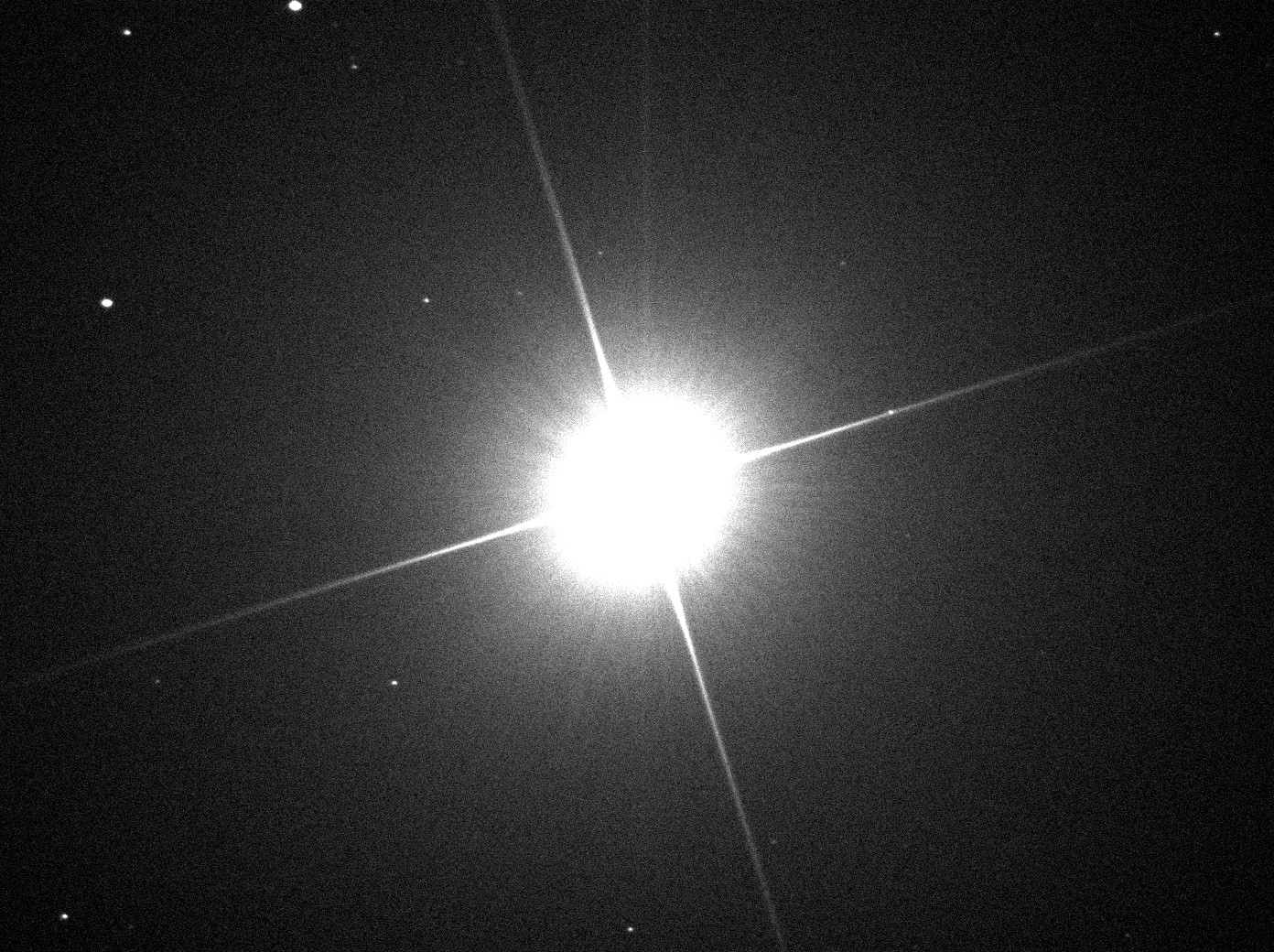
In this case the electrons flow out and down the columns that the electrons would normally be read. The Sun is a great source of column bleeding in a lot of videos online: see this one, for instance. Or bright stars--here is a weak version (it's the faint vertical column, not the diagonal streaks):
Arcturus

Since it's difficult to control all the sources of light in any possible photo scene, the CCD manufacturers have ways of trying to mitigate the overflowing electrons. One technique is to put drainage canals around the pixels and dump the electrons. This is good, but the extra space for drainage costs you some light sensitivity and light measuring accuracy.

moon
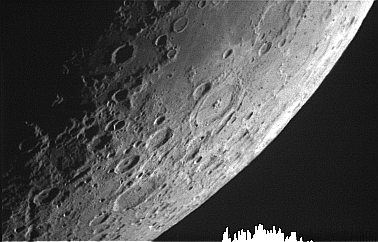
Another problem can develop while you are moving the electrons off the CCD to be measured--if you have a shutterless camera, then light is still hitting all the pixels and can still cause overflow problems. One technique (used a lot for video cameras, at least in the old days) is to make the CCD twice as big with half of the chip covered up. At the end of the exposure you quickly move the electrons in the lit part over to the dark part and then leisurely read them out. This helps, but you can still have those overflowing electrons come down into your dark area.

So, in the lightning video, you can see that the extremely bright strike produces too many electrons in the CCD of the camera, and they flow 1. into the dark frame-transfer area and 2. down the columns (the vertical bleeds).
You can see at least one of these effects in some of the other strikes in the video.

Tuesday, August 05, 2008

In case of weather emergency in Chicago

Rely on WFLD, Fox 32, for your severe weather information. Do not expect the otherwise stellar Tom Skilling at WGN to give you info until well after the threat passed you by. This is born out by the south suburban tornado in June and yesterday's severe weather, which I watched out the window while downtown during round 1 and in Hyde Park during round 2. Telling the bartender to switch to WGN offered no new information other than the county was under a tornado threat--and that was obvious from watching the Cubs game. Watch the line organize here.

Monday, August 04, 2008

Stanley Fish doesn't get it on lighting

Stanley Fish writes in the NYTimes:

But my house is now full of environmentally approved lightbulbs. They are dim, ugly and expensive, but I am told that they will last beyond my lifetime. (That’s supposed to be reassuring?) A neighbor told me today that he is planning to stockpile incandescent bulbs in the face of a prediction that they will be phased out by 2012.

Meanwhile, by the weak light shed by the virtuous bulbs, ...


Clearly he didn't read the article in his own newspaper about the importance of choosing the right CFL for each location.

Buy a higher rated CF wattage than the so-called equivalent, pick the right color, and don't give up. There are acceptable CFLs for high-usage, non-wet, non-dimmable locations. You've got to get the right one for each situation and not give up because one "cheap" size does not fit all.

Why you shouldn't stop a sports game because of weather

Tom Skilling writes in the WGN Weather Center Blog:


The rain ended, and the game continued on a sloppy field.
With the Pittsburgh Steelers leading the College All-Stars 24-0 late in the
third quarter the heavens opened up again as severe thunderstorms struck.
Winds gusted to 64 m.p.h. as the rain fell in torrents. The game was
stopped, but as the players left the field unruly fans ran out and knocked
down both goal posts. Even though the rain let up the game was cancelled. It
was the last College All-Star game ever played.


Football is the sort of sport that shouldn't let weather get in the way of the game. I guess the fans agreed. Kudos to WGN for the last two sentences--a tale to remind ourselves of true grit and/or moral turpitude.

Saturday, July 26, 2008

Wall Street Journal on Light Pollution

The WSJ has an article on light pollution: http://online.wsj.com/article/SB121692767218982013.html?mod=googlenews_wsj

Light pollution has tripled since 1970, according to Italian astronomer Fabio Falchi.

Not mentioned in the article is the billions of dollars this light represents in wasted energy costs in the U.S. Every business should be aware that some large percentage of their lighting bill goes out without making a cent for them if they aren't using fully shielded lights. Using those clichéd acorns to light your lot? You are losing some 70% of your electric bill for lighting straight into the sky and into the pained, scrunched, unhappy eyes of the customers who can't see beyond your lights, who can't see into otherwise well-lit areas in your lot because of the glare from the acorns.

Thursday, July 24, 2008

Granite counters: the claim of radiation risk

granite

The New York Times has a surprising article today about the radiation risks of granite counters.

Granite is an intrusive rock--slowly cooled from magma several kilometers below the surface, the rock grows large crystals from the hundred-thousand to million year cooling period. It is also chemically more "continental"; that is, more quartz, more "felsic" minerals, as opposed to the "mafic" minerals that contain much olivine and pyroxene, two minerals rich in iron and magnesium. True granite is a chemically specific intrusive, and much of what is called granite isn't, but a cousin of it. Roughly you can say to expect quartz, feldspar (of some type, there are several), and a sheet silicate like mica or biotite.

Despite the popular image of the Earth's crust riding on an ocean of molten magma, there is little liquid under our feet. While it's hot, there is enough pressure to keep things solid. Occasionally something will upset that balance and allow the rock to melt, whether by bringing hot material up to a lower pressure (like at the mid-ocean ridges) or by adding a special ingredient to make it melt (like water released by ocean sediments subducting under a continent). Melting is complicated and rarely complete, and some minerals melt at a lower temperature than others, leaving behind and chemically changing what sort of rock it is. Granite is like this. It melts at a lower temperature than basaltic materials. It often contains more water. And it brings with it certain compatible elements including uranium and thorium. This is why granites are more radioactive than most rocks. They can contain 10-20x more uranium and thorium than the solid left behind. Some of the more exotic "granites" are pegmatites--the extremely large crystal remnants of the last little bits of liquid at the end of solidification--and they contain the highest amounts of these elements.

But is this a hazard? Granites I've encountered have rates ranging from nothing to about 10x background. This isn't that much. Time spent at cruising altitude is about 40x background at 500ft. It certainly wouldn't be worth the fuss of ripping up a kitchen, unless it was proven to be the source of elevated radon levels. After reading the literature about naturally occurring radon sources, I have difficulty assigning the radon to just a small granite piece. Any soil or rock within 4 gas-diffusion-days of the basement or slab can be a source of radon for a home, and the total amount of uranium in that quantity is going to exceed the amount in the countertop (especially the part of the countertop that is within radon's half-life time of the surface). If you covered your walls in granite it might be different.

Wednesday, July 09, 2008

Walker Lake, Nevada

Will we have the political fortitude to solve the problem of a oversubscribed watershed before all native fish die in the second largest natural lake fully in Nevada?

The cost of mitigating the health issues of a completely dry lake bed must be more expensive than a few water rights purchases, yes?

http://www.lasvegassun.com/news/2008/jul/08/lakefront-homes-while-lake-lasts/

Tuesday, July 01, 2008

elements in glass

Ever wondered about the elemental composition of the differently colored versions of glass? Or what exactly does "crystal" glass contain that regular glass doesn't? Have a geochemist bring back last night's empties to the lab. To first order, be careful with the fancy-ware. More iron means more color. And if you need white, try some zinc oxide.

Trace elemental analysis of a big night out
P.S. Of course this is just about these particular elements, and doesn't count the bulk silicon, oxygen, sodium and such.