Monday, October 30, 2006

International Space Station pass -- seen through a telescope


The ISS is the largest artifical satellite orbiting Earth -- with 240ft long solar panels and a 150ft long body, its mass is over 227 tons. Being this big, and orbiting at only a 350km altitude, it can be discerned as a non-pointlike object with a normal sized telescope. If your telescope can keep up, that is. The ISS crosses the sky in about five minutes. It's usually much easier just to enjoy watching it look like a bright star crossing the sky (predictions here: Heavens-Above.com)

Mike Tyrrell followed the ISS in his 10" Meade telescope and made a fantastic video, a three minute pass sped up 8x.

The old Mir space station before its demise appeared as a blazing "T" shape in the Ryerson telescope.

Thursday, October 19, 2006

New title background

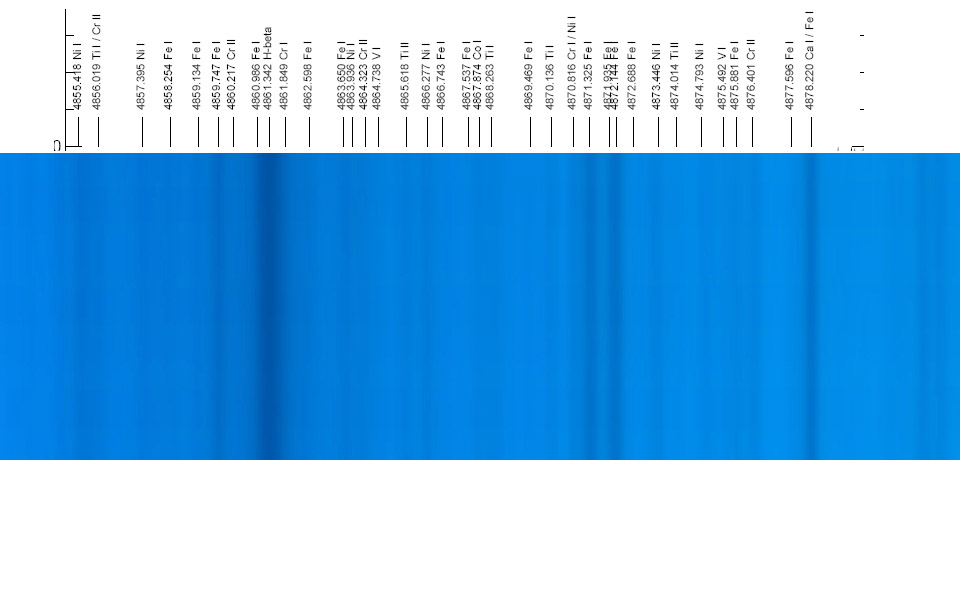
is the hydrogen beta line in the solar spectrum.

I derived the background from an image taken through a homebuilt spectroscope at Ryerson Observatory.

Here's a couple of crops of the same image:


And another one: Blue solar spectrum

I have a link to a PDF of an analysis of the absorption lines here:
http://www.kwasan.kyoto-u.ac.jp/~kamio/archive/spectrum/hb_1st.pdf
The sharp line just to the left of H-beta is Fe I, or unionized iron, for instance. I resized the image to match the scale on the PDF (at least how it appears on my computer); putting the two together gets you identifications of the lines in my image.

It isn't perfect--on the spectrum I did a motion blur in the vertical direction to smooth out noise, but I know everything is not perfectly vertical (I think there is some curvature of field in the spectroscope, and probably in the camera lens). In addition, the hydrogen beta line is definitely not symmetrical.

It's kinda neat that you can say there's iron, nickel, chromium, cobalt, titanium, and even maybe vanadium in the sun, yes?


I'm not sure I'm keeping this design, but for the moment it stays.

Sunday, October 15, 2006

What they did to Jose Padilla

Michael Milligan has posted the complaint of Jose Padilla, an American, while being incarcerated without any ability to talk to his lawyer, to challenge his detention, to access any of his God-given rights at all. I was astonished to read the things done to him in the complaint. I post Milligan's emphasis in bulk.


In an effort to gain Mr. Padilla’s "dependency and trust," he was tortured for nearly the entire three years and eight months of his unlawful detention. The torture took myriad forms, each designed to cause pain, anguish, depression and, ultimately, the loss of will to live. The base ingredient in Mr. Padilla’s torture was stark isolation for a substantial portion of his captivity. For nearly two years – from June 9, 2002 until March 2, 2004, when the Department of Defense permitted Mr. Padilla to have contact with his lawyers – Mr. Padilla was in complete isolation. Even after he was permitted contact with counsel, his conditions of confinement remained essentially the same. He was kept in a unit comprising sixteen individual cells, eight on the upper level and eight on the lower level, where Mr. Padilla’s cell was located. No other cells in the unit were occupied. His cell was electronically monitored twenty-four hours a day, eliminating the need for a guard to patrol his unit. His only contact with another person was when a guard would deliver and retrieve trays of food and when the government desired to interrogate him.

His isolation, furthermore, was aggravated by the efforts of his captors to maintain complete sensory deprivation. His tiny cell – nine feet by seven feet – had no view to the outside world. The door to his cell had a window, however, it was covered by a magnetic sticker, depriving Mr. Padilla of even a view into the hallway and adjacent common areas of his unit. He was not given a clock or a watch and for most of the time of his captivity, he was unaware whether it was day or night, or what time of year or day it was.

In addition to his extreme isolation, Mr. Padilla was also viciously deprived of sleep. This sleep deprivation was achieved in a variety of ways. For a substantial period of his captivity, Mr. Padilla’s cell contained only a steel bunk with no mattress. The pain and discomfort of sleeping on a cold, steel bunk made it impossible for him to sleep. Mr. Padilla was not given a mattress until the tail end of his captivity. Mr. Padilla’s captors did not solely rely on the inhumane conditions of his living arrangements to deprive him of regular sleep. A number of ruses were employed to keep Mr. Padilla from getting necessary sleep and rest. One of the tactics his captors employed was the creation of loud noises near and around his cell to interrupt any rest Mr. Padilla could manage on his steel bunk. As Mr. Padilla was attempting to sleep, the cell doors adjacent to his cell would be electronically opened, resulting in a loud clank, only to be immediately slammed shut. Other times, his captors would bang the walls and cell bars creating loud startling noises. These disruptions would occur throughout the night and cease only in the morning, when Mr. Padilla’s interrogations would begin.

Efforts to manipulate Mr. Padilla and break his will also took the form of the denial of the few benefits he possessed in his cell. For a long time Mr. Padilla had no reading materials, access to any media, radio or television, and the only thing he possessed in his room was a mirror. The mirror was abruptly taken away, leaving Mr. Padilla with even less sensory stimulus. Also, at different points in his confinement Mr. Padilla would be given some comforts, like a pillow or a sheet, only to have them taken away arbitrarily. He was never given any regular recreation time. Often, when he was brought outside for some exercise, it was done at night, depriving Mr. Padilla of sunlight for many months at a time. The disorientation Mr. Padilla experienced due to not seeing the sun and having no view on the outside world was exacerbated by his captors’ practice of turning on extremely bright lights in his cell or imposing complete darkness for durations of twenty-four hours, or more.

Mr. Padilla’s dehumanization at the hands of his captors also took more sinister forms. Mr. Padilla was often put in stress positions for hours at a time. He would be shackled and manacled, with a belly chain, for hours in his cell. Noxious fumes would be introduced to his room causing his eyes and nose to run. The temperature of his cell would be manipulated, making his cell extremely cold for long stretches of time. Mr. Padilla was denied even the smallest, and most personal shreds of human dignity by being deprived of showering for weeks at a time, yet having to endure forced grooming at the whim of his captors.

A substantial quantum of torture endured by Mr. Padilla came at the hands of his interrogators. In an effort to disorient Mr. Padilla, his captors would deceive him about his location and who his interrogators actually were. Mr. Padilla was threatened with being forcibly removed from the United States to another country, including U.S. Naval Base at Guantanamo Bay, Cuba, where he was threatened his fate would be even worse than in the Naval Brig. He was threatened with being cut with a knife and having alcohol poured on the wounds. He was also threatened with imminent execution. He was hooded and forced to stand in stress positions for long durations of time. He was forced to endure exceedingly long interrogation sessions, without adequate sleep, wherein he would be confronted with false information, scenarios, and documents to further disorient him. Often he had to endure multiple interrogators who would scream, shake, and otherwise assault Mr. Padilla. Additionally, Mr. Padilla was given drugs against his will, believed to be some form of lysergic acid diethylamide (LSD) or phencyclidine (PCP), to act as a sort of truth serum during his interrogations.

Throughout most of the time Mr. Padilla was held captive in the Naval Brig he had no contact with the outside world. In March 2004, one year and eight months after arriving in the Naval Brig, Mr. Padilla was permitted his first contact with his attorneys. Even thereafter, although Mr. Padilla had access to counsel, and thereby some contact with the outside world, those visits were extremely limited and restricted. Significantly though, it was not until Mr. Padilla was permitted to visit with counsel that one of his attorneys, Andrew Patel, was able to provide Mr. Padilla with a copy of the Qur’an. Up until that time, for a period of almost two years, Mr. Padilla was the right to exercise his religious beliefs.

The deprivations, physical abuse, and other forms of inhumane treatment visited upon Mr. Padilla caused serious medical problems that were not adequately addressed. Apart from the psychological damage done to Mr. Padilla, there were numerous health problems brought on by the conditions of his captivity. Mr. Padilla frequently experienced cardiothoracic difficulties while sleeping, or attempting to fall asleep, including a heavy pressure on his chest and an inability to breath or move his body.

In one incident Mr. Padilla felt a burning sensation pulsing through his chest. He requested medical care but was given no relief. Toward the end of his captivity, Mr. Padilla experienced swelling and pressure in his chest and arms. He was administered an electrocardiogram, and given medication. However, Mr. Padilla ceased taking the medicine when it caused him respiratory congestion. Although Mr. Padilla was given medication in this instance, he was often denied medication for pain relief. The strain brought on by being placed in stress positions caused Mr. Padilla great discomfort and agony. Many times he requested some form of pain relief but was denied by the guards.

The cause of some of the medical problems experienced by Mr. Padilla is obvious. Being cramped in a tiny cell with little or no opportunity for recreation and enduring stress positions and shackling for hours caused great pain and discomfort. It is unclear, though, whether Mr. Padilla’s cardiothoracic problems were a symptom of the stress he endured in captivity, or a side effect from one of the drugs involuntarily induced into Mr. Padilla’s system in the Naval Brig. In either event, the strategically applied measures suffered by Mr. Padilla at the hands of the government caused him both physical and psychological pain and agony.

It is worth noting that throughout his captivity, none of the restrictive and inhumane conditions visited upon Mr. Padilla were brought on by his behavior or by any actions on his part. There were no incidents of Mr. Padilla violating any regulation of the Naval Brig or taking any aggressive action towards any of his captors. Mr. Padilla has always been peaceful and compliant with his captors. He was, and remains to the time of this filing, docile and resigned – a model detainee.

Mr. Padilla also wants to make clear that the deprivation described above did abate somewhat once counsel began negotiating with the officials of the Naval Brig for the improvements of his conditions. Toward the end of Mr. Padilla’s captivity in the Naval Brig he was provided reading materials and some other more humane treatment. However, despite some improvement in Mr. Padilla’s living conditions, the interrogations and torture continued even after the visits with counsel commenced.

In sum, many of the conditions Mr. Padilla experienced were inhumane and caused him great physical and psychological pain and anguish. Other deprivations experienced by Mr. Padilla, taken in isolation, are merely cruel and some, merely petty. However, it is important to recognize that all of the deprivations and assaults recounted above were employed in concert in a calculated manner to cause him maximum anguish. It is also extremely important to note that the torturous acts visited upon Mr. Padilla were done over the course almost the entire three years and seven months of his captivity in the Naval Brig. For most of one thousand three hundred and seven days, Mr. Padilla was tortured by the United States government without cause or justification. Mr. Padilla’s treatment at the hands of the United States government is shocking to even the most hardened conscience, and such outrageous conduct on the part of the government divests it of jurisdiction, under the Due Process clause of the Fifth Amendment, to prosecute Mr. Padilla in the instant matter.

Thursday, October 12, 2006

Robins singing earlier due to light pollution, part 2

Mark W. Miller of the Department of Wildlife Ecology and Conservation, USGS Florida Cooperative Fish and Wildlife Research Unit, Fort Lauderdale Research and Education Center, University of Florida has quantified the effect of light pollution on robins, as mentioned in a previous post.

Link to Apparent Effects of Light Pollution on Singing Behavior of American Robins (PDF)


HTML link

Wednesday, October 04, 2006

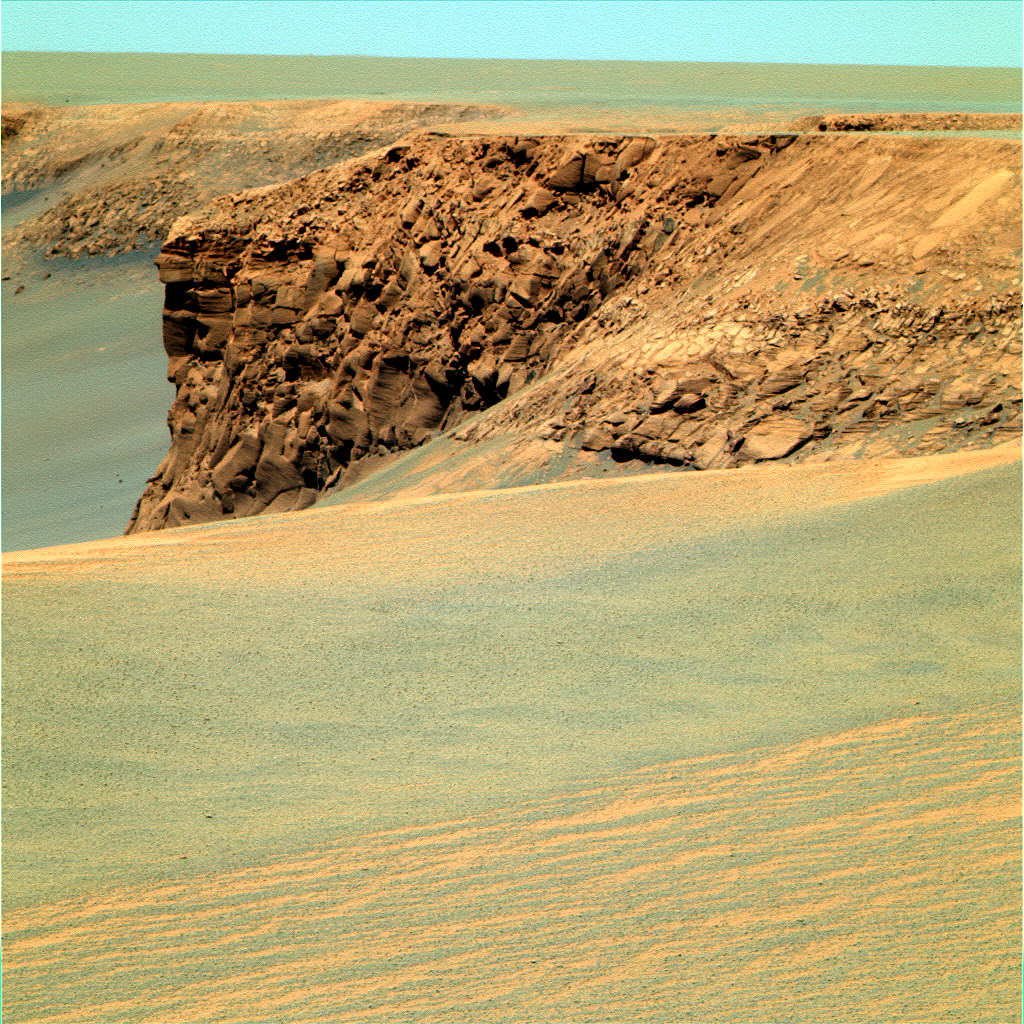
Synthesized color image of Victoria Crater cliff on Mars from Opportunity


I took three images from the raw frames available on JPL's Mars Rover web site and created a color image. They are not the fully correct colors: I used the "near-IR" (750nm) filter for red, green for green, and the UV (or short-pass 430nm) filter for blue. Opportunity Color filter IDs are from Mars Rover Pancam Filter Specs. I sharpened the image and slightly reduced the cyan content. Colors are, as you should always suspect, suspect. Click on the image above to get the full 1024x1024 image.

Saturday, September 30, 2006

Hi-res images from HiRISE: a transform fault on Mars


HiRISE (The High Resolution Imaging Science Experiment) is on the Mars Reconnaissance Orbiter (MRO) and offers 1 meter / pixel resolution. They've just taken a few images from yesterday and released them. (The official blurb says the resolution is 25cm/pixel on this image).

Big images--this one is a 1.3MB JPEG, it shows a region in Valles Marineris called Ius Chasma.

Take a look in the middle of the big image, or look at my crop above--that sure looks like a transform fault!

HiRISE via http://wohba.com/2006/09/hirise-hi-res.html.

UPDATE: They've spotted it and added commentary. They are intrepreting it as a thrust fault tilted on its side. Great resolution on their images.

Friday, September 29, 2006

Opportunity reaches Victoria Crater on Mars


The Mars Rover Opportunity has reached Victoria Crater on Mars: a half-mile in diameter.

They've taken a panorama from the rim (2.7MB).

Take a look at this full-res sharp image of a cliff to right of the rover: http://marsrovers.jpl.nasa.gov/gallery/all/1/p/952/1P212696205EFF76EKP2388R1M1.JPG
The rock has a smooth almost sculpted quality to it.

No color images yet--they've concentrated on stereo images.

Sunday, September 24, 2006

Content-free update

Work has been taking over my time lately, and won't lighten up until next week, despite a great need for a vacation (not a day missed for months). That said, I've been working on a fantastic project which I am quite excited about and have spent nearly all of my free time on in the past month, but I am not ready to commit to talking about quite yet. However, someone else is working on the same idea. I have some nice test images with prior inferior iterations--at the latest moment my images are 6000x8000 pixels, 1200dpi; wide-angle up the wazoo; and I have some crazy ideas about color. Some have seen me wandering the seven stories of the library; I continue to do so, wishing the days would not wither away so quickly as they do in the fall.

Friday, September 22, 2006

NYTimes review of Posner book

"A Jurist’s Argument for Bending the Constitution"

The New York Times' MICHIKO KAKUTANI slams Posner's new book:

"...a depressing relativism in which there are no higher ideals and no absolute rights worth protecting."

"By the end of this chilling book, the reader realizes that Judge Posner is willing to use virtually any argument — logical or not — to redefine constitutionally guaranteed rights like freedom of speech during wartime."

"...this book suggests that Judge Posner does regard the Constitution as an old piece of parchment — a piece of parchment with certain rules, but rules that “are made to be broken” by a president during an emergency, no matter how long that emergency may last."

Not a Suicide Pact: The Constitution in a Time of National Emergency.
By Richard A. Posner.


UPDATE: There is some back and forth debate on the University of Chicago Law School Faculty blog about it here and here. Posner actually states:
Civil liberties are valuable, but their values should be assessed in a practical, hard-headed way, rather than treated with quasi-religious veneration. Maybe David Hume went too far (though I don’t think so) when he said that “The safety of the people is the supreme law. All other particular laws are subordinate to it, and dependent on it.” But I am not prepared to die at the hands of terrorists in order to defend the Miranda rule, or Brady, or Burton, or Mapp, or Doyle, or the other arabesques that the Supreme Court in the Earl Warren era inscribed on the helpless text of the Constitution.


Geez... he seems to have forgotten his oath to defend the Constitution, and "that all men are created equal, that they are endowed by their Creator with certain unalienable Rights, that among these are Life, Liberty and the pursuit of Happiness."

At least Geoffrey Stone is able to contain him somewhat.

Tuesday, September 19, 2006

When the Cato Institute and I agree

...perhaps there is something wrong with the government. Republicans claim they are for limited government but instead have driven us towards fascism. Democrats either are unorganized, vote for these repressive ideas for fear of votes, or think the populace are polarized about some trivial issue that is not that important.

"Doublespeak and the War on Terrorism by Timothy Lynch" (PDF).

Monday, September 18, 2006

Shuttle and ISS in front of the Sun


Wow. Thierry Legault in France caught the Space Shuttle undocking from the ISS while transiting the Sun from his location. Keep in mind the ISS transits the sun in about a fifth of a second. Click on the image for the full frame.

As seen on Spaceweather.com"

Wednesday, September 13, 2006

2003 UB313 named!

Meet Eris and its moon Dysnomia.

From the Minor Planet Mailing list (via the IAU Circulars):


(134340) PLUTO, (136199) ERIS, AND (136199) ERIS I (DYSNOMIA)
Following the Aug. 24 resolution by the IAU to the effect that
the solar system contains eight "planets" (Mercury-Neptune), with
(1) Ceres, Pluto (cf. IAUC 255), and 2003 UB_313 (cf. IAUC 8577) to
be considered representative "dwarf planets", the Minor Planet
Center included Pluto and 2003 UB_313 (along with two other new
potential dwarf-planet candidates) in the standard catalogue of
numbered objects with well-determined orbits as (134340) and
(136199), respectively (see MPC 57525). Following near-unanimous
acceptance by both the Committee on Small-Body Nomenclature and the
Working Group on Planetary-System Nomenclature (in consultation
with the discovery team), the IAU Executive Committee has now
approved the names Eris for (136199) and Dysnomia for its satellite
(136199) Eris I [formerly S/2005 (2003 UB_313) 1; cf. IAUC 8610].

special PDF circular

Eris is the goddess of strike, discord, and rivalry, and Dysnomia is the goddess of lawlessness.

My last post about the MPC designations for Pluto & the other large KBOs


2003 UB 313, Pluto, and other related Kuiper Belt posts:

An animation of Pluto

Direct measurements of 2003 UB 313

More science on 2003 UB 313

The The definition of a planet: IAU conference and the issue of 2003 UB313

Pluto's new moons named: Nix and Hydra


New Horizons--aka the Pluto and Kuiper Belt mission


Ortiz response

2003 EL61: bulgy or salt and pepper?

Huge new Kuiper Belt Object / Transneptunian Object?